

Some chapters of your life hurt too much to revisit. In Lamentations, a grieving writer finds hope while the ruins still stand, because the LORD’s mercies are new every morning.
By Dianna Hobbs
Some chapters of life are too painful to revisit. (Getty Images)
My oldest daughter, Kyla, downloaded the Kindle edition of Finding Gratitude in the Dark to support me. Yesterday, for the second time, she came to me and told me she could not get through it. Each time she has tried to read it, the story has overwhelmed her, and she has had to set it down because the sadness and emotion were too much. I told her it was okay.
Then my youngest daughter, Kaiah, shared that my 2018 book, God Did It, affected her the same way. She knows God worked a miracle and brought me through. Still, the grueling details of what I endured were too difficult for her to relive on the page, and she could not finish it.
I understand. My children lived those chapters alongside me. For them, reading about those days means walking back into a season they already survived once. They know how the story ends. They know God brought me through. Even so, knowing the outcome does not make the suffering any easier to remember.
In many ways, my life story does feel deeply sad. In 2019, I suffered a traumatic brain injury and ministroke. I continue to face lingering struggles in my brain and my immune system, and I yet grieve what that season took from me.
I still get flashbacks of the way my husband, Kenya, wept in the hospital after God brought me from the brink of death. The trauma of it all came pouring out of his eyes as perpetual fountains.
My health battles left a traumatizing mark on the people I love most. Our whole family lost parts of me, and each of us lives with what remains.
When I wrote the Introduction to Finding Gratitude in the Dark, I said it this way: “If I separated the hardest parts of my life story from gratitude, I would be left with devastation. Nothing more.”
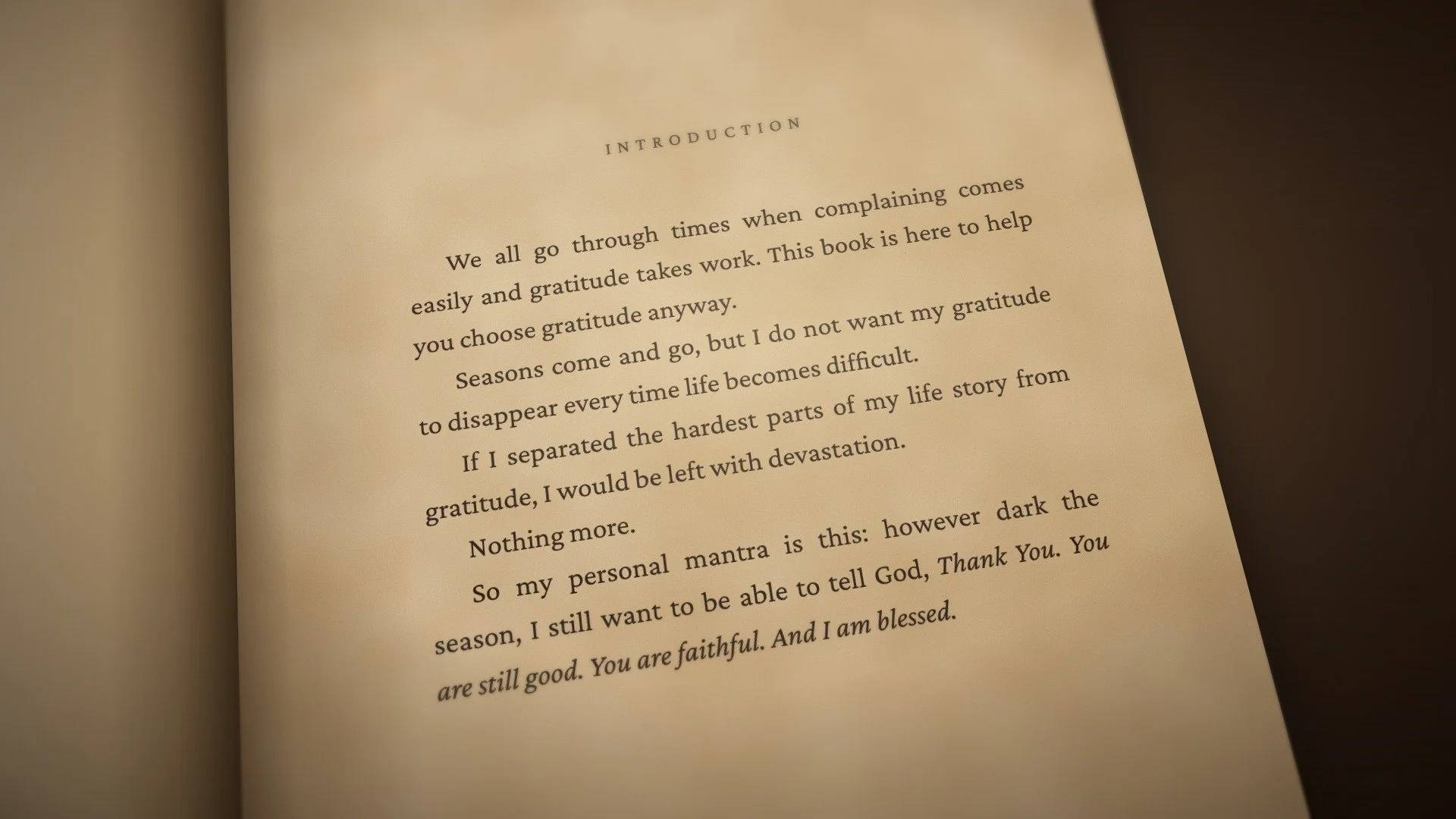
From the Introduction of Finding Gratitude in the Dark. (Credit: EEW Magazine Online)
I meant every word. Without the thread of gratitude running through my story, grief over everything I have lost would swallow me. My family and I are collectively held together by that same thread of gratitude. It is what keeps the sad parts from having the final word.
The Bible includes a whole book that reads like the chapters my daughters could not finish. Lamentations mourns the fall of Jerusalem. The city lies in ruins, her people have gone into captivity, and the writer weeps until his eyes fail him (Lamentations 2:11).
By the third chapter, he turns the grief inward and describes his own suffering in painful detail. Then he says this: “Remembering mine affliction and my misery, the wormwood and the gall. My soul hath them still in remembrance, and is humbled in me” (Lamentations 3:19-20 KJV).
If you closed the book there, you would walk away as heavy as my girls did. The very next verse turns everything: “This I recall to my mind, therefore have I hope” (Lamentations 3:21 KJV).
The Hebrew behind “recall to my mind” is ’āshîv ’el-libbî. The verb comes from shûv, which means to turn back or return, and in this form it means to cause something to return. Libbî means “my heart.” The writer is saying, in effect, “This I will bring back to my heart.”
His affliction was already lingering in his memory. He did not have to work to remember it. It pressed on him and weighed his soul down. So he made a deliberate choice to bring something else back to his heart, and here is what he brought: “It is of the LORD’s mercies that we are not consumed, because his compassions fail not. They are new every morning: great is thy faithfulness” (Lamentations 3:22-23 KJV).
The LORD’s mercies meet you new every morning. (Svetlana Repnitskaya/Getty Images)
The writer does not try to hide the devastation. Lamentations keeps lamenting after chapter 3, and the grief remains on the page all the way to the end. Nothing around him changed between verse 20 and verse 21. Jerusalem lay in ruins, and his suffering had not lifted. While he sat in the ashes, he deliberately brought the faithfulness of God back to his heart, and what he remembered gave him hope.
That is what gratitude does for me. My brain and my body remind me every day of what I have been through. I do not have to go looking for my affliction. Gratitude helps me turn my heart and mind back toward God’s mercies and tell Him, Thank You. You are still good. You are faithful. And I am blessed. My story still holds undeniably sad chapters. I have also lived to see that His compassions did not fail in a single one of them.
This is why I wrote, “When you are hanging on by a thread, let gratitude be that thread.”
Maybe your story has chapters you cannot bear to reread either. Maybe the people you love have watched you suffer, and it still aches to know what it cost them. You do not have to force yourself to revisit every painful detail. You can set the hardest pages down for a while, the way my daughters did, and still bring the LORD’s mercies back to your heart.
The God who met the writer of Lamentations in the ruins is the same God who sees you in yours. His compassion did not run out on your worst day, and it never will. Every morning you wake up, His mercies are waiting for you, fresh and sufficient for whatever that day holds.
Look again at what the writer said: “It is of the LORD’s mercies that we are not consumed.” Now look at your own life for a moment. Some of what you have been through could have consumed you. The diagnosis could have taken you out, and the loss could have crushed you beyond repair. Yet here you are, reading these words. That is the mercy of God.
His mercies arrive fresh, like the manna God rained down on Israel in the wilderness (Exodus 16), a new portion with every sunrise. Yesterday’s mercy covered yesterday, and today has a portion all its own. The tears you cried last night did not drain the well. The pain you woke up with this morning did not get there before His mercy did. Before your feet ever hit the floor, God had grace waiting on you with your name on it.
So lift your head, friend, even if nothing around you has changed yet. The God who gave the writer of Lamentations hope in the ashes has brought you to another sunrise. Go ahead and tell Him, “great is thy faithfulness.”
Those words, taken from Lamentations 3:23, are what I’m stirring into your cup of inspiration as today’s sweetener.
As you drink down the contents of your cup, know this: the LORD’s mercies were present in every sad chapter, and they will meet you, new again, every single morning. Whatever you face, however hard it gets, our faithful God will be right there to see you through.
Now, let’s pray.
Father, thank You that Your mercies are new every morning and Your compassion does not fail. You know the parts of my story that still hurt to remember, and You know the people I love who have hurt alongside me. When my affliction sits heavy in my memory, help me bring Your goodness back to my heart, meditate on it, and declare, “Great is Your faithfulness.”
In Jesus’ name, Amen.