If an empty chair, a hard diagnosis or an unanswered prayer has you dreading the season, gratitude can make room for your grief and still point you to God.
By Dianna Hobbs
An empty chair at the holiday table can make the season hard to face after a loss. Photo: Richard David/Getty Images
The holidays arrive with a script, and most of us know it by heart. Gather at the table. Count your blessings. Go around the room and say what you are thankful for. In a good year, the words come easily. This year, for a lot of people, they will not come at all. There will be an empty chair at more tables than we realize.
Some people will eat Thanksgiving dinner from a hospital tray, or at home on the couch because their body will not cooperate. And some are still waiting on a prayer they have prayed for so long that they have stopped saying it out loud.
If any of that is you, I want you to hear this before anything else. Gratitude still belongs to you, even here.
I know this season from the inside, and I am still learning it. In 2025, I lost my father, Bishop Joseph Brinson Sr., in July. Four months later, I lost my brother, Bishop Christopher Brinson.
Two losses that close together do something to you. You are still trying to catch your breath from the first one when the second one comes. On Nov. 13, I will mark the first anniversary of my brother’s death, right around the time the rest of the country starts talking about turkey and side dishes.
Old photographs can bring back the faces we miss most during the holidays. (Photo: Jill Ferry Photography/Getty Images)
Grief was not my first lesson in the dark, though. In 2017, I came close to dying, and people gathered for a prayer service to ask God to heal me. He brought me through, and I wrote about that miracle in my first book, God Did It: A True Story of Miraculous Healing.
Then, in August 2019, a rare reaction to a common antibiotic sent me to intensive care. I had more than two dozen seizures and a ministroke. My left side was paralyzed, and I could no longer speak. Some things have come back to me over the years. Others have not. The brain damage is permanent, and I still live with anxiety and PTSD.
Three months after that crisis, I sat down to write a 28-day gratitude series for my devotional blog. People still introduced me as an award-winning journalist, and there I was, looking up where commas and periods belonged. It was humbling. Each entry took hours, and more tears than I like to admit.
I kept asking God why. Why would He ask me to write about gratitude when I could barely put a sentence together? The answer did not come right away. It took years. Now I believe He wanted me to write from the valley, before triumph, for those who are still valley dwellers like me.
The valley taught me something I wish I had learned sooner. Scripture never asks us to pretend.
Think about Moses in the wilderness. He had led an entire nation out of slavery, and now they were complaining about the food. Again. Worn down to nothing, he said to God, “If this is how you’re going to treat me, why don’t you just kill me? I can’t face this trouble anymore” (Numbers 11:15 GW).
I imagine God could have rebuked him for talking that way. He did not. He answered by sending help, appointing 70 elders to share the load. The burden had grown too heavy for Moses, and God made it lighter.
Habakkuk got honest, too. He looked out at fig trees that would not blossom, vines with no fruit and stalls with no cattle, and still he said, “Yet I will rejoice in the LORD, I will joy in the God of my salvation” (Habakkuk 3:18 KJV). I love that little word “yet.” It holds everything he just listed, every loss, and still turns his face toward God.
Paul put it this way: “In every thing give thanks: for this is the will of God in Christ Jesus concerning you” (1 Thessalonians 5:18 KJV). In every thing. I have read that verse more times than I can count, and it still makes me pause and reflect.
Thanksgiving happens inside our circumstances, while they are still unfolding, while the diagnosis is still the diagnosis and the chair is still empty. That is why I write the way I do. People in a low place need to hear from someone who is struggling day in and day out like them. They need to learn how to be grateful through it, not after it or for it.
So what does that look like when the holidays hurt?
Start by telling God the truth. Say what is breaking your heart, out loud if you can, on paper if you cannot. Name the empty chair. Name the diagnosis. You do not have to clean it up first. Honest lament clears space for honest gratitude, and God can handle both.
Grief can make the brightest season feel like the darkest night. (Photo: Minoru M/Getty Images/Illustration EEW Magazine Online)
Then look for one thread. Just one. You do not need a list of 10 blessings, and on some days you will not find 10. Look for one small provision from today. Maybe a phone call came at the right moment. Maybe someone dropped off a warm meal, or you found the strength to get out of bed when your body said no.
Write it down, even if it feels small. In that same chapter of Numbers, the Israelites grew tired of manna and stopped seeing it as the daily miracle it was. Pain has a way of hiding provision in plain sight. Writing it down can help you begin to see it again.
Let gratitude sit alongside the help you need. In my own recovery, God has used therapy, medication, a care team and the people who love me, and I thank Him for every one of them. Giving thanks for those gifts is part of my healing. If you are struggling this season, reaching out to a counselor, a pastor or a trusted friend is an act of faith.
And when you can, make room for someone else’s grief and pain. Be an encouragement. Give to someone in need, or volunteer your time. Proverbs teaches that those who refresh others will be refreshed themselves.
If you have nothing left to give this year, that is all right, too. Remember Moses. Sometimes you are the one God sends the help to. Let people bring the meal, make the call and sit with you awhile. Receiving their kindness with an open heart is gratitude, too. Gratitude grows when we share it, and so does comfort.
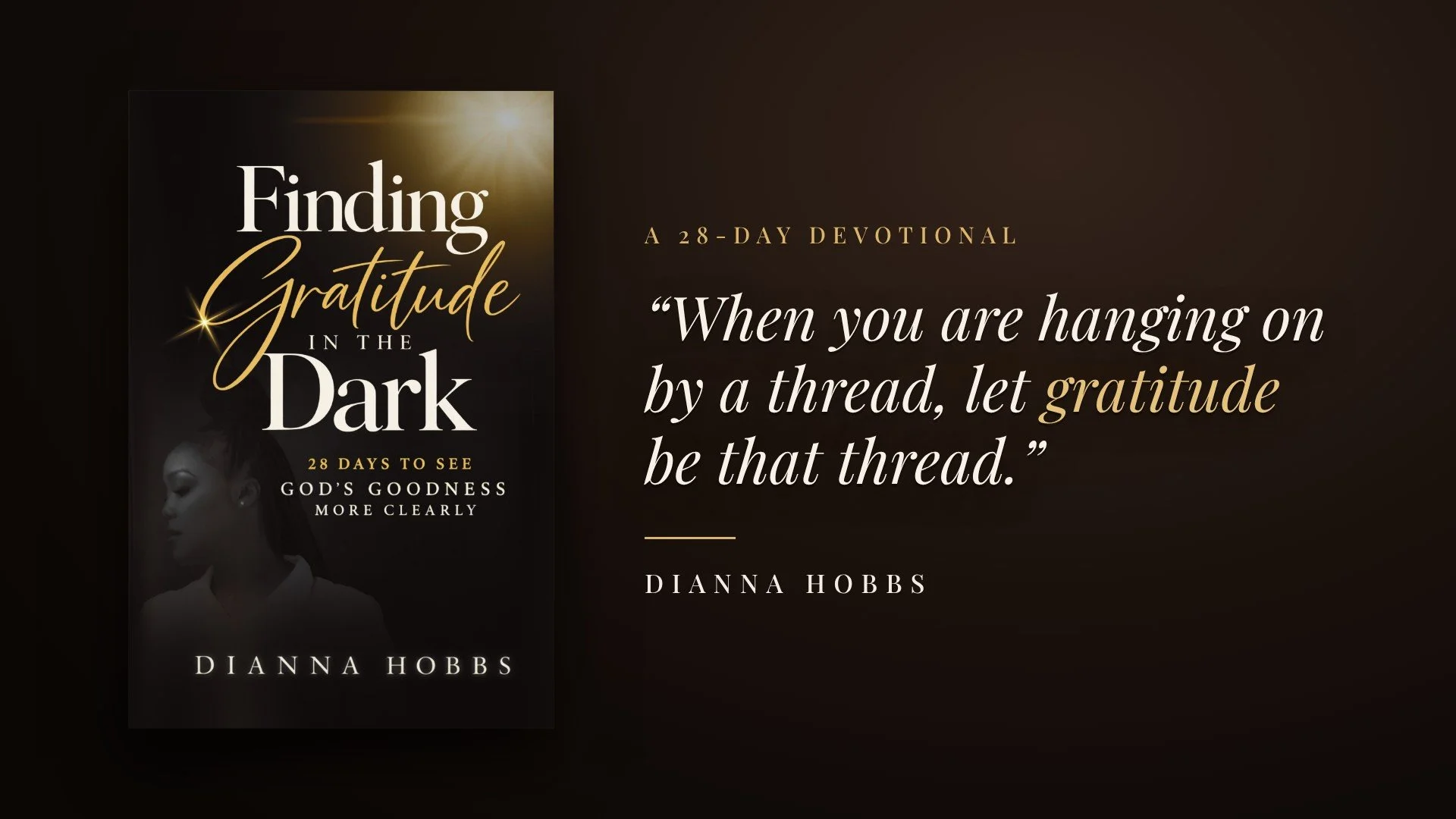
There is a line that kept me going through my darkest days, and it became the heartbeat of my new book: When you are hanging on by a thread, let gratitude be that thread. I know the thread may feel thin this year. Some days it may feel like it is barely there. Hold on to it anyway. God is present in the valley, and He has not let go of you.
Dianna Hobbs is the founder and editor-in-chief of EEW Magazine Online and the founder of Empowering Everyday Women Ministries. Her new devotional, Finding Gratitude in the Dark: 28 Days to See God’s Goodness More Clearly, is available on Kindle. Readers can join her free 28-Day Gratitude Challenge.