

Drone strikes have killed children in markets, displacement shelters and residential neighborhoods. With Sudan’s war now in its fourth year, millions of children face mounting threats from violence, hunger and collapsing essential services.
By EEW Magazine Online News Editors
A displaced Sudanese student looks out from a tent at an elementary school run by the Sudanese Coalition for Education in partnership with UNICEF, south of Port Sudan, on April 26, 2026. More than 8 million children in Sudan are out of school, according to UNICEF. (Photo by Khaled Desouki/AFP via Getty Images)
At least five children between the ages of 7 and 14 were killed when an armed drone struck a market in Nyala, the capital of Sudan’s South Darfur state, on Oct. 26, according to the United Nations Children’s Fund. Three were boys and two were girls. Two other children were injured. An eyewitness told the Sudanese news site Darfur24 that the dead included workers from local restaurants and shops, along with children who earned money shining shoes.
“Markets are places where families buy food, and people work to make a living. A trip to the market should never cost a child their life,” Etleva Kadilli, UNICEF’s regional director for Eastern and Southern Africa, said in an Oct. 29 statement.
The strike came amid escalating drone warfare between Sudan’s military and the paramilitary Rapid Support Forces, which have been fighting since April 2023. The full death toll from the Nyala attack has not been independently confirmed, and the groups reporting on it are measuring different things.
FILE: A student takes a break in a dormitory at an Islamic boarding school in Nyala, South Darfur, Sudan, on Aug. 13, 2007. (Photo by Mustafa Ozer/AFP via Getty Images)
Doctors Without Borders said the Nyala Teaching Hospital it supports received 36 bodies and treated more than 150 wounded patients. The rights group Emergency Lawyers, which tracks violence against civilians, put the toll for the entire attack at 102 killed and 113 wounded. Both groups attributed the strike to the Sudanese military.
The Special Operations Forces, a unit fighting alongside the military, said its strike hit a Rapid Support Forces camp in the area. It was the second drone strike on a Nyala market in 10 days. An Oct. 16 attack on the city’s livestock market killed at least four people, including a child, according to Doctors Without Borders.
UNICEF said more than 400 children were reported killed or injured in Sudan between January and September 2026, with armed drone attacks responsible for a significant share. The strikes have also damaged homes, schools, health facilities, water systems and markets.
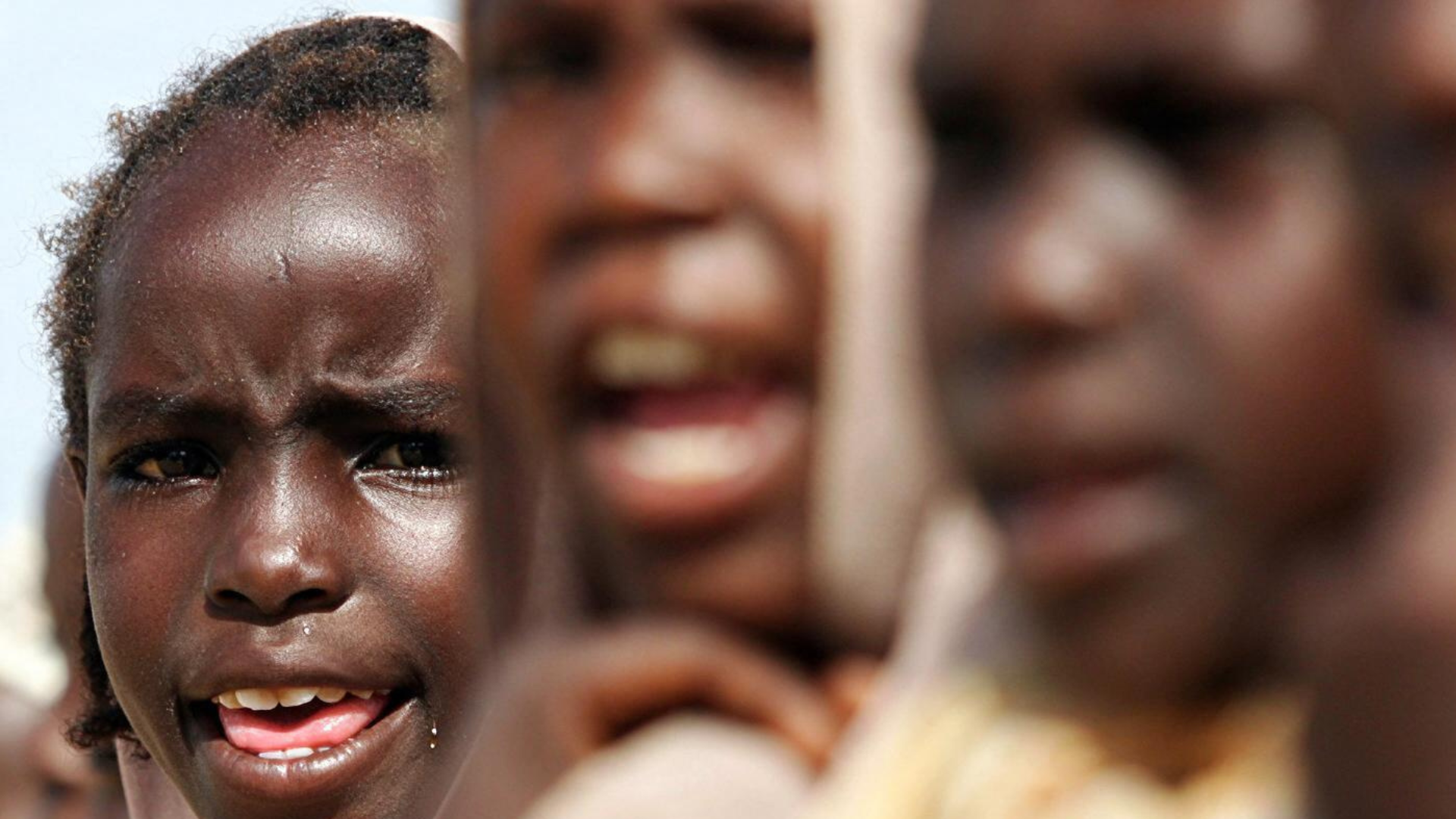
FILE: Displaced children attend a music lesson outside their school in the Sakali camp for displaced people in Nyala, South Darfur, Sudan, on Aug. 7, 2007, during an earlier conflict in the region. (Photo by Mustafa Ozer/AFP via Getty Images)
For many families, the danger follows them. On Oct. 17, at least nine children, five boys and four girls between the ages of 5 and 10, were killed in an attack on a camp for displaced families east of Sanakit in West Kordofan state, UNICEF said. Two days later, an armed drone struck a residential area of Khartoum, reportedly killing three children, two girls and a boy between the ages of 2 and 6, along with their father.
“In West Kordofan, children were killed in a camp their families had fled to for safety. In Khartoum, three young children were reportedly killed with their father in their own neighborhood, in a city where many families have returned to rebuild their lives,” Angela Kearney, UNICEF’s acting representative in Sudan, said in an Oct. 20 statement. “Every party to this conflict must protect children, wherever they are.”
Late on Sept. 30, a drone struck the Al Mina Al Bari shelter for displaced people in Al Obeid, North Kordofan, reportedly killing one boy and injuring 12 other children, according to UNICEF. Many of the families at the shelter had already been displaced several times over, the agency said.
The violence is falling on children already weakened by war. UNICEF says 17.3 million children in Sudan need humanitarian assistance, and its 2026 appeal describes a health system near total collapse, with 70% of facilities not functioning. In August alone, UNICEF-supported programs treated 51,506 children for severe acute malnutrition. They also reached 751,400 people through cholera response and nearly 770,000 through a diphtheria vaccination campaign in high-risk areas, the agency reported.
Funding has lagged far behind the need. As of Aug. 31, UNICEF had raised $352.2 million of the $962.9 million it is seeking for Sudan this year, a 63% gap.
A displaced Sudanese student sits inside a tent serving as a temporary classroom at an elementary school run by the Sudanese Coalition for Education in partnership with UNICEF, south of Port Sudan, on April 26, 2026. (Photo by Khaled Desouki/AFP via Getty Images)
Drought is adding to the danger. U.N. humanitarian coordinator Denise Brown has warned that severe rainfall deficits are deepening needs, especially in Darfur and Kordofan. She said that without urgent additional funding, humanitarian food and nutrition stocks are expected to run out by early 2027.
UNICEF has called on all parties to the conflict to comply with international humanitarian law and protect civilians and civilian infrastructure.
“Children should be able to go to a market, attend school or seek health care without risking their lives,” Kadilli said. “After more than three years of conflict, children in Sudan need greater protection from violence, not new ways for the conflict to reach them.”
Empowering Everyday Women Ministries, the nonprofit behind EEW Magazine Online, supports Sudanese families facing hunger through its Sudan Hunger Relief appeal.
Reporting note: This article is based on published statements and reports from UNICEF, Doctors Without Borders, Emergency Lawyers and the United Nations, along with news reports from Darfur24. All casualty figures and attributed remarks come from those sources. No direct EEW interviews are represented.
