

Funding cuts have closed more than 230 nutrition centers, the World Food Programme says, leaving 1.1 million children and mothers without help.
By EEW Magazine Online Editors
Newly displaced women register as their children are screened for malnutrition at a camp for displaced people outside Kismayo, Somalia, April 22, 2026. (Simon Maina/AFP via Getty Images)
Mariam had already lost her farm, her livestock and the crops that once fed her five children when her 1-year-old daughter became severely malnourished. With no livelihood left, the Somali mother gathered her children and walked for three days to reach a health clinic supported by the Christian humanitarian organization World Vision.
There, her daughter, Hanan, was diagnosed with severe acute malnutrition, the deadliest form of the condition.
“I don’t know what I will give my children to eat,” Mariam told World Vision. “I don’t want my children to die of hunger.”
World Vision changed the family’s names to protect their privacy. The organization has not reported how Hanan is doing.
Millions of Somalis are caught in the same emergency, driven by drought, displacement, conflict and shrinking international aid. About 1.92 million children under 5 are expected to suffer acute malnutrition between July 2026 and June 2027, according to a September analysis released by the Somali government and the United Nations. Of those, 433,000 are projected to suffer severe acute malnutrition.
Mothers whose children attend World Food Programme-supported nutrition programs line up for medical and food assistance at the Feynuus Nutrition Center on the outskirts of Mogadishu, Somalia, Aug. 19, 2026. (Hassan Ali Elmi/AFP via Getty Images)
The same analysis projected that 5.4 million people would face crisis levels of hunger or worse from October through December. That includes about 1.5 million people at emergency levels.
Mariam reached the Waberi Health Facility in Burhakaba, a district in Somalia’s Bay region that has been among the hardest hit by drought. More than 1,500 children are screened there each month. Health workers have reported at least five new cases of severe malnutrition every day, according to World Vision.
Children with severe acute malnutrition are far more vulnerable to infection and disease. Treatment can include therapeutic foods, close medical monitoring and hospital care for children with complications. For families who live far from a clinic, reaching that care can mean a long journey after their food and money have already run out.
Funding cuts are leaving more of those journeys unanswered. The World Food Programme says more than 230 nutrition centers have closed, leaving 1.1 million children and mothers without nutrition assistance. Under current funding, the agency warns, 90 percent of children with moderate acute malnutrition will receive no support from October onward. Without adequate food and treatment, moderate cases can become severe.
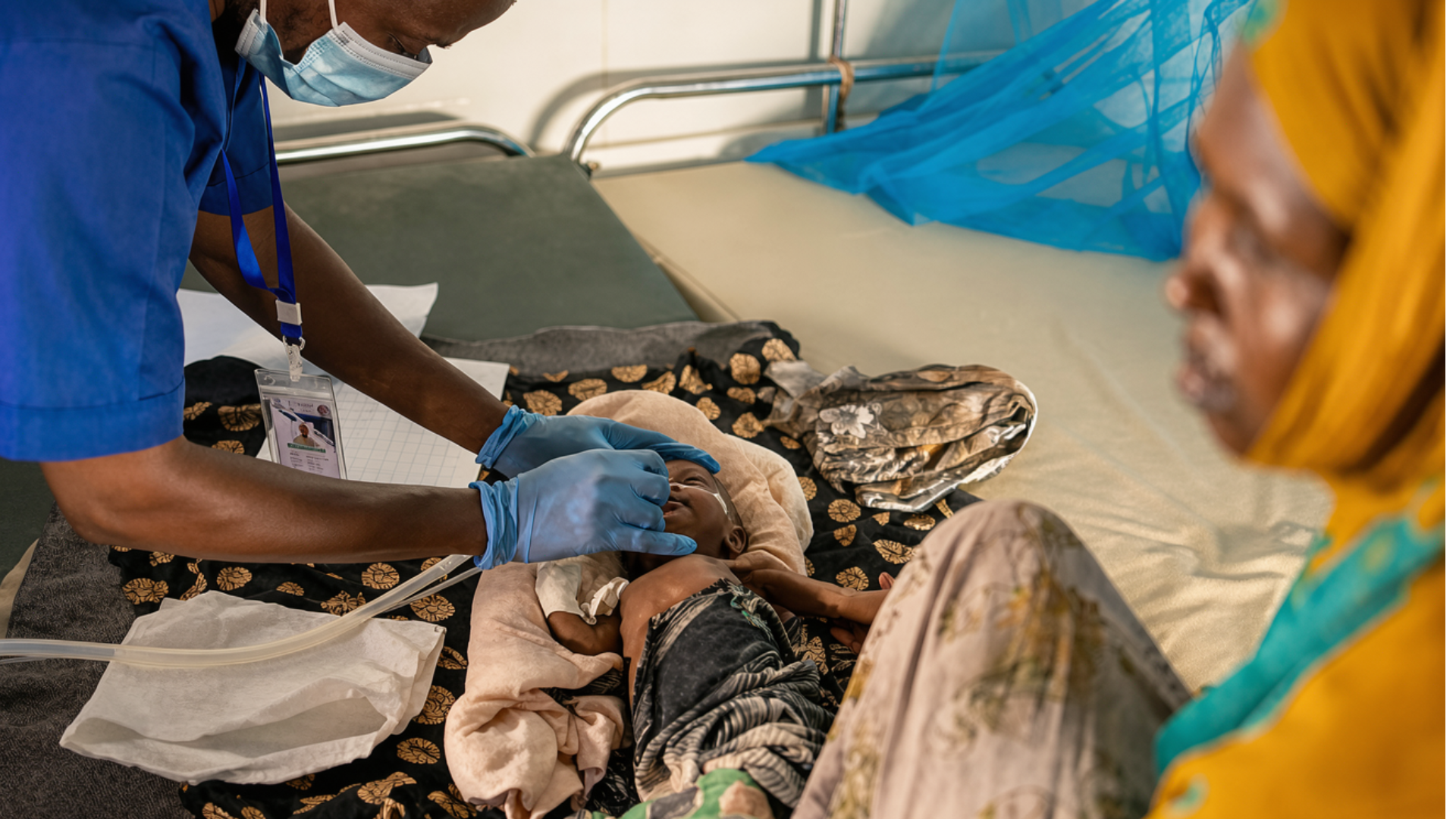
A doctor treats a severely malnourished baby at a stabilization center for children with severe acute malnutrition in Kismayo, Somalia, April 22, 2026. (Simon Maina/AFP via Getty Images)
WFP says it urgently needs $162 million to sustain lifesaving assistance through March 2027.
The need is concentrated in the countryside. Nearly 62 percent of Somalia’s child malnutrition burden falls on rural populations, according to the September analysis. Flooding linked to El Niño during the October-to-December rainy season is expected to disrupt food production and force more families from their homes.
In Baidoa, also in the Bay region, the analysis identified a risk of famine among displaced people under a plausible worst-case scenario. Nearly 26,000 displaced people there are projected to face catastrophic hunger through December. Because that finding relied on data collected in April, a follow-up assessment was planned for October.
“The humanitarian crisis in Somalia remains dire and millions of people are at risk due to these high levels of hunger and malnutrition,” George Conway, the UN humanitarian coordinator for Somalia, said in a September statement. He called for urgent action and additional resources to keep the crisis from worsening. Conway has since warned that repeated fighting in Baidoa is forcing more families from their homes and cutting off access to food aid and health care.
World Vision has worked in Somalia since 1993. The organization reports reaching more than 1.3 million people there through programs in health and nutrition, clean water and sanitation, education, child protection, food security and livelihoods.
The September analysis also showed what a sustained response can do. Burhakaba, where Mariam brought her daughter for care, was at risk of famine in April. By September, malnutrition there had improved after seasonal rains and a scaled-up humanitarian response, the UN said.