

Church titles can stir confusion and suspicion, yet a careful look at Scripture equips believers to discern wisely and disagree with grace.
By EEW Magazine Online Editors
Detail of the Synaxis of the Twelve Apostles, an early 14th-century Byzantine icon held at the Pushkin State Museum of Fine Arts in Moscow. (Wikimedia Commons)
Somewhere this Sunday, a woman will hear a minister introduced as Apostle and wonder what the title means. In some congregations, it honors a leader who has planted churches, raised up pastors and overseen ministries across a region. In others, the word belongs only to the men Jesus personally sent to lay the foundation of His church, and hearing it applied to a modern preacher raises an eyebrow.
Both responses usually come from sincere convictions about Scripture. Sorting them out calls for a close look at how the New Testament uses the word, what it teaches about the office and how believers can tell God’s Word apart from the interpretations through which they learned to read it.
The Greek word apostolos describes one who is sent, a messenger commissioned to act on behalf of the one who sent him. The New Testament applies it first to Jesus Himself. Hebrews 3:1 calls Him “the Apostle and High Priest of our profession,” a role that belongs to Christ alone as the One sent by the Father. Scripture then uses the word for the Twelve and for Paul. Beyond that circle, it extends to Barnabas, to Epaphroditus, whom the Philippian church sent to Paul, and to messengers of the churches.
That range shows the word was not confined to the Twelve. It does not establish that everyone who bore it possessed the authority of Peter or Paul. Context decides how much authority the word signals in a given passage.
When Judas’ seat among the Twelve stood empty, Peter set the qualifications for his replacement in Acts 1. He had to be a man who had walked with the disciples from John’s baptism until the day Jesus was taken up, so he could join them as a witness of the resurrection. Matthias was chosen.
Paul later grounded his own apostleship in having seen the risen Lord, and he told the Galatians his commission came directly from Jesus Christ and God the Father.
A 16th-century Russian icon of the Apostle Paul, from the collection of the Church Archaeological Cabinet of the Moscow Theological Academy. (Wikimedia Commons)
Ephesians 2:20 describes the household of God as built on the foundation of the apostles and prophets, with Jesus Christ Himself the chief cornerstone. From this verse and the accounts in Acts and Galatians, many Christians conclude that the office of apostle was given to the church’s founding generation alone. Those who subscribe to this belief argue that a foundation is laid once, and every generation after builds on the testimony those witnesses left in Scripture.
Acts 1 has limits as a universal test. Its requirements applied to one vacancy among the Twelve, and Paul did not meet them, since he did not travel with Jesus during His earthly ministry. Scripture still calls him an apostle without hesitation. The passage defines who could join the Twelve, yet it leaves open many questions the wider New Testament raises about the word.
Believers who are convinced the office continues in the modern church turn to Ephesians 4:11–13. Paul writes that Christ gave apostles, prophets, evangelists, pastors and teachers for the perfecting of the saints and the edifying of His body, “till we all come in the unity of the faith.”
Evangelists, pastors and teachers still serve the church, and the church has yet to reach the unity and maturity Paul describes. These believers reason that if the work of equipping is unfinished, the gifts Christ gave for it remain, apostles and prophets included.
They see apostolic ministry today as planting churches, developing leaders and advancing the Gospel into new places. Scripture still sets the boundary for any such ministry. A modern apostle serves under the authority of the Word and cannot add to it or replace the testimony of the first apostles. Any claim to apostolic authority that contradicts Scripture must be rejected.
Those who believe the office has ended give different reasons. Some stress that the first apostles were specially commissioned witnesses of the risen Christ, a role they believe cannot be repeated. Others tie the close of that office to the completion of the New Testament, which preserves apostolic teaching for every generation since.
Pages from the oldest surviving near-complete copy of Paul’s letters, written on papyrus in Egypt around A.D. 200. At lower right, Colossians opens with “Paul, an apostle of Jesus Christ.” (Chester Beatty Library/Wikimedia Commons)
Other believers separate the office of apostle from the work apostles did. They see the church continuing that work today through sending missionaries, planting churches and establishing new ministries, without giving anyone the formal title.
Christians across these perspectives affirm the call to spread the Gospel and plant churches. Their disagreement centers on whether Scripture teaches that the office of apostle continues today and, if it does, what authority comes with it.
Pentecostals themselves answer that question differently. The Assemblies of God, which affirms the present work of the Holy Spirit, states in its position paper that the church maintains an apostolic function without formal apostolic offices or titles. The paper allows that other churches may, in good faith and with careful biblical definition, recognize certain leaders as apostles. It also warns against any claim to authority equal to that of the apostles Jesus personally appointed.
In some Black Pentecostal and independent church traditions, the title of apostle has deep roots. Some leaders who built churches and denominations while much of American society shut Black believers out were honored as bishops, overseers and apostles.
In July 1982, at the close of Bible Way Church’s Silver Jubilee, its executive board of bishops unanimously voted to recognize founder Smallwood E. Williams as an apostle. More than 5,000 people attended the ceremony, The Washington Post reported. A historical marker erected that year in Washington, D.C., still identifies him as “Founder, Pastor, Apostle.”
Black churches differ widely on the title, and many do not use it. That history explains why the title sounds familiar, even honored, in some congregations and foreign in others.
Familiar practices can shape how believers read Scripture, and Jesus spoke to that danger in Mark 7. When Pharisees and scribes faulted His disciples for skipping ceremonial handwashing, He exposed how the custom of Corban allowed a person to declare resources devoted to God and then withhold support from a needy parent. A practice honored as religious had become a way around the command to honor father and mother.
Jesus’ rebuke was direct: “Making the word of God of none effect through your tradition, which ye have delivered” (Mark 7:13). He was confronting a custom that set aside a clear commandment of God.
Sincere disagreement over a difficult passage is a different matter.
Mark 7 does not decide the apostleship question, yet it supplies a principle for examining every teaching on it.
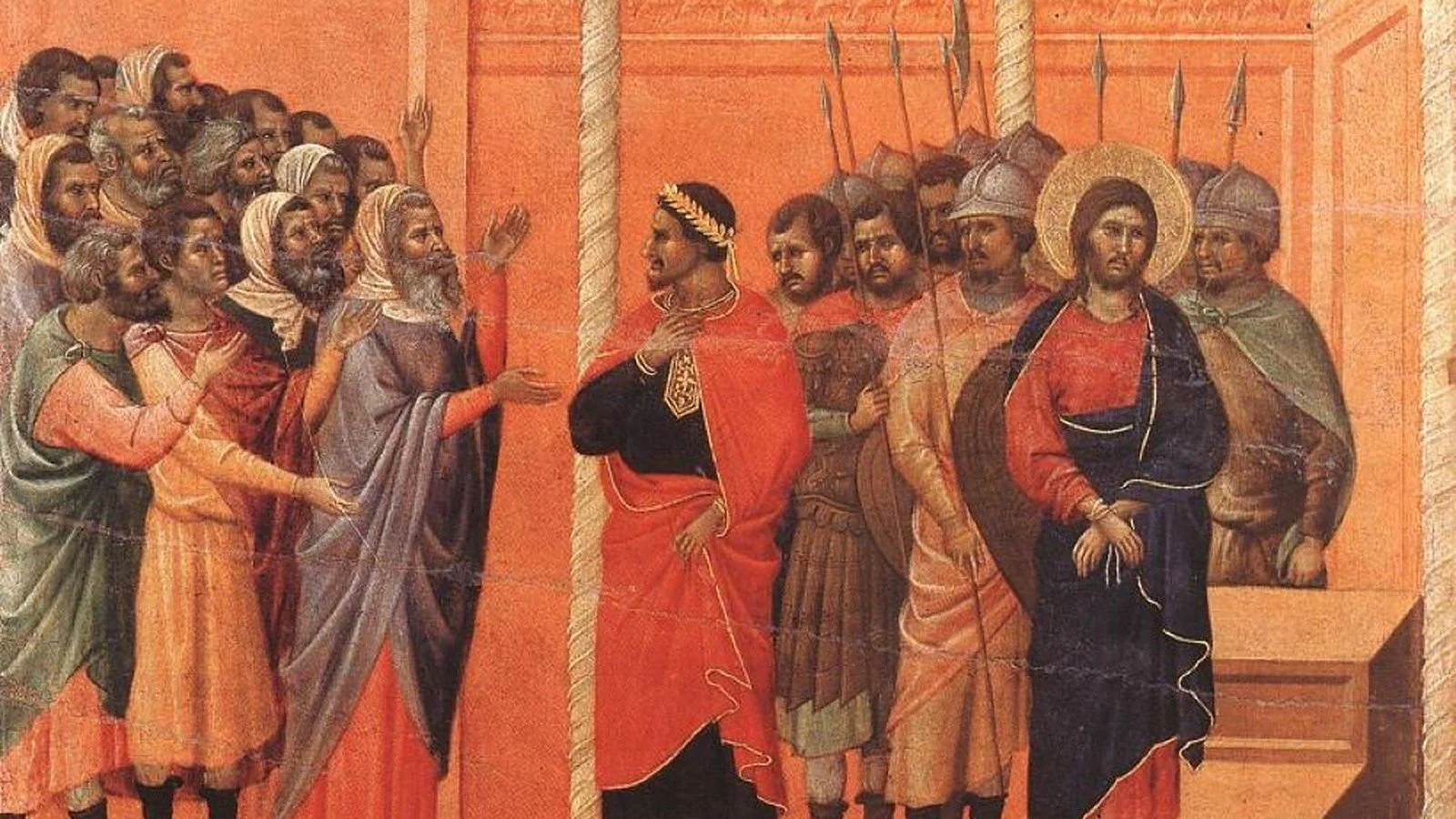
The Pharisees press their case against Jesus in “Christ Accused by the Pharisees,” a panel by Duccio di Buoninsegna, circa 1308. (Wikimedia Commons/Museo dell’Opera del Duomo)
Many Christians receive their understanding of the Bible through trusted pastors and denominations. Those interpretations may be carefully reasoned. Even so, an interpretation passed down for generations must still be weighed against the full witness of Scripture.
The test applies equally to inherited conclusions that the office has ended and to generational practices of ordination and spiritual hierarchy.
Scripture also calls believers to test claims of spiritual authority. Paul told the church to judge prophecy. The risen Christ commended the believers at Ephesus for examining those who called themselves apostles and exposing the false ones. Such testing weighs the doctrine, character and accountability of any leader who exercises authority in the church. A title cannot prove a calling, and suspicion cannot disprove one.
Testing calls for the right posture. Paul told the church at Rome, “Him that is weak in the faith receive ye, but not to doubtful disputations” (Romans 14:1). The chapter concerns food and holy days, yet its counsel still shapes how believers treat one another in disagreement.
To Timothy, Paul wrote that the servant of the Lord must avoid strife and be gentle toward all, patient, able to teach and meek in correcting those who oppose him. Believers can stand firm in their convictions, search the Scriptures carefully and correct what they believe to be error without treating those who disagree as enemies or apostates.
In Mark 10, Jesus gave His disciples the measure for any title the church confers: “Whosoever will be great among you, shall be your servant.” He set that standard as the Son of Man who came to serve and to give His life a ransom for many.
Whatever offices a congregation recognizes, Jesus Christ remains its highest authority, and the greatest among His people is the one who serves.
