
Is Marriage a Blood Covenant? What Scripture Actually Says
A popular teaching says a wife's blood seals the marriage covenant before God. Scripture never makes that claim.
By EEW Magazine Online Editorial Team
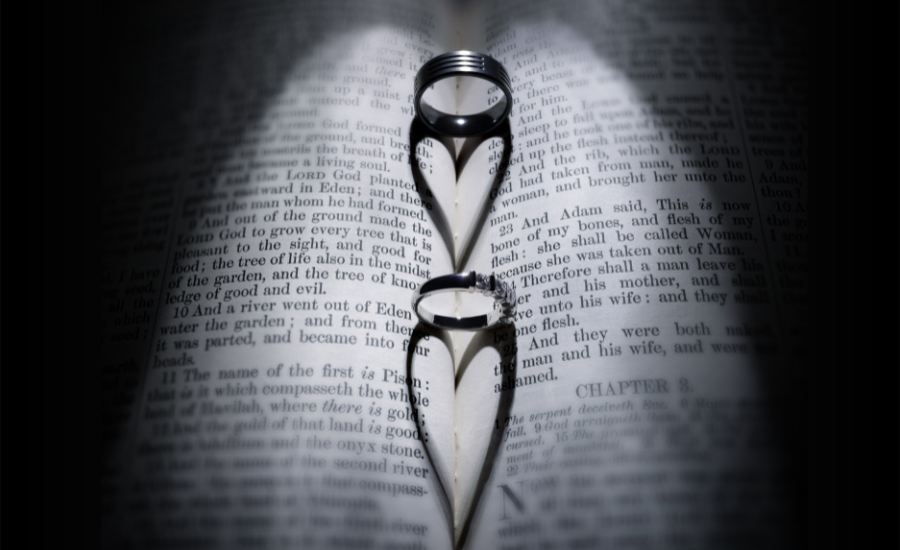
Millions of Christians have grown up believing something most of us never stopped to question: that marriage is a blood covenant, and a wife's bleeding the first time she has sex is proof of it.
Here's how the teaching usually goes.
Covenants in the Bible, and across the ancient world, were confirmed by the shedding of blood. Something had to bleed, or die, for the agreement to be binding. So when a husband takes his wife for the first time and her hymen tears, that blood is the confirmation. It's the moment the covenant becomes official before God. From then on, every time the husband and wife come together in the marriage bed, they're renewing that covenant.
It's a tidy theory. It even sounds like it lines up with how covenants worked in Scripture. But where does that leave the woman who doesn't bleed?
And where, exactly, does the Bible say any of this in the first place?
Turns out, it doesn't. The theory might feel clever. It might even follow a kind of logical pattern, if you're connecting your own dots. But connecting dots isn't the same as Scripture saying something, and Scripture never says this.
Marriage is called a covenant, no question there.
Malachi 2:14 calls a wife "the wife of thy covenant." Genesis 2:24 tells us what that covenant produces: two becoming "one flesh." Jesus quotes that same verse in Matthew 19:6 and adds his own weight to it: what God has joined together, let no one separate. Hebrews 13:4 says marriage should be honored among all, and the marriage bed kept undefiled.

Go back through every one of those verses. Not one mentions blood. Not one ties the covenant to anything physical happening on a wedding night. What seals the covenant, according to Scripture, is God's word and the joining itself.
If there's a passage anywhere close to a blood covenant argument, it's Deuteronomy 22:13-21. A bride's blood served as evidence of her virginity, something her family could point to if her new husband accused her of unfaithfulness. But look closer and the blood isn't sealing anything.
It's evidence.
Proof of what was already true going into the marriage. The covenant itself rested on the union the couple had already entered, and the blood simply backed that up if it was ever challenged.
This kind of thing happens more than people realize. Scripture gets stretched past what it actually says, and a story becomes a rule. Take Genesis 38. Judah's son Onan was married to Tamar, and when his brother Er died without an heir, custom required Onan to give Tamar a child to carry on his brother's name and inheritance. Onan had sex with Tamar, but pulled out before completion every time, refusing to let her conceive. He wanted his brother's inheritance for himself without doing his duty by his brother's widow. That's what God killed him for. Selfishness, posing as compliance, at a grieving widow's expense.
None of that is about masturbation. But pull "Onan spilled his seed on the ground" out of that context, and generations of preachers have used it to build an entire doctrine that any release of seed outside of procreative marital sex is sin, masturbation included.

The text was never written to settle that question. It's a story about a man cheating a widow out of what she was owed, and the method he used to do it.
There's also the bigger picture argument, the one about typology. Marriage is described as a picture of Christ and the church, a husband's love compared to the way Christ loved the church and gave himself for her (Ephesians 5:23-25). The New Covenant was sealed through Christ's blood (Luke 22:20).
So it feels like marriage, as a reflection of that covenant, should require blood too.
But types in Scripture rarely match their fulfillment detail for detail. Adam is called a type of Christ (Romans 5:14), and the comparison works at the level of pattern, one man's act affecting many, without Adam's life mirroring the specifics of Christ's sacrifice. That's how typology tends to work; it points toward something bigger without copying it line for line. Marriage pictures Christ and the church through faithfulness, sacrifice, and oneness. Blood was never the detail Scripture asked that picture to carry.
And then there's the body itself. The blood covenant teaching leans on the idea that a woman's hymen will reliably tear and bleed the first time she has sex. It just doesn't hold up. Studies put the number of women who bleed the first time somewhere between 43 and 50 percent. Some women don't bleed at all. Some have a hymen that changed shape years before marriage, from activity that had nothing to do with sex.
Some don’t have a hymen at all.

Every other sign God set up in Scripture happens the same way every time. Circumcision marked the body, without exception. Baptism involves water, every time it's performed. The bread and the cup are there, every time communion is observed. None of those come down to chance. A sign meant to carry this much weight shouldn't land closer to a coin flip than a certainty.
That gap between the theory and the text has carried real weight for women over the years. Many who didn't bleed on their wedding night have quietly carried questions for decades. What it meant. Whether something was wrong with them. Whether their marriage had really been sealed the way they were taught it should be. Scripture never asked them to carry any of that.
What the Bible actually teaches leaves no room for that question. A man and woman become one flesh the moment God joins them, and that union is the covenant (Genesis 2:18, Genesis 2:24, Malachi 2:15). Nothing was missing.
Nothing needed to bleed to make it real.
Growing up with a teaching like this one, and then finding out it isn't actually in Scripture, can feel disorienting, like something sacred just got pulled out from under you.
But nothing sacred moved.
What shifted was a tradition, not the foundation. The marriage covenant was never resting on a wedding night. It rested on God's word the moment He joined two people together, and it has held that way for every marriage since, blood or no blood.