

Federal health officials report influenza running above typical November levels and expect hospital visits to climb during the holiday week, while RSV and COVID-19 remain low.
By EEW Magazine Online Editors
Flu, RSV and COVID-19 share many symptoms, which can make the three hard to tell apart without a test.
Ohio health officials announced Friday that a teenager from Ross County had died, the state’s first flu-related pediatric death of the 2026-27 season. The news came the same day the Centers for Disease Control and Prevention reported in its weekly respiratory update that flu activity continues to rise in many parts of the country. Thanksgiving is less than a week away, and families are preparing to spend long days together indoors.
Flu activity is running higher than is typical this early in the season, the CDC says. In its latest FluView report, covering the week ending Nov. 14, the agency estimates at least 3.7 million flu illnesses, 50,000 hospitalizations and 2,800 deaths so far this season. Separately, seven children have died of flu-related illness this season, according to reports to the agency. The H1N1 strain of influenza A accounts for the large majority of viruses public health labs have identified.
The CDC forecasts that flu hospital admissions and emergency room visits will rise during Thanksgiving week. Agency officials have also noted that an early start does not necessarily mean a higher peak or a more severe season.
COVID-19 activity is low nationally, and RSV activity is low in most of the country. The CDC expects flu, COVID-19 and RSV together to send about as many people to the hospital at the season’s peak as they did last winter, though the timing and severity of each virus remain uncertain.
For women caring for newborns, aging parents or relatives with chronic illness, the weeks ahead bring practical decisions about vaccines, testing and when to call a doctor. Some of this year’s guidance has changed, and each virus calls for a different response.
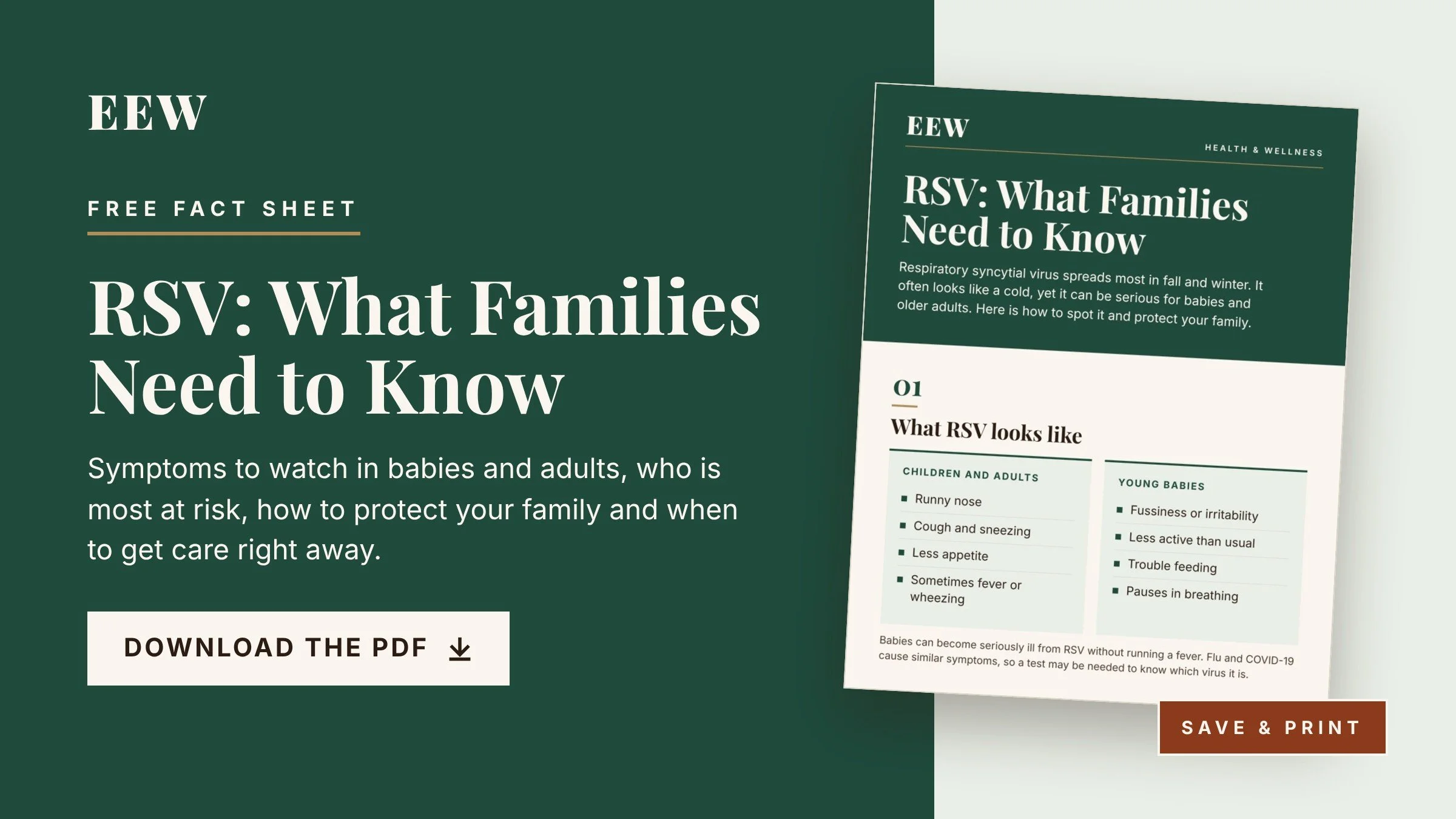
The three illnesses share many symptoms, including cough, congestion, fatigue and fever. Flu tends to come on suddenly, with fever, chills, headache, body aches and deep exhaustion that can arrive within hours. RSV often resembles a common cold, bringing a runny nose, cough, sneezing and a weaker appetite. COVID-19 can produce any of these symptoms, along with a change in taste or smell.
In young babies, RSV can look different. An infant may become fussy, less active or uninterested in feeding, and some have pauses in breathing without having a fever.
Symptoms alone often cannot identify the cause. Many clinics and pharmacies offer tests that check for more than one virus from a single sample, and the result can determine which treatment is available and how quickly it must begin.
Adults 65 and older, children younger than 5, pregnant women and people with weakened immune systems face a higher risk of severe illness, according to the CDC. Asthma, chronic obstructive pulmonary disease, heart disease, diabetes and kidney disease raise the risk as well. An infection that keeps one family member home for a few days can put another in the hospital.
The CDC tracks flu, COVID-19 and RSV from its Atlanta headquarters. With the Thanksgiving holiday, the agency will post its next weekly flu report on Monday, Nov. 30. (CDC)
The CDC recommends a flu vaccine every year for everyone 6 months and older. That recommendation remains in effect this season under federal court orders. In January, the CDC moved children’s flu shots, along with several other childhood vaccines, to a category called “shared clinical decision-making,” leaving the choice to families and their doctors. A federal judge in Massachusetts blocked that change in March, restoring the earlier schedule while the government appeals.
Some children ages 6 months through 8 years need two doses, given at least four weeks apart, depending on their vaccination history. Adults 65 and older are advised to get an enhanced vaccine, such as a high-dose, adjuvanted or recombinant shot, when one is available.
The American Academy of Family Physicians also counts Moderna’s new mRNA flu vaccine, mFlusiva, among the preferred options for that age group. Pregnant women should get the flu shot, since the nasal spray vaccine is not recommended during pregnancy. Protection takes about two weeks to develop, so a shot now can be working well before Christmas gatherings and the months of flu season still ahead.
For RSV, the CDC recommends a single dose of vaccine for all adults 75 and older and for adults 50 to 74 at increased risk, including those with chronic heart or lung disease or weakened immune systems. It is a one-time vaccine, so adults who have already received it do not need another dose this year.
Most babies need only one form of RSV protection, either a vaccine given to the mother during pregnancy or an antibody shot after birth.
Babies can be protected in one of two ways. A mother can receive Pfizer’s Abrysvo vaccine during weeks 32 through 36 of pregnancy. The CDC recommends that vaccine from September through January in most of the country.
The American College of Obstetricians and Gynecologists has extended its window this season through March 1 in most of the continental United States, and the AAFP follows that guidance. The CDC has not changed its window. Babies whose mothers were not vaccinated can receive a long-acting RSV antibody shot instead. Most infants do not need both, and pregnant women should ask their obstetric provider which option fits their due date.
COVID-19 guidance varies by age. The CDC recommends a 2026-27 vaccine for all adults 18 and older. For children 6 months through 17 years, the agency recommends vaccination for those who are moderately or severely immunocompromised and leaves the decision for other children to families and their doctors.
Major medical groups go further in some areas. The American Academy of Pediatrics recommends the vaccine for all children 6 through 23 months and for older children at high risk, and supports it for any child whose parents want protection. The AAFP advises adults 65 and older to get a second dose six months after the first. The American College of Obstetricians and Gynecologists recommends COVID-19 vaccination for all pregnant women.
The New York State and New York City health departments endorsed the medical associations’ recommendations in September.
For people at higher risk, early treatment can prevent serious complications, and the clock starts when symptoms begin. Flu antivirals such as oseltamivir, sold as Tamiflu, work best when started within 48 hours. High-risk patients should still call a doctor if more time has passed.
For COVID-19, Paxlovid must be started within five days of the first symptoms, and remdesivir, an IV treatment, within seven. Paxlovid interacts with a number of common medications, so doctors review a patient’s prescriptions along with kidney and liver health before prescribing it. People at high risk can qualify for treatment even when symptoms are mild.
Doctors generally treat RSV with fluids, symptom relief and, when needed, hospital care. Antibiotics do not work against any of the three viruses, though a doctor may prescribe them for a secondary bacterial infection such as pneumonia.
Most of these infections can be managed at home. Certain symptoms, however, call for immediate care. The CDC’s warning signs for adults include trouble breathing, persistent chest pain or pressure, confusion and seizures. In children, they include fast or labored breathing, ribs pulling in with each breath, bluish lips or face, signs of dehydration such as no urine for eight hours, and a child who is not alert when awake.
For babies younger than 12 weeks, any fever warrants immediate medical attention. At any age, a fever or cough that improves and then returns or worsens is a warning sign, and a serious infection can develop without a high fever.
A few habits lower the risk at holiday tables and church fellowship meals alike. Wash hands before cooking and before holding a baby. Open a window or run an air purifier when the house fills up. Skip shared cups and serving utensils, and wipe down frequently touched surfaces.
Anyone who becomes sick should stay home until symptoms have been improving overall for at least 24 hours and they have gone that long without a fever or fever-reducing medicine, the CDC advises. For the five days after, the agency recommends added precautions such as masking, keeping distance, cleaner air or testing before being around others. People with weakened immune systems may need more individualized precautions.
Hosts can help by telling guests ahead of time that staying home when sick is welcome. Rescheduling a visit with a newborn or a frail grandparent costs far less than exposing them to a virus.
The CDC posts updated national and state figures each week on its data channel. For the women keeping track of everyone’s appointments and prescriptions this season, the guidance comes down to two habits: get the vaccines that fit each family member, and call the doctor early when someone at higher risk falls ill.