

Bishop Rudolph McKissick Jr. named three Black conservatives from a historic Harlem pulpit and reached for some of the harshest words Black Americans use on one another. Scripture speaks to the preacher and to the believers in the pews who vote differently.
By EEW Magazine Online Editors
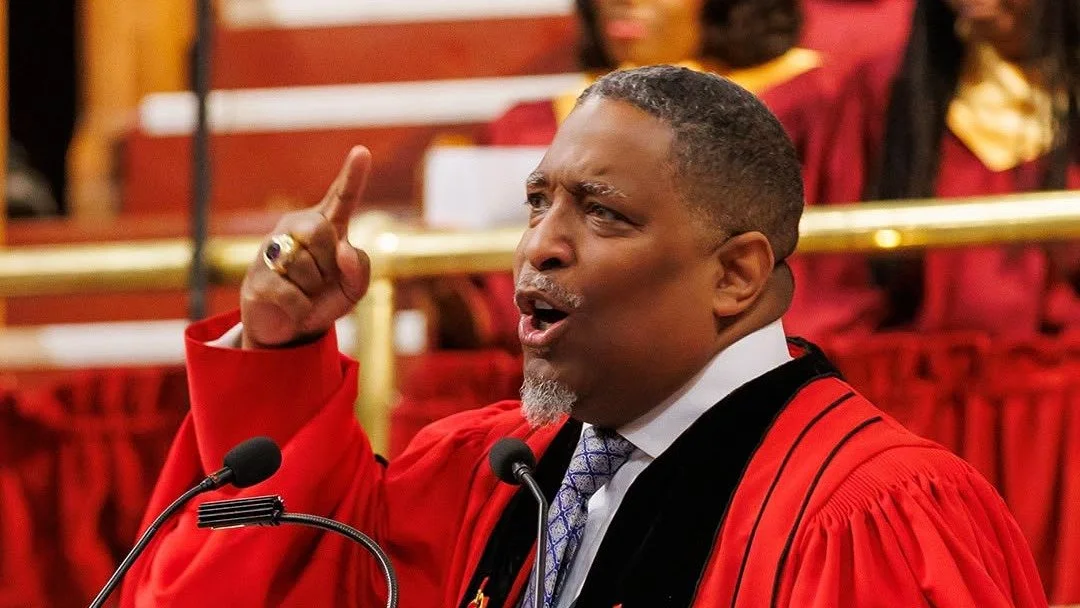
Bishop Rudolph McKissick Jr. preaches “The Faithfulness of God” at Harlem’s Abyssinian Baptist Church on Nov. 8, 2026, during the church’s 218th anniversary service. (Credit: The Abyssinian Baptist Church in the City of New York, Inc.)
On the Sunday after the midterm elections, Bishop Rudolph McKissick Jr. stood in the pulpit of Harlem’s Abyssinian Baptist Church to preach its 218th anniversary. His sermon was titled “The Faithfulness of God.” About 20 minutes in, the Jacksonville pastor told Black leaders to quit “shucking and jiving and cooning and hoeing.” Then he stopped. “I’m sorry,” he said. “I thought I was back at Bethel,” his home church.
A 93-second clip of that stretch has spread online. It shows McKissick mocking Florida Gov.-elect Byron Donalds over a remark Donalds made as President Donald Trump returned to office. On Fox News in January 2025, Donalds predicted Americans would welcome Trump’s policies and added, “Daddy’s back.” From the pulpit, McKissick answered, “I’d rather be a bastard than call him my daddy.”
The full sermon runs 38 minutes, and EEW Magazine Online reviewed it. Heard in full, it leaves two questions. One is whether a preacher can condemn political actions without degrading the people who take them. Another is what believers do when they sit under that preaching and vote differently.
Donald Trump and Byron Donalds embrace onstage at a 20/20 Bipartisan Justice Center event. Donalds, one of Trump’s closest allies in Congress, takes office as Florida’s governor Jan. 5. (Credit: Byron Donalds campaign site)
McKissick preached from Deuteronomy 7, where Moses reminds Israel that God chose them when they were few and powerless. He warned that people who gain power can forget where they started. “You can develop amnesia about what it felt like when you didn’t have any,” he said.
Then he gave examples. “We’ve got some that look like us, who are our color, but they ain’t our kind,” he said.
He named Sen. Tim Scott of South Carolina. He named Donalds, “who voted against advancing the John Lewis Voting Rights Act in 2021.” He named Justice Clarence Thomas, “who joined the decision to strike down the Voting Rights Act.” He told them, “You forgot where you came from.”
The viral clip trims that passage. It leaves out “ain’t our kind.” It opens on “shucking and jiving like you don’t remember where we came from,” followed by Donalds’ name. In the full sermon, that sentence begins with Scott’s name. McKissick cited no vote or act by Scott.
He also turned on his own profession. He condemned Black preachers who “prostitute God’s pulpit just for some money instead of preaching liberation.”
New York Attorney General Letitia James speaks from the pulpit of Harlem’s Abyssinian Baptist Church in October 2026, ahead of the midterm elections. (Credit: The Abyssinian Baptist Church in the City of New York, Inc.)
Partisan signals appeared elsewhere in the message. McKissick joked that Florida was “the only state that didn’t understand the assignment” on Election Day. He also faulted Rep. Haley Stevens of Michigan, saying she acted in petulance after losing her party’s Senate primary. Stevens endorsed Republican Mike Rogers two days before the election. She traced her decision to antisemitism surrounding the campaign of Democratic nominee Abdul El-Sayed and its supporters, and said El-Sayed “made it clear I was not welcome.”
McKissick’s criticism of Donalds did not begin Sunday. In a Sept. 1 post on X, writing as pastor of what he called the largest Black Baptist church in Florida, he asked Donalds to denounce what he described as bigoted attacks on Florida Democrat Angie Nixon.
The same sermon proclaimed grace. “God loved you before you could even make a case for why you should be loved,” McKissick said. He called for a church that loves everybody “beyond judgment, beyond mistakes.”
His larger argument was about memory and obligation. He said any policy that treats Black and brown communities as disposable “deserves prophetic scrutiny.” He ended the passage with a charge to anyone who holds power: “Your gratitude for being liberated ought to help you liberate somebody else.”
The three men he named have answered their critics in their own words. Donalds voted against the John R. Lewis Voting Rights Advancement Act in August 2021. He argued that the bill would federalize election law and give the Justice Department the power to veto state election laws.
On the “Daddy’s back” remark, Donalds told rapper Luther Campbell in October that it was a misinterpreted joke. “Do I think he’s my daddy? No,” he said. He added that some Black voters wrongly assume his closeness to the president means he is not his own person.
Scott has faced the same kind of charge. In a 2021 national address, he said, “I get called ‘Uncle Tom’ and the n-word by progressives, by liberals.” He later said he is proud to be Black and became a conservative because he concluded that conservative principles are the way to set people free.
Thomas’ record is more specific than the sermon suggests. In Shelby County v. Holder in 2013, he joined the majority striking down the formula determining which states needed federal approval to change voting rules. He argued for going further. In April’s Louisiana v. Callais, he joined a ruling narrowing the Voting Rights Act’s application to redistricting, while arguing that Section 2 does not apply to districting at all. Neither decision struck down the entire law.
Supreme Court Justice Clarence Thomas looks on during Pam Bondi’s swearing-in as U.S. attorney general at the White House in Washington on Feb. 5, 2025. (Credit: REUTERS/Kent Nishimura)
The bishop’s words have a history. The coon caricature depicted Black men as lazy, easily frightened, chronically idle and inarticulate, according to the Jim Crow Museum at Ferris State University. Among Black Americans today, “cooning” accuses a person of performing for white approval.
“Hoeing” comes from a slur for a prostitute and accuses a person of selling himself. “Shucking and jiving” accuses him of putting on an act. Together, the phrases form a vocabulary of racial betrayal, here aimed at the first Black Republican elected governor in U.S. history.
“Our color, but they ain’t our kind” goes past any vote. It questions whether three Black men still belong.
Abyssinian’s tradition makes room for political speech. In an NY1 feature on the anniversary, Senior Pastor Kevin R. Johnson said the church “has always had a prophetic voice.” In a 2021 Pew study, 62% of Black adults said it is at least important for houses of worship to offer sermons on political topics like immigration and race relations.
The Rev. Kevin R. Johnson, senior pastor of Harlem’s Abyssinian Baptist Church, speaks from the pulpit. (Credit: The Abyssinian Baptist Church in the City of New York, Inc.)
For many Black preachers, Scripture requires it. Nathan confronted King David over a specific sin, and Jesus launched His ministry by announcing deliverance to the captives.
Other believers read the preacher’s job more narrowly. Paul’s charge to Timothy begins, “Preach the word.” In the same Pew study, respondents were least likely, at 24%, to call sermons on political topics essential, out of seven church functions measured.
McKissick endorsed no candidate Sunday, and the election was over. His sermon did cheer one party’s results and condemn the other side’s most prominent Black figures. Listeners will disagree about whether that amounts to taking a side.
Scripture also speaks to how a preacher corrects. The verse that commands Timothy to “reprove, rebuke, exhort” adds “with all longsuffering and doctrine.”
Then there are the voters. NBC News exit polls estimate Donalds won 13% of Black voters in Florida, including 25% of Black men and 6% of Black women.
Nationally, Trump’s share of Black voters rose from 8% in 2020 to 15% in 2024, including 21% of Black men, according to a Pew Research Center study of validated voters. Pew attributed most of the change to who turned out. This year, the AP Voter Poll found that only about one in 10 Black men nationally backed Republican House candidates. Florida ran well ahead of that.
Black institutions have marked Donalds’ win differently. The NAACP left him out of its “History Was Made” tribute to midterm firsts, as EEW reported last week. The organization says it “supports policies, not politicians.” The Legal Defense Fund, a separate organization, listed him among 19 barrier-breaking winners from both parties.
McKissick aimed his words at officeholders and preachers. He did not say whether his judgment reaches the people who voted for them.
Scripture gives those believers direction of their own. The Bereans tested even Paul’s preaching against the Scriptures. Writing to Roman believers divided over food and holy days, Paul told them, “Let every man be fully persuaded in his own mind,” and urged them to stop judging one another. Whether a vote belongs in that category is part of the dispute.
The bishop offered one more standard that morning, while discussing Stevens. Loyalty, he said, “can’t require you to surrender your conscience.” He was separating conviction from wounded pride, and he did not say where a Black conservative’s convictions fall. Black conservatives make the same appeal to conscience about their own votes.
Donalds takes office Jan. 5. The clip will fade before then. The questions beneath it will remain in the pews: whether a preacher can rebuke without degrading, and what a church and its members owe one another when they vote differently.
Watch the Full Sermon
“The Faithfulness of God”
Video: The Abyssinian Baptist Church in the City of New York, Inc.
