

The civil rights group that once documented violence against Black voters in Florida honored eight Democrats after the midterms. Byron Donalds, the first Black Republican elected governor in U.S. history, was not among them.
By EEW Magazine Online Editors
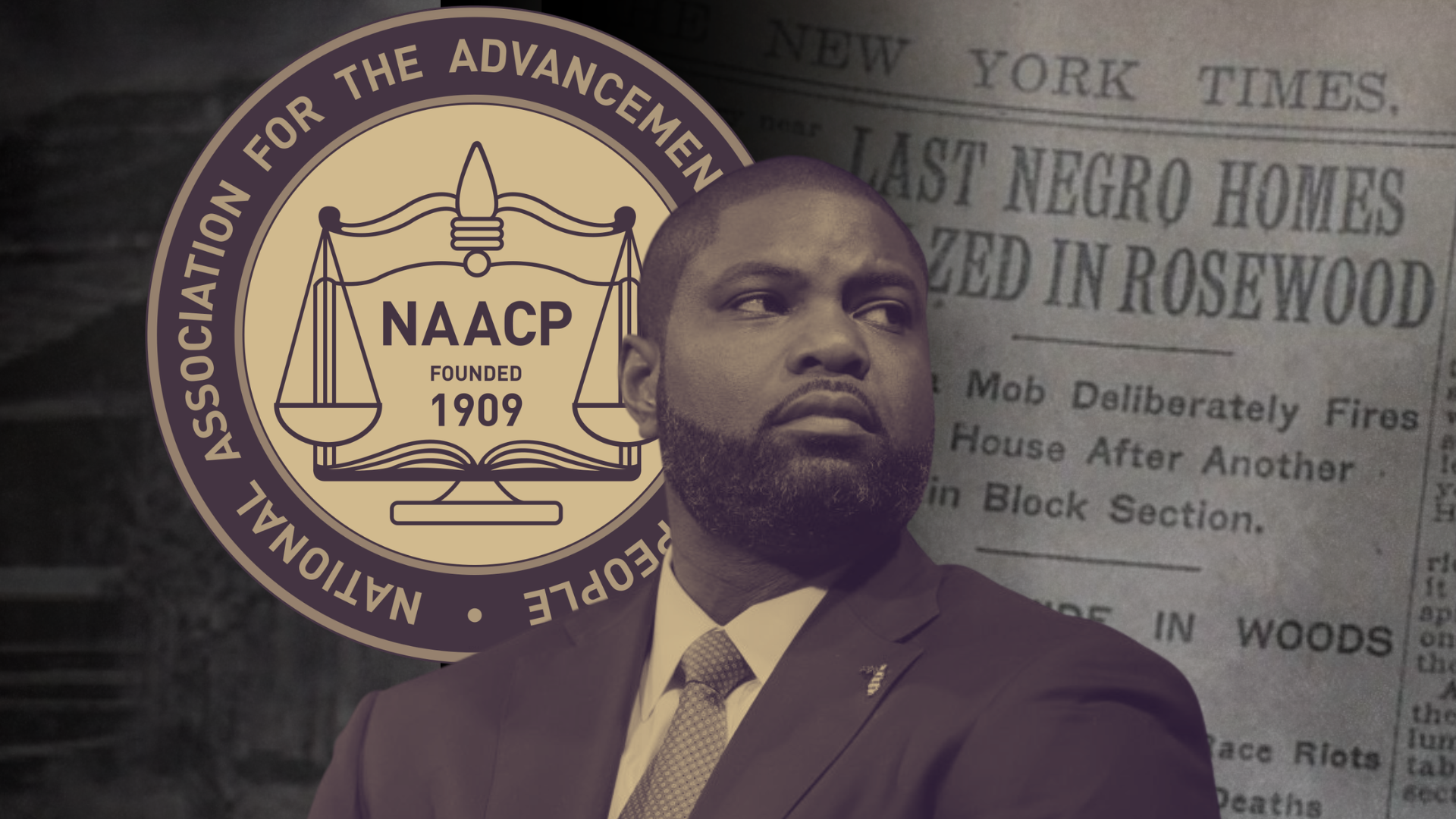
Florida Gov.-elect Byron Donalds, the NAACP seal and a 1923 New York Times report on the burning of Rosewood. (Getty Images/Illustration by EEW Magazine Online)
In the early morning of Nov. 3, 1920, a white mob in Orlando lynched July Perry, a Black community leader who had helped his neighbors in nearby Ocoee register to vote. Three years later, another mob burned the Black town of Rosewood.
On Nov. 3, 2026, exactly 106 years after Perry was killed, Florida voters elected Byron Donalds as the state’s first Black governor. The Republican congressman from Naples won with 50% of the vote. He also becomes the first Black Republican elected governor in American history.
The next day, the nation’s oldest civil rights organization left him out of its celebration. The NAACP’s Instagram tribute to the midterms’ historic firsts, headlined “HISTORY WAS MADE,” featured eight Democrats.
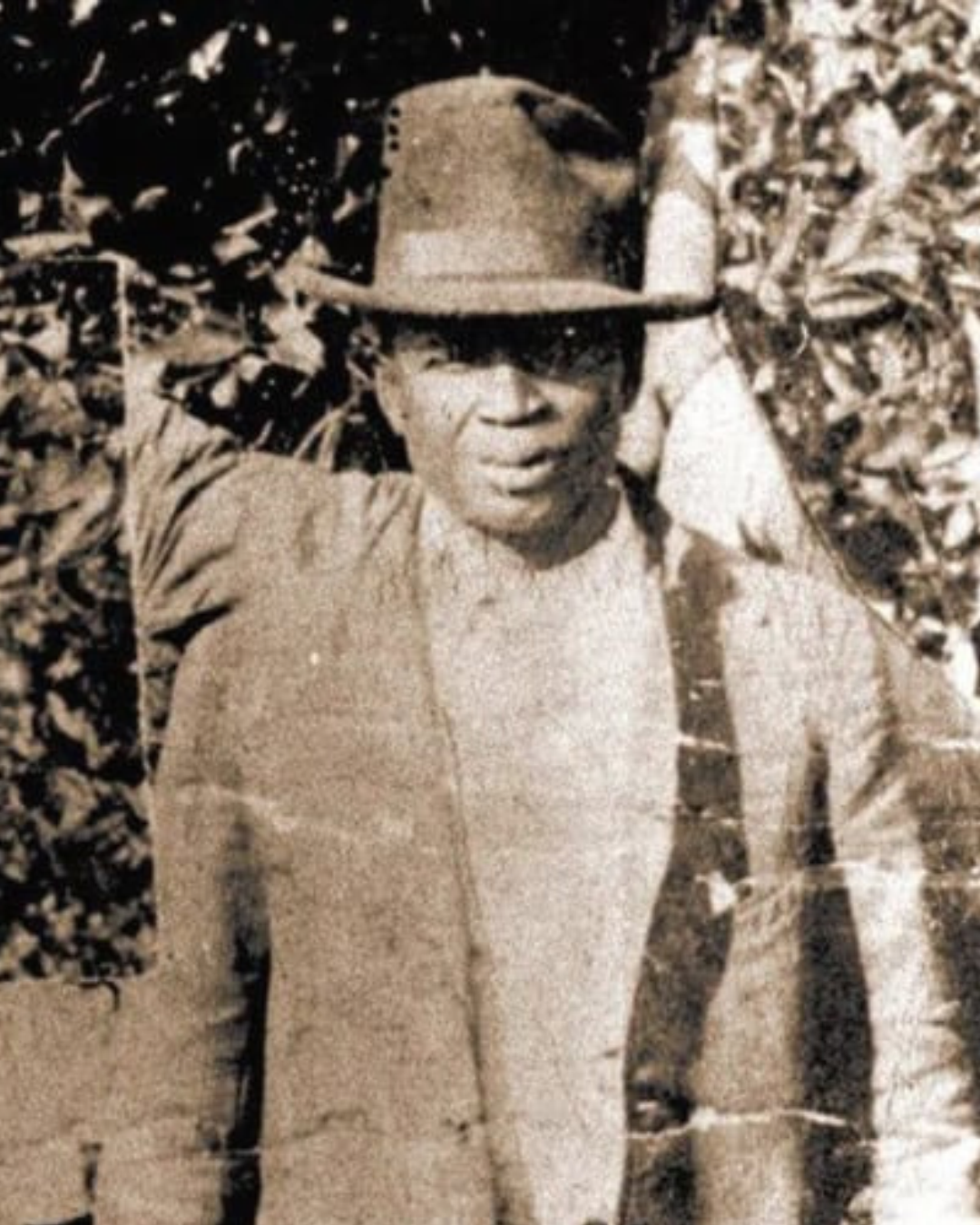
July Perry, a Black community leader who helped his neighbors in Ocoee register to vote, was lynched in Orlando on Nov. 3, 1920. (AP Photo)
Four were honored by the NAACP for Black firsts. Georgia Gov.-elect Keisha Lance Bottoms is the first Black woman elected governor in U.S. history. Wisconsin’s David Crowley and Nevada’s Aaron Ford are the first Black governors of their states. The graphic identified Stacey Plaskett as the first Black woman to become governor of the U.S. Virgin Islands.
Melat Kiros, Colorado’s first Black congresswoman, appeared on the graphic as the first Gen Z woman elected to Congress. The other three were honored for milestones outside Black representation. Michigan’s Abdul El-Sayed will be the first Muslim U.S. senator. Gina Hinojosa will be Texas’ first Latina governor, and New Mexico’s Deb Haaland will be the first Native American woman to lead a state.
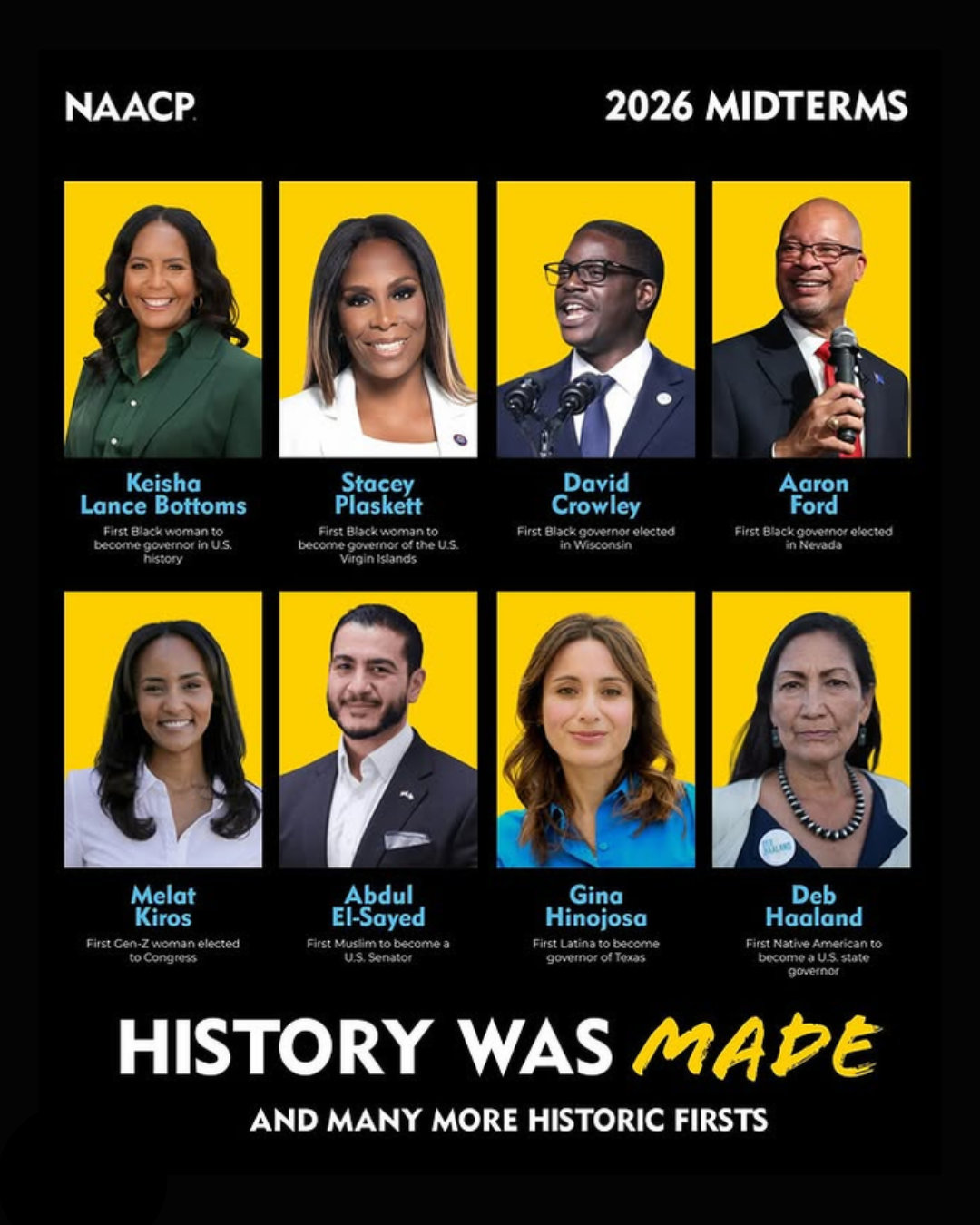
The NAACP’s Instagram tribute to historic firsts from the 2026 midterms featured eight Democrats and did not include Florida Gov.-elect Byron Donalds. (NAACP/Instagram)
“History was made at the ballot box!” the NAACP wrote in its caption. “So many firsts, so many reasons to celebrate.” Beneath the photos, the graphic noted “many more historic firsts.” Comments under the post ranged from questions about Donalds’ absence to approval of the lineup.
The NAACP’s formal response to the election also left him out. In a Nov. 4 press release, the organization credited Black voters with a series of historic wins and named five of them: Bottoms, Kiros, Crowley, Ford and El-Sayed. It describes itself there as a nonpartisan organization that “supports policies, not politicians.”
Neither the release nor the Instagram post explained how the honorees were chosen.
The Legal Defense Fund handled the moment differently. The civil rights law organization, founded by Thurgood Marshall in 1940 as an arm of the NAACP and independent since 1957, published its own list of 19 history-making winners from both parties. Every candidate on the NAACP graphic appears on it. So does Donalds, recognized as the first Black man elected governor of Florida. So does Republican Marsha Blackburn, Tennessee’s first woman elected governor.
The NAACP’s statement pledged to hold officials of every party accountable. It did not address whether recognizing a historic first differs from supporting the official who achieved it. The Legal Defense Fund’s list named winners from both parties and described each one only by the barrier broken.
The NAACP has its own history with Black voters in Florida. In 1920, Black Floridians were mostly Republicans, loyal to the party of Abraham Lincoln. On Election Day that year, Mose Norman, a Black landowner who helped register Black voters in Ocoee, went to the polls planning to vote for Republican Warren G. Harding.
White election officials turned him away. Norman sought advice from John M. Cheney, a Republican judge in Orlando who had helped with the registration drive. When Norman returned to the polls, armed white men attacked him.
That night, a mob surrounded the home of Norman’s friend July Perry, who had paid poll taxes for neighbors who could not afford them. Perry was wounded and taken to the Orange County Jail in Orlando. Early on Nov. 3, a mob took him from custody and hanged him near Cheney’s home.
Mobs burned Black homes, churches and a lodge in Ocoee. The Equal Justice Initiative counts as many as 30 Black people killed and says the survivors fled and never returned. On Nov. 5, 1920, the NAACP’s investigator Walter White arrived in Orlando to document what had happened.
His report ran in The Crisis and went before Congress.
People stand among the smoldering ruins of a Black family’s home in Rosewood, Fla., in January 1923, after white mobs attacked the town. (State Archives of Florida/Florida Memory)
Black political loyalty shifted in the decades that followed. In the 1930s, Black adults were as likely to support Republicans as Democrats. Republican affiliation began declining in the 1940s, according to the Pew Research Center. Today, 14% of Black adults identify with or lean toward the Republican Party, compared with 73% who identify with or lean Democratic, a Pew 2026 survey finds.
Donalds is not the first Black Republican to break a statewide barrier in Florida. In 2010, voters elected Republican Jennifer Carroll lieutenant governor on Rick Scott’s ticket. She was the first Black person elected to that office and, according to Ballotpedia, the first Black person elected to statewide office in Florida. Donalds is the first Black Floridian elected to the state’s highest office.
He won with limited Black support. Exit polls conducted for a group of news organizations, which combine Election Day interviews with surveys of early and mail voters, estimate that Donalds won about 13% of Black voters and Democrat David Jolly won 86%. Those polls put his support at about a quarter of Black men and 6% of Black women.
The AP Voter Poll, a separate survey, estimated about a quarter of Black men and about one in 10 Black women.
Both are estimates, not ballot counts. Donalds had set a goal of at least 20%.
Byron Donalds gives a thumbs-up at a campaign rally in Lakeland, Fla., on Oct. 1, 2026. Donalds was elected Florida’s first Black governor on Nov. 3. (Kevin Lamarque/Pool/Getty Images)
Critics point to his record. As EEW Magazine Online reported in October, Donalds has backed restrictions on diversity, equity and inclusion programs and defended President Donald Trump’s immigration agenda. Students booed him at a September town hall at Florida A&M University, where he studied for three years before finishing his degree at Florida State University.
In 2021, he voted against the John Lewis Voting Rights Advancement Act and the George Floyd Justice in Policing Act, along with nearly every House Republican. He has said he opposed the voting rights bill because it would have extended federal preclearance of election changes nationwide. On policing, he backed Sen. Tim Scott’s Republican alternative.
His 2024 remarks on the Jim Crow era also drew criticism. At a Philadelphia campaign event, Donalds said, “During Jim Crow, the Black family was together,” and argued that more Black people voted conservatively at the time. He later said he was talking about Black marriage rates.
A PolitiFact review found that Jolly’s claim that Donalds “suggested there were good parts of Jim Crow” was missing context. Experts told PolitiFact that the claim about conservative voting during that era could not be proven.
EEW Magazine Online covered the debate on election night.
FAMU marked Donalds’ victory the day after the election. The university congratulated its former student, and President Marva B. Johnson called his win a historic milestone. She said FAMU “stands ready to partner with his administration to expand opportunity for every Floridian.”
Bottoms, Georgia’s governor-elect, is a FAMU graduate, according to the Tallahassee Democrat. On X, one reply to FAMU’s post asked how an HBCU student could be a Republican. Charrise Lane, a Florida pageant titleholder, answered, “I graduated from FAMU and I’m Republican.”
Byron Donalds speaks at a Student Government Association town hall in Lee Hall at Florida A&M University in Tallahassee, Fla., on Sept. 29, 2026. (FAMU)
Donalds and the NAACP have clashed directly. When the organization issued a travel advisory for Florida in 2023, Donalds called it “silly” and “political.” In 2024, NAACP President Derrick Johnson called Donalds’ Jim Crow remark “unfortunate.”
This is not the first time the organization has faced criticism over omissions. After the 2014 midterms, a Republican National Committee spokesman faulted the NAACP for leaving the victories of Sen. Tim Scott and Rep. Mia Love out of its election statement.
Gainesville City Commissioner Cynthia Moore Chestnut, a longtime Black Democrat, endorsed Donalds in September after breaking with Jolly over his choice of running mate. Her own career is tied to Rosewood.
In January 1923, after a white woman in nearby Sumner said a Black man had attacked her, white mobs killed Black residents of Rosewood and burned the town. Seventy-one years later, in May 1994, then-Rep. Chestnut stood beside Gov. Lawton Chiles as he signed a bill compensating Rosewood survivors and their descendants. The Florida Historic Capitol Museum preserves a photograph of the signing.
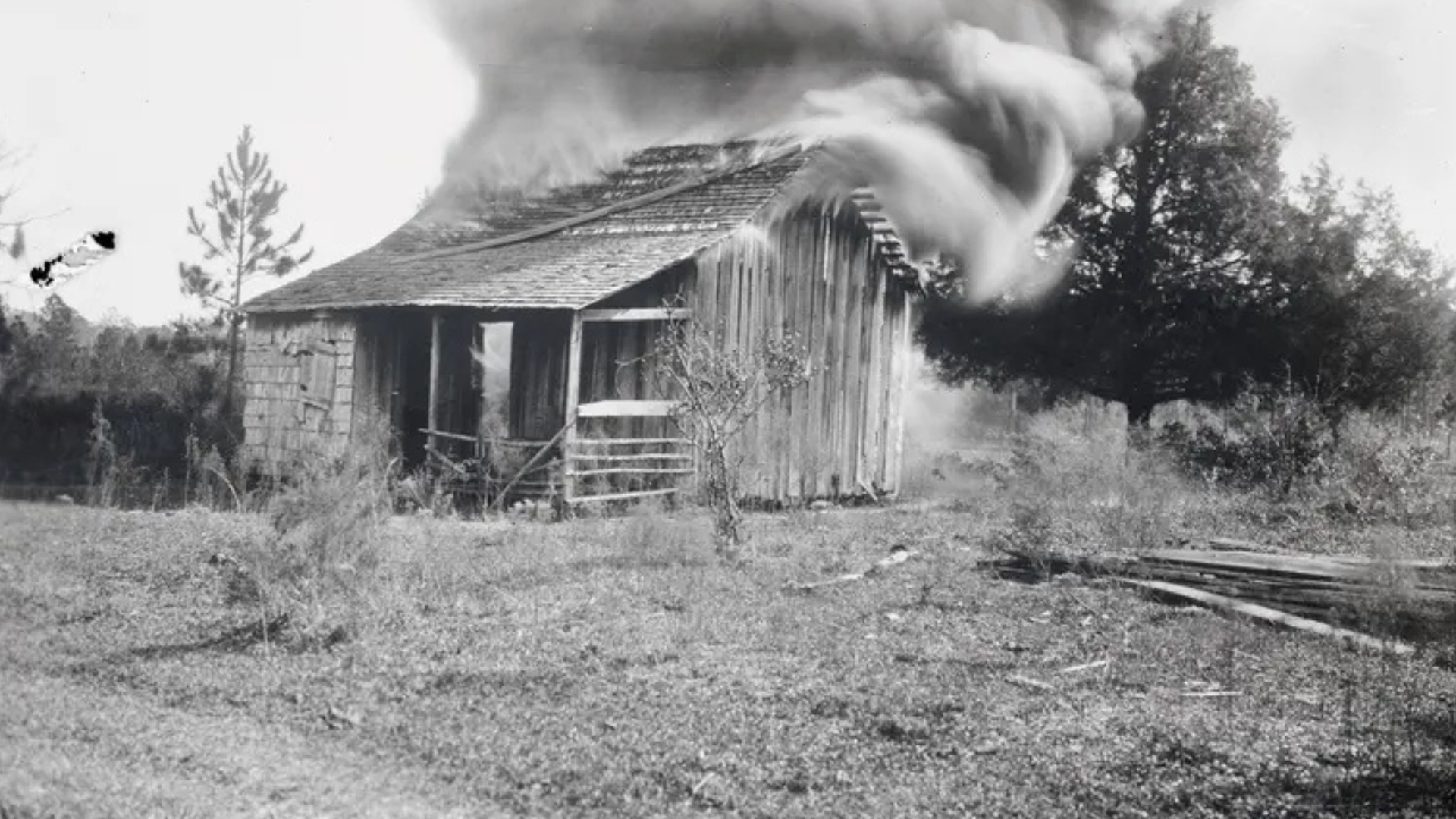
A home burns in Rosewood, Fla., in January 1923, as white mobs attacked the town’s Black community. (Bettmann Archive/Getty Images)
“My endorsement of Byron Donalds is not a betrayal of my values; it is a declaration that Black voters are not political property,” Chestnut wrote on Facebook. “I want to see a Black governor of Florida in my lifetime,” she said.
Chandra, a Florida Republican, raised the same history in a message to EEW Magazine Online after the election. “It is ironic that Black Republicans were once killed for trying to vote in an election,” she wrote. “A Black Republican has been voted into power in a free and fair election, and Black people are arguing over whether he is worthy of recognition.”
She added a personal reflection: “I wonder what those who fought, suffered, and died at Rosewood would think of the Black community’s attitudes were they alive today.”
The divide reached national television on election night. On MS NOW, host Symone Sanders Townsend called Donalds’ victory “a historic win,” then turned to his politics.
“I will say, though, you know, as they say in my community, all kinfolk ain’t skinfolk,” she said, appearing to reverse the familiar saying “All skinfolk ain’t kinfolk.” She continued, “And what I say and what I mean by that is Byron Donalds is making history, but he is going to continue the political direction that Ron DeSantis is going to continue in Florida.”
Donalds will be sworn in Jan. 5. He will be one of five Black governors serving at once, a first in American history, alongside Bottoms, Crowley, Ford and Maryland Gov. Wes Moore.
When Walter White reached Orlando in November 1920, the NAACP had sent him to document what had been done to Black Floridians who tried to vote. Most of them were Republicans.
Nearly 106 years later, Florida has elected a Black Republican as governor.
The organization that sent White has not said why Donalds was left out of its tribute.