

The change targets households that earn slightly above federal limits or hold modest savings. In Western New York, pantries are already seeing more visitors.
By EEW Magazine Online Editors
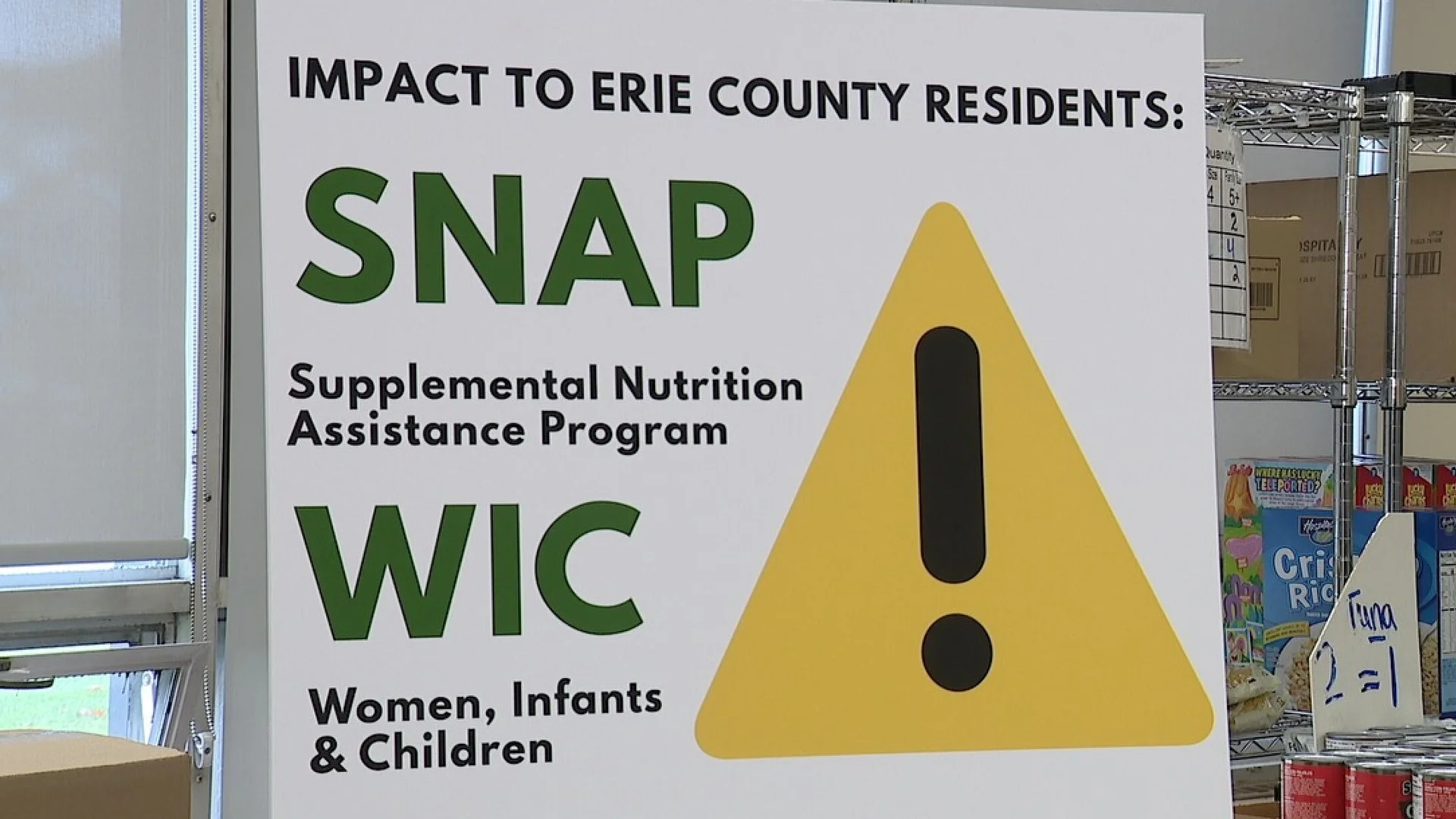
A sign warns Erie County residents about disruptions to SNAP and WIC benefits, displayed among food pantry shelves during an earlier round of federal changes to the programs. (Credit: WKBW 7 News Buffalo)
In Erie County, where about 126,714 people received SNAP benefits in July, food pantries in the FeedMore WNY network recorded 4,600 more visits this summer than a year earlier, The Buffalo News reported. The county is already paying millions of dollars more to run the program after federal changes took effect Oct. 1.
Now the Trump administration has proposed a rule that could cut off working households in Western New York and across the country who earn slightly more than federal limits allow or who have managed to save a little.
The U.S. Department of Agriculture estimates that about 6.3 million people in 3.2 million households would lose SNAP by fiscal year 2029 under the proposed rule, published Tuesday. That is nearly 18% of participants. Federal spending on food benefits would fall by about $44.6 billion over five years.
The proposal has not taken effect. USDA is accepting public comments through Dec. 10 before deciding whether to finalize it.
The U.S. Department of Agriculture’s Jamie L. Whitten Federal Building in Washington. The department published a proposed rule Tuesday that would narrow who qualifies for SNAP. (Credit: USDA)
At issue is broad-based categorical eligibility, a state option that ties SNAP to services funded by the federal Temporary Assistance for Needy Families program, such as child care help or job training. Most households without elderly or disabled members must have gross income at or below 130% of the federal poverty level to qualify for SNAP. The option lets states raise that limit, in many cases as high as 200%, and loosen or drop the test on savings.
New York is one of the states that uses the option to eliminate the SNAP asset test. If the rule is finalized, many New Yorkers would face a federal savings limit again, and a household could lose benefits because of money it has set aside.
Under the proposal, categorical eligibility would remain only for households in which every member receives ongoing TANF assistance, Supplemental Security Income or state general assistance. Everyone else would have to qualify under SNAP's standard income and resource tests.
USDA says limiting categorical eligibility this way aligns with SNAP's requirements under federal law. In its regulatory agenda, the department described the goal as serving "households that have demonstrated a need for assistance." Conservative policy groups, including the America First Policy Institute, have long called the option a loophole that lets people enroll without meeting SNAP's traditional financial requirements.
Advocates for low-income families describe those households differently. The National Women's Law Center says the option serves working families whose income lands just over the cutoff, often while they pay for child care and housing, and that ending it would bring back a "cliff effect." The Center on Budget and Policy Priorities says it also allows older adults and people with disabilities to keep modest savings without losing SNAP.
Shoppers’ staples, from canned goods to dried beans and oats, line the aisles of a grocery store. USDA projects its proposed SNAP rule would reduce federal spending on food benefits by about $44.6 billion over five years. (File photo)
Women raising children make up much of the program's caseload. In 2024, two-thirds of SNAP households with children were headed by a single adult, and 86% of those adults were single mothers, according to the law center. African Americans make up nearly a quarter of SNAP participants, according to a Food Research & Action Center review of USDA data.
Children would feel the change at school. USDA projects that about 1.78 million children would lose automatic eligibility for free school meals. Most would still qualify. About 1.66 million would keep free meals, 93,000 would move to reduced-price meals and 28,000 would pay full price, although families could have to complete a separate school meal application.
About 42,000 children could lose summer grocery benefits beginning in 2029, and about 5,500 people would lose eligibility for the Special Supplemental Nutrition Program for Women, Infants, and Children, known as WIC.
The rule would also add work for state agencies already under strain. USDA estimates states would spend about $928.5 million more over five years on additional eligibility checks.
That comes on top of changes in President Donald Trump's 2025 tax and spending law. States began paying 75% of SNAP administrative costs on Oct. 1, up from 50%. Starting Oct. 1, 2027, states with higher payment error rates will also pay part of the cost of benefits.
Erie County expects its added SNAP costs to reach $13.75 million in 2027. County Executive Mark Poloncarz told The Buffalo News the county could face $55 million to $60 million in additional costs in 2028 if the law is not changed, which could force cuts elsewhere in county government, a tax increase or both.
The first Trump administration proposed similar limits in 2019. The Biden administration withdrew that rule in 2021.
For now, households that receive SNAP do not need to take any action. In Western New York, groups funded through New York's Nutrition Navigators program, including FeedMore, Jericho Road and the Network of Religious Communities, help residents apply for benefits and keep them. FeedMore WNY did not immediately respond to a request for comment.
Members of the public can read the proposal and submit comments through the Federal Register until Dec. 10. Parents who receive a notice about school meals should complete the school's application promptly, since most affected children are expected to remain eligible.