Pastors held the microphone. Baptist conventions, Montgomery kitchens and Sea Island classrooms supplied the organizers, money and voters who gave the pulpit its reach.
By EEW Magazine Online Editors
The Rev. Martin Luther King Jr. delivers his “I Have a Dream” speech at the Lincoln Memorial on Aug. 28, 1963. Dorothy Height, seated behind him in a patterned hat, helped organize the march but was left off its speaking program. (AP Photo)
Dorothy Height spent the summer of 1963 helping build one of the largest demonstrations in American history. As president of the National Council of Negro Women, she organized transportation and helped mobilize the crowds that filled the National Mall on Aug. 28, 1963.
That afternoon she sat on the platform at the Lincoln Memorial, a few feet from the Rev. Martin Luther King Jr. as he delivered his "I Have a Dream" speech. She never took the microphone.
Height and Anna Arnold Hedgeman of the National Council of Churches had pressed the march's male leadership to include a woman speaker. The organizers settled on a brief tribute to Black women freedom fighters. Daisy Bates of Little Rock, Arkansas, stood in for Myrlie Evers and delivered its 142 words, which a male staffer had written for her. "We could not get women's participation taken seriously," Height later said, according to the Smithsonian.
Her experience reflects a pattern that runs through the history of the Black church in American public life. Women did much of the organizing that turned faith into political power, while most of the public credit went to men.
From left, Roy Wilkins, Floyd McKissick, Dorothy Height, A. Philip Randolph, Whitney Young and the Rev. Martin Luther King Jr., members of the Council for United Civil Rights Leadership. Height is the only woman in the group. (National Park Service/National Archives for Black Women’s History)
That history returned to view this fall as Black churches mobilized voters ahead of the Nov. 3 midterm elections. Congregations used postcard campaigns, multistate tours and weekday rallies to reach voters, Religion News Service reported in October. Among the organizers was the Rev. Barbara Williams-Skinner, co-convener of Faiths United to Save Democracy, a nonpartisan group rooted in Black church voter mobilization. Her work follows a path Black church women cleared more than a century ago.
In September 1900, a 21-year-old Nannie Helen Burroughs stood before the National Baptist Convention in Richmond, Virginia, and delivered an address titled "How the Sisters Are Hindered from Helping." She argued that the church was failing to use the gifts of its women.
Nannie Helen Burroughs told the National Baptist Convention in 1900 that the church was failing to use the gifts of its women. She went on to lead the Woman’s Convention for nearly half a century. (Library of Congress, Prints and Photographs Division)
That year the convention's women organized the Woman's Convention and named Burroughs its corresponding secretary, according to the National Park Service. She held the post for nearly 50 years and became the convention's president in 1948.
Through the Woman's Convention, Black Baptist women raised money for missions, ran schools and aided struggling families. They also gained administrative and public leadership experience that racism and sexism denied them elsewhere.
Historian Evelyn Brooks Higginbotham traced that work in her book Righteous Discontent: The Women's Movement in the Black Baptist Church, 1880–1920. Her research shows how women's organizing allowed Baptist churches to build schools, feed and clothe the poor and offer a range of social services.
Burroughs put those principles into practice. In 1909, she opened the National Training School for Women and Girls in Washington, D.C. The convention bought the land, and she built the school with donations from the Black community.
Students work in a vocational class at the National Training School for Women and Girls, which Nannie Helen Burroughs opened in Washington, D.C., in 1909. The photo was taken before 1930. (Library of Congress)
She also championed women's suffrage. After the 19th Amendment was ratified in 1920, she urged Black women to organize, study candidates and vote. As president of the National League of Republican Colored Women, a group she helped found, she asked members to complete a questionnaire on Black women's political participation after the 1924 election. A completed copy survives among her papers at the Library of Congress.
By December 1955, another generation of Black women in Montgomery, Alabama, had the experience to start a citywide protest.
In the late 1940s, educator Mary Fair Burks founded the Women's Political Council to promote voter registration and civic action among Black women. Jo Ann Robinson, an Alabama State College English professor and a member of Dexter Avenue Baptist Church, later became its president. Under her leadership, council members met with city officials about the abusive treatment of Black bus riders.
Mary Fair Burks founded Montgomery’s Women’s Political Council in the late 1940s. She later taught English at the University of Maryland Eastern Shore for more than 25 years. (University of Maryland Eastern Shore)
When Rosa Parks was arrested on Dec. 1, 1955, the council was ready. Late that night, Robinson, two of her students and colleague John Cannon mimeographed about 52,500 leaflets calling for a boycott of the city's buses, according to Stanford University's King Institute.
The one-day protest grew into a 381-day boycott and brought King, the young pastor of Dexter Avenue Baptist Church, to national prominence. Churches hosted the mass meetings. Women helped run the meetings, carpools and communications that sustained the boycott.
Georgia Gilmore supplied another essential resource: money.
A Montgomery cook, Gilmore organized the Club from Nowhere, a network of women who prepared and sold food to support the boycott. Their sales helped pay for the alternative transportation system that let Black residents keep their jobs while staying off segregated buses.
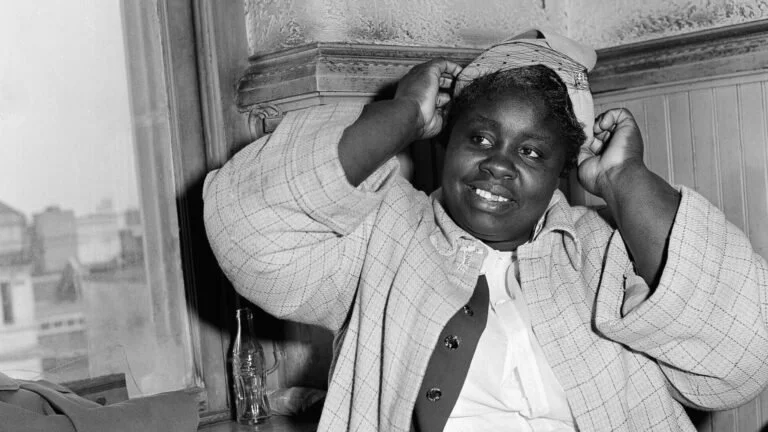
Georgia Gilmore adjusts her hat for photographers during the 1956 trial of the Rev. Martin Luther King Jr. in Montgomery, Alabama. She testified about her mistreatment on city buses and lost her job as a cook for it. (AP Photo)
A 2023 study in the journal Religions examines how Gilmore and other working-class women turned their cooking into a source of financial support for the movement.
The organizing reached into classrooms. Septima Clark, a Charleston educator, helped open the first Citizenship School on Johns Island, South Carolina, in January 1957. She worked with Esau Jenkins, a Johns Island community leader, and her cousin Bernice Robinson, a beautician who became the school's first teacher.
The schools taught Black adults to read, to understand their rights and duties as citizens and to fill out voter registration forms. After Tennessee forced the program's sponsor, the Highlander Folk School, to close in 1961, the Southern Christian Leadership Conference built its Citizenship Education Program on Clark's model.
Clark became SCLC's director of education and teaching. In 1965, King praised her direction of the program, which he called "the bulwark of SCLC's program department," according to the King Institute.
Ella Baker, then SCLC's executive director, saw the same potential in young people. When student sit-ins spread across the South in early 1960, she organized an April conference at Shaw University in Raleigh, North Carolina, her alma mater.
Baker urged the students to form their own organization and keep their independence from established civil rights groups. The Student Nonviolent Coordinating Committee grew out of that gathering, according to the SNCC Digital Gateway.
Fannie Lou Hamer took the work into electoral politics. After the Mississippi sharecropper registered to vote in 1962, she lost her job and her home. She kept organizing, and she led spiritual songs to strengthen fellow activists.
In 1964, Hamer helped found the Mississippi Freedom Democratic Party to challenge the all-white delegation Mississippi sent to the Democratic National Convention. That August, her televised testimony before the convention's credentials committee drew national attention to what Black Mississippians faced when they tried to vote. A Library of Congress exhibit documents her role.
The women held no single party loyalty. Burroughs organized Republican women in the 1920s. Four decades later, Hamer challenged the segregationist Democratic establishment in Mississippi. Others worked through churches, schools, civic clubs and independent civil rights organizations. Each helped build institutions that gave Black Americans more say over their own lives.
Black churches were never uniform in their politics. Some opened their doors to civil rights organizing, and others kept their distance. Women also met resistance from male leaders who relied on their organizing while limiting their authority.
Height saw that tension up close in 1963. Within days of the march, the National Council of Negro Women convened a meeting called "After the March, What?" The gathering turned attention to the daily concerns of Black women and children and planted the seeds of the council's Wednesdays in Mississippi program, which sent teams of Northern women into the state in 1964.
Dorothy Height in her office at the National Council of Negro Women headquarters in Washington on Dec. 3, 1997. She led the council for four decades. (The Washington Post via Getty Images)
The historical record places women at every level of the Black freedom struggle. They opened schools, financed a boycott, taught adults to read and register, and helped build a political party.
When Americans talk about the Black church's political influence, the conversation usually turns to pastors, candidates and elected officials. The longer story runs through women's conventions, classrooms, kitchens and church auxiliaries, where much of the organizing began.
In 1900, Nannie Helen Burroughs told the National Baptist Convention what its sisters could do. More than a century later, the record shows they did it.