

After a targeted attack attempt at the White House Correspondents’ Dinner, new scrutiny falls on how political language may be shaping real-world threats in the U.S.
Written By Beverly Harris // EEW Magazine Online
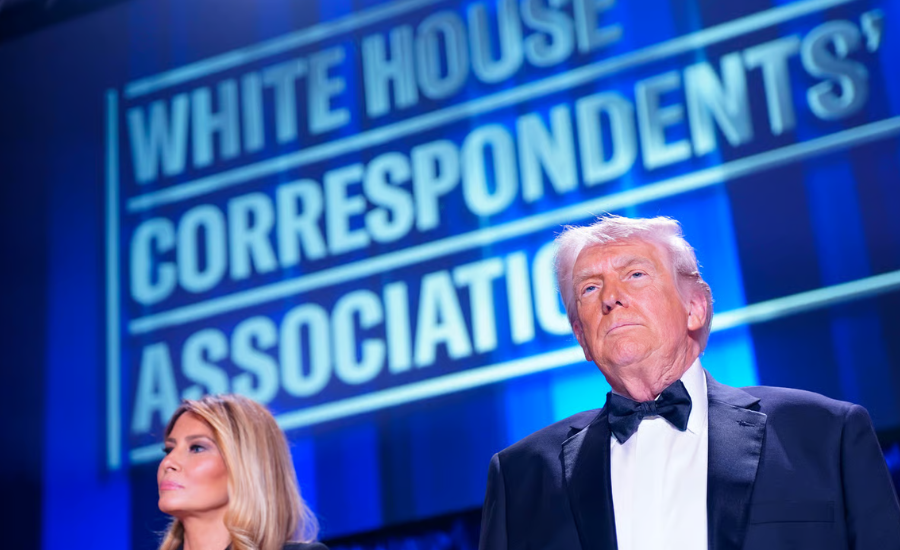
First Lady Melania Trump and President Trump at the annual White House Correspondents Association Dinner April 25, 2026 in Washington, D.C. (Credit: Nathan Howard | Getty Images)
WASHINGTON — The man accused of attempting to storm the ballroom at the White House Correspondents’ Association dinner arrived in the nation’s capital after a cross-country trip that investigators say was deliberate and targeted. According to federal officials, the suspect traveled by train from California to Chicago and then to Washington, where he checked into the hotel hosting one of the most visible annual gatherings of political power and press.
Acting Attorney General Todd Blanche said investigators believe the suspect intended to target members of the Trump administration, “likely including the president.” The man, identified by law enforcement officials as 31-year-old Cole Tomas Allen of Torrance, California, attempted to rush into the ballroom at the Washington Hilton shortly after the event began.
He was subdued in a chaotic confrontation that included gunfire, a wounded officer, and the evacuation of President Donald Trump from the stage.
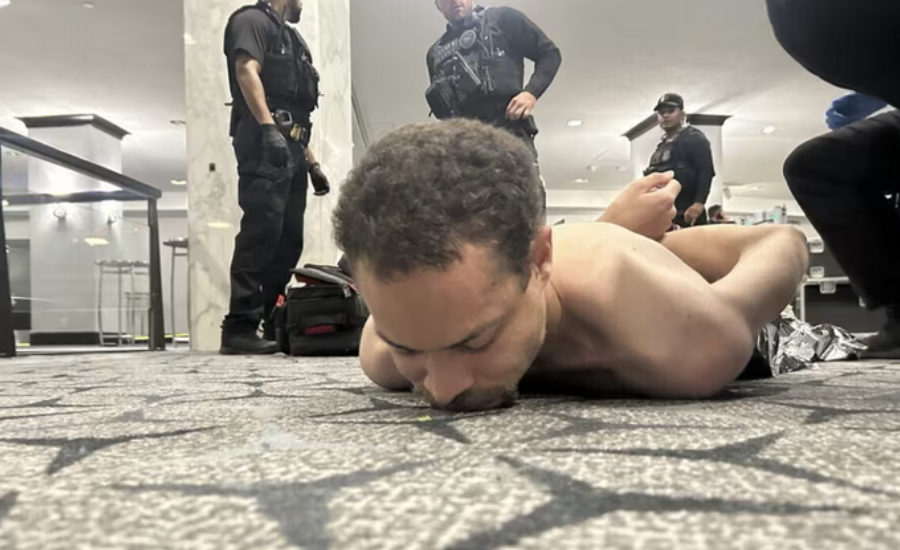
Photo shared on President Donald Trump’s Truth Social account shows the suspect, Cole Allen, being apprehended during the White House Correspondents’ Association dinner in Washington on Saturday. (Credit: Truth Social)
The officer, protected by a bullet-resistant vest, is recovering. The suspect was taken into custody and is expected to face multiple charges. Authorities say he has not been cooperative.
The White House Correspondents’ Dinner is not a campaign rally or a partisan event. It is one of the few remaining fixtures in Washington where political leadership, media institutions, and public figures occupy the same room under a shared set of expectations about order and access. The attempted breach of that space, according to investigators’ preliminary findings, was not incidental. It was directed.
Law enforcement officials who reviewed the suspect’s electronic devices and writings told Associated Press they believe he intended to target administration officials attending the dinner.
The suspect’s background, including advanced degrees in engineering and computer science and a record of professional activity as a tutor and software developer, has been publicly documented, though authorities have not indicated how those details factor into motive.
The sequence of events unfolded within minutes. As the program began, the suspect moved past security barricades. Secret Service agents responded. Shots were fired. Guests dropped beneath tables. The president was removed from the stage. Outside, National Guard personnel and additional law enforcement units secured the perimeter as helicopters circled overhead. Organizers initially attempted to resume the evening before canceling the event.
The episode joins a growing list of incidents in which individuals have attempted to carry out acts of violence tied to political figures or institutions. What distinguishes this case, based on the facts currently available, is the combination of planning, proximity, and target selection. The suspect did not act at a distance or through symbolic threat. He traveled, positioned himself inside the venue, and attempted to advance toward a room that included senior officials of a sitting administration.
That sequence narrows the gap between rhetoric and action in a way that is difficult to dismiss as abstract. Federal officials have not attributed the suspect’s motives to any single cause, and investigations into political violence routinely reveal overlapping factors, including personal grievance and ideological fixation. But in this case, the targeting itself is not in dispute. It was specific, and it was physical.
Public language surrounding political opponents in the United States has, in recent years, moved toward sharper and more absolute terms. Officials and candidates across parties have described rivals not only as wrong, but as dangerous, illegitimate, or existential threats to the country. That language is legal. It is also consequential. It defines the stakes of political conflict in terms that can be interpreted beyond the bounds of debate.
The law draws a clear line at incitement. Most political speech does not cross it. But the absence of legal liability is not the same as the absence of effect. The environment in which individuals act is shaped, in part, by how conflict is described by those with public platforms. When political opposition is framed in existential terms, the range of responses available to unstable actors can expand.
Blanche’s assessment of the suspect’s intent places the incident squarely within that context. A targeted attempt against administration officials at a high-profile public event is not an ambiguous signal. It is an instance in which political grievance appears to have translated into planned action against identifiable individuals in a defined space.
By early Sunday, the Federal Bureau of Investigation, alongside local law enforcement, had secured Allen’s residence in Torrance, California.
According to the White House, Allen’s brother alerted police in New London, Connecticut, before the shooting, telling authorities that Allen had sent family members what was described as a manifesto outlining plans to target administration officials.
Officials said a review of Allen’s online activity also revealed posts expressing anti-Trump and anti-Christian views.
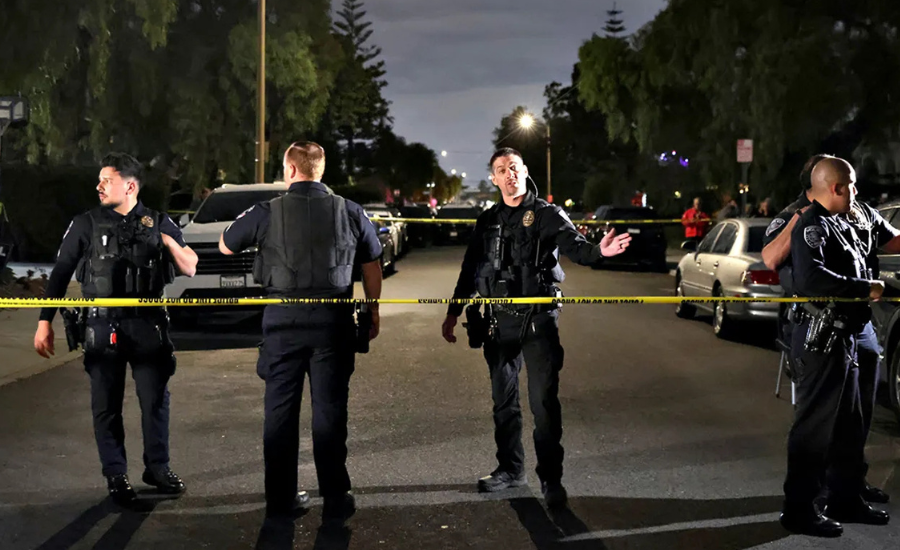
Law enforcement officials block off a street at an address connected to Cole Tomas Allen, the shooting suspect at the White House Correspondents Dinner, in Torrance, Calif., on April 25, 2026. (AP Photo/Ethan Swope)
The investigation will determine how the suspect acquired his weapons, what he wrote, what he believed, and whether others were involved. Those are matters of record and law. The broader conditions in which the incident occurred are less easily adjudicated, but they are not obscure.
The United States is operating in a political climate where threat language has become routine and where the distance between expression and action, in isolated cases, is shortening.
The attack failed. Law enforcement intervened. The officer survived. The president was secured. The event was canceled and will be rescheduled. Those are the outcomes. The circumstances that produced the attempt remain in place.
More on EEW Magazine Online:





Jesus speaks directly to chronic worry in Matthew 6, pointing anxious hearts to the birds, the lilies and a Father who already knows every need.