
Supreme Court Hands Trump Two Major Immigration Wins in Back-to-Back Rulings
High court clears path to terminate deportation protections for hundreds of thousands and allows border metering policy to resume
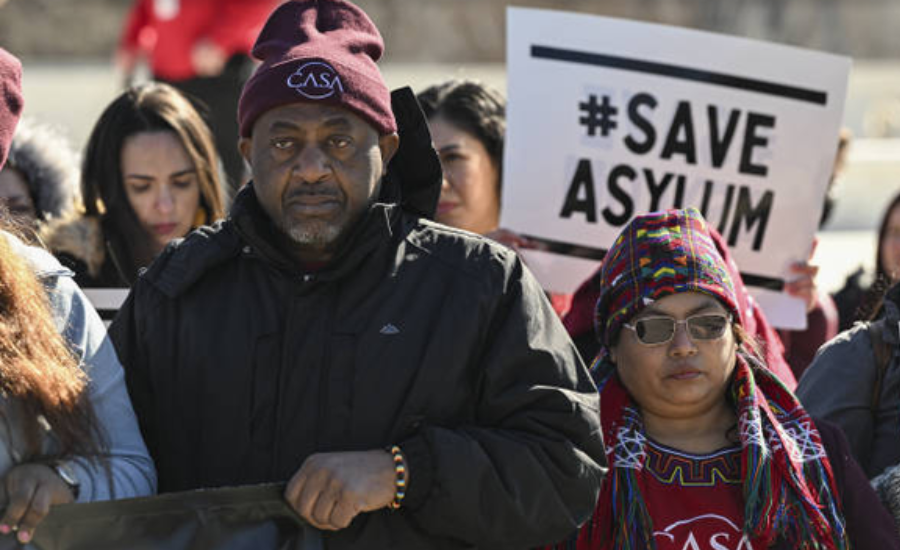
Immigration advocates gathered outside the U.S. Supreme Court in February 2024 to call for asylum protections. (Celal Gunes/Anadolu via Getty Images)
The U.S. Supreme Court handed the Trump administration two sweeping immigration victories Thursday. In back-to-back 6-3 rulings, the justices cleared the way to end humanitarian protections for hundreds of thousands of migrants and allowed border officials to turn away asylum seekers before they set foot on American soil.
The decisions, both written by Justice Samuel Alito and joined by all five other conservative justices, came as the court approaches its summer recess with several major cases still pending.
In the first case, the court cleared the way for the Trump administration to terminate Temporary Protected Status (TPS) for an estimated 350,000 Haitian nationals and approximately 6,000 Syrians currently living and working legally in the United States.
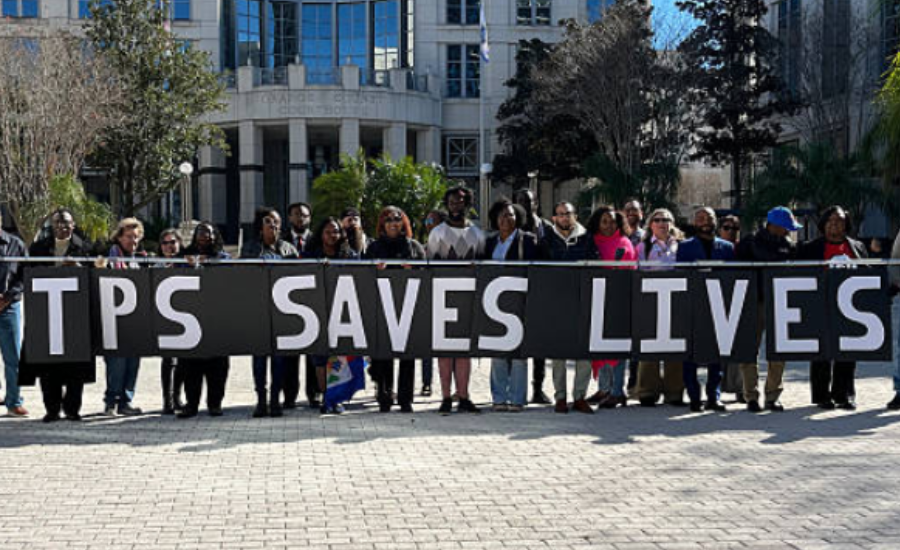
Advocates gathered outside the Orange County Courthouse in Orlando, Florida on Jan. 29, 2026, calling on President Trump to create a pathway to permanent residency for Haitian TPS holders. (Natalia Jaramillo/Orlando Sentinel/Tribune News Service via Getty Images)
The ruling lifts lower court orders that had blocked the terminations while legal challenges worked their way through the courts.
TPS is a humanitarian program Congress created in 1990 to shield migrants from deportation when conditions in their home countries are deemed too dangerous for return. The United States first extended TPS to Haitians after a devastating 7.0-magnitude earthquake struck the country in 2010. Syria received the designation in 2012 as its government's military repression plunged the country into civil war.
Then-DHS Secretary Kristi Noem moved to terminate TPS for both countries last year, arguing conditions had improved sufficiently for nationals to return. Federal courts blocked those terminations, citing concerns that the review process was rushed and potentially influenced by discriminatory factors. The government asked the Supreme Court to intervene.
Alito, writing for the majority, ruled that the TPS statute explicitly bars most judicial review of the Secretary's termination decisions. "The secretary's TPS designation decisions are not subject to judicial review," Alito wrote, holding that the law's judicial review bar "very clearly overcomes the general presumption in favor of judicial review."
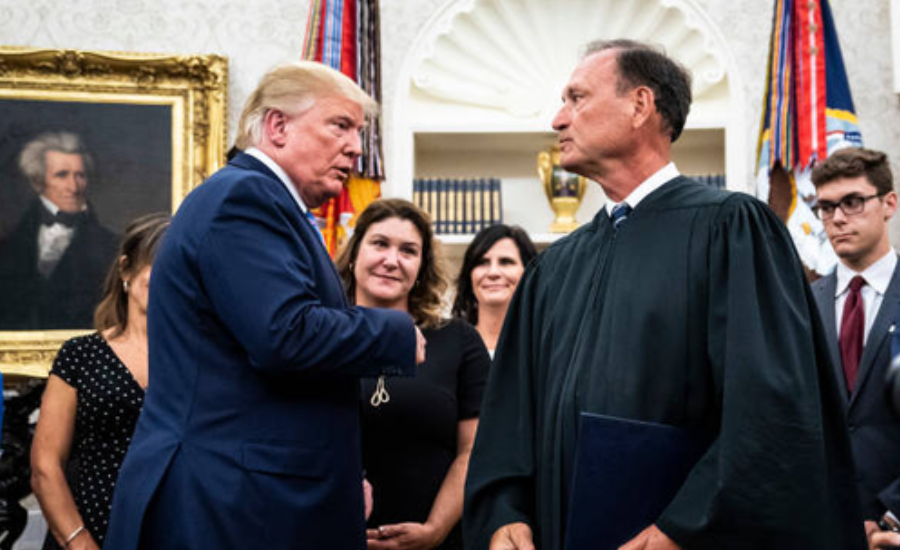
President Donald Trump greets Supreme Court Justice Samuel Alito at the White House in July 2019. Alito wrote both majority opinions in Thursday's 6-3 rulings. (Jabin Botsford/The Washington Post via Getty Images)
The ruling does not itself deport anyone. It does not find that Haiti or Syria are safe to return to. What it does is remove the court-ordered shield that had paused the terminations, starting a legal clock that will eventually strip affected individuals of their work authorization and legal status unless they qualify for another form of protection.
Once an individual's specific status officially expires, they will lose legal work authorizations and driver's licenses, with employment, mortgages, and daily lives thrown into immediate legal limbo.
DHS is currently led by Secretary Markwayne Mullin, confirmed in March 2026, whose name now appears on both cases.
The Asylum Ruling: Mullin v. Al Otro Lado
In the second case, the court ruled that migrants who present themselves at the U.S.-Mexico border but are turned away before crossing are not entitled to apply for asylum under the Immigration and Nationality Act.
At issue was a CBP practice known as "metering," which dates to at least 2016. Under the policy, border officials told migrants to wait in Mexico when processing capacity was exceeded, rather than allowing them to present claims on U.S. soil. The practice was rescinded in 2021 under the Biden administration. The Trump administration asked the court to reinstate its legality.
Alito found that the federal law allowing asylum seekers to present claims when they "arrive in" the United States does not apply to migrants who are still inside Mexico. "A person arrives in a destination only when he enters it, and that conclusion does not change because someone or something blocks entry," he wrote.
The ruling reverses a Ninth Circuit decision that had held a noncitizen stopped at the border was still eligible to apply for asylum. The immigrant rights group Al Otro Lado and 13 asylum seekers had argued that U.S. law requires the government to review protection claims from people who seek entry at the border.
All three liberal justices, Sonia Sotomayor, Elena Kagan, and Ketanji Brown Jackson, dissented in both cases.
Kagan wrote that the evidence offered by Haitian plaintiffs includes statements by the president "so repellent and racially inflected that the majority declines to put them in print." Among the evidence, the plaintiffs cited Trump's 2024 disputed campaign remarks claiming Haitian migrants in Springfield, Ohio, were abducting and eating residents' pets, arguing the comments reflected racial animus that motivated the administration's decision to end the protections.
Alito rejected that argument, writing that none of the statements cited were overtly racial and that the policy views expressed could rest on race-neutral justifications.
The White House called both decisions a "tremendous win." Spokeswoman Abigail Jackson said the TPS ruling "affirmed what President Trump has always maintained: temporary protected status is, by definition, temporary" and was never intended to function as a pathway to permanent status.
Critics responded sharply. Lupe Aguirre, Deputy Director of U.S. Litigation at the International Refugee Assistance Project, called the ruling "catastrophic for Syrian and Haitian TPS holders, the country, and the rule of law," and called on Congress to act before the decision takes effect in 32 days.
The House passed a bipartisan measure in April aimed at preserving TPS for Haitians, though the legislation has stalled in the Senate.
The court has not yet issued decisions in eight remaining cases this term, including the Trump administration's effort to end automatic birthright citizenship, whether states may ban transgender athletes from competing on girls' sports teams, and the president's bid to fire a Federal Reserve governor.
The court announced it will issue additional opinions Monday.
More on EEW Magazine Online:





Waiting on God can be painful, but Scripture reveals purpose in the delay.