
Byron Donalds Just Complicated a Longstanding Narrative About Race and Republicans
A decisive primary win makes Donalds one of three Black Republicans nominated for governor this year, testing a claim about the GOP that rarely gets weighed against the record.
By EEW Magazine Political Editors
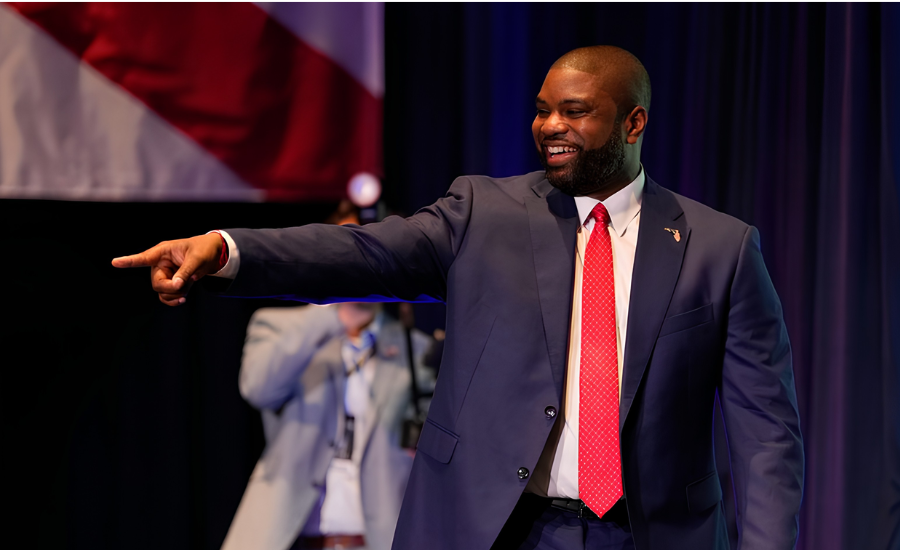
Florida Republican gubernatorial candidate Byron Donalds points at supporters Tuesday during a primary election party in Orlando, Fla. (John Raoux/Associated Press)
If you ask many Democrats, they will tell you without flinching that Republicans are too racist to throw their support behind a Black candidate.
On Tuesday, Republican voters in Florida handed their party's gubernatorial nomination to a Black man by a decisive margin.
U.S. Rep. Byron Donalds won about 48 percent of the Republican primary vote, finishing more than 20 percentage points ahead of Lt. Gov. Jay Collins, his nearest competitor. Donalds will face Democrat David Jolly in November.
If elected, he would become Florida's first Black governor.
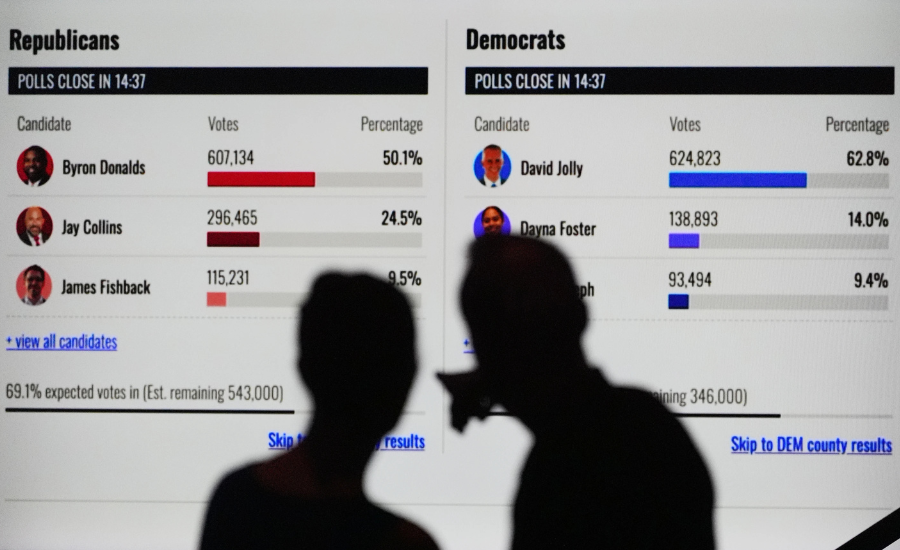
Attendees watch results at a primary election night watch party for Florida Democratic gubernatorial candidate David Jolly on Tuesday, Aug. 18, 2026, in Miami Lakes, Fla. (AP Photo/Rebecca Blackwell)
Donalds' victory just made a very common narrative about race and the Republican Party harder to tell.
And Donalds is not alone.
For the first time in American history, eight Black major-party gubernatorial nominees will appear on ballots in the same election year. Three are Republicans: Donalds in Florida, U.S. Rep. John James in Michigan and Minnesota House Speaker Lisa Demuth.
The Democratic nominees include Maryland Gov. Wes Moore, former Atlanta Mayor Keisha Lance Bottoms in Georgia, Nevada Attorney General Aaron Ford, Wisconsin's David Crowley and South Carolina state Rep. Jermaine Johnson.
The number is striking because governorships have remained particularly difficult territory for Black candidates.
Only three Black Americans have ever been elected governor: Douglas Wilder of Virginia, Deval Patrick of Massachusetts and Moore of Maryland. All three are Democrats. Other Black governors, including Republican P.B.S. Pinchback in Reconstruction-era Louisiana and Democrat David Paterson in New York, reached the office through succession rather than election.
If Donalds wins in November, he would become the fourth Black American elected governor and the first Black Republican elected to a governorship.
Despite the possible historic milestone, Donalds rarely presents his candidacy in those terms.
After winning Tuesday, he mentioned neither race nor Trump, who endorsed him, in his victory speech. Asked afterward about the prospect of becoming Florida's first Black governor, Donalds described Florida as a "great meritocracy" and told reporters, "I'll let you guys write about that."
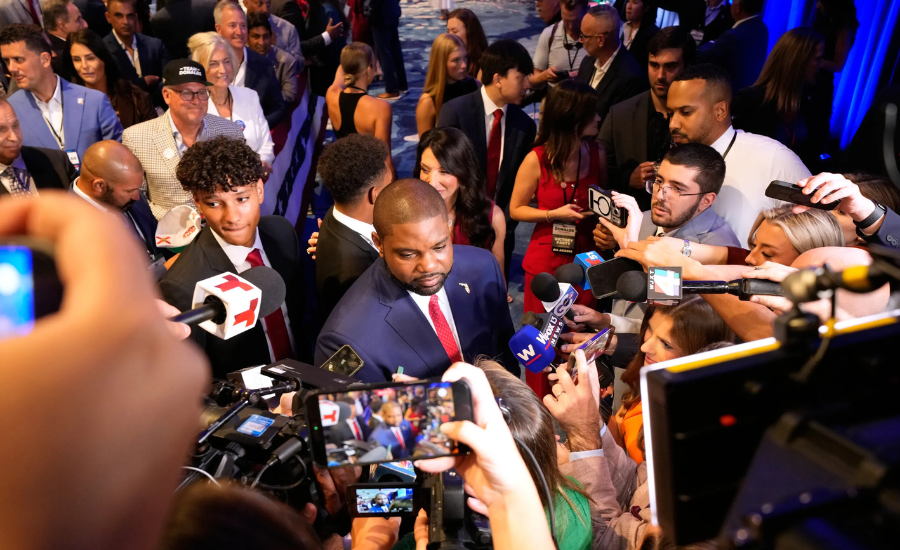
Florida Republican gubernatorial candidate Byron Donalds answers questions during a primary election party Tuesday, Aug. 18, 2026, in Orlando, Fla. (AP Photo/John Raoux)
Throughout much of his political career, Donalds has resisted the premise that his racial identity should determine his political affiliation, ideology or policy positions.
If you trace his political journey, that will not surprise you.
Donalds first entered politics through the Tea Party movement in 2010. He was a young father and financial-services worker in Naples, Florida, as a new crop of conservative voices expressed anger over the financial crisis and federal bailouts. At rallies in overwhelmingly white and affluent communities, Donalds stood out as a Black conservative voice in a movement often accused of racial insensitivity. The exposure helped establish him as a recognizable figure within Florida's emerging conservative grassroots.
Donalds was raised by a single mother in Brooklyn and has shared that he arrived in Florida at 17 on a Greyhound bus with a trunk full of clothes. He eventually entered state politics, served in the Florida House and won election to Congress in 2020.
By 2023, he had gained enough influence among House conservatives to receive votes for Speaker of the House during Republican leadership battles. President Donald Trump later considered him among his potential 2024 running mates and endorsed Donalds for governor before he formally entered the race.
He entered the gubernatorial contest as a nationally recognized MAGA figure, Trump ally and sitting member of Congress.
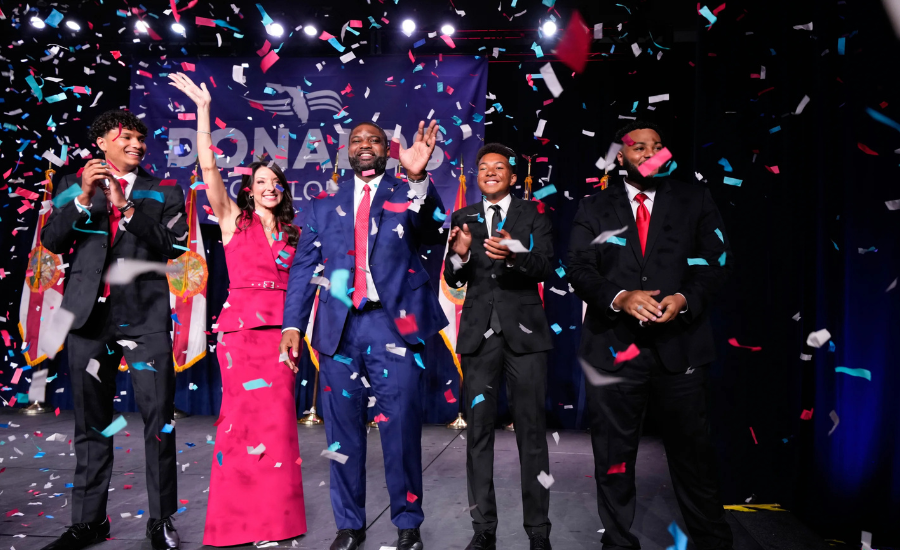
Florida Republican gubernatorial candidate Byron Donalds, center, waves next to his wife Erika, while standing on stage with their children Darin, left, Damon, second from left, and Mason during a primary election party Tuesday, Aug. 18, 2026, in Orlando, Fla. (AP Photo/John Raoux)
Ironically, some Black political voices that have warned Black conservatives against trying to fit in with Republicans, who they say will ultimately reject them, have themselves rejected Donalds.
In 2021, after his election to Congress, Donalds sought membership in the Congressional Black Caucus but was not admitted. The caucus, founded to advance the interests of Black Americans through Congress, had previously included Black Republicans.
The disagreement between Donalds and prominent Black Democrats has intensified since then.
In 2024, the Congressional Black Caucus accused him of embracing "racist ideologies" after comments he made about Black families during the Jim Crow era. The caucus said Donalds had misrepresented one of the darkest periods in American history and demanded that he apologize.
Donalds rejected that characterization.
Speaking at a Trump campaign event in Philadelphia, Donalds said Black marriage rates were higher during the Jim Crow period than at any point since, and argued that federal anti-poverty programs under Lyndon Johnson contributed to the decline. House Minority Leader Hakeem Jeffries called it a "factually inaccurate statement that Black folks were better off during Jim Crow." Donalds said on MSNBC that he was not being "nostalgic" about the era and was making a narrower point about marriage rates and political identity.
A PolitiFact review of the episode found that some Democratic characterizations of his remarks were overbroad, but that Donalds' own claims held up poorly on their own terms.
Researchers who study the marriage data said the decline in Black marriage rates reflected factors well beyond federal policy. They included job losses in manufacturing, higher incarceration rates among Black men, and shifting social patterns that affected white marriage rates too, just less steeply.
Donalds' ideological disagreements do not end with Democrats.
In 2023, Donalds publicly criticized part of Florida's new African American history standards, which instructed students that enslaved people developed skills that, in some instances, could later be used for their "personal benefit." Donalds described the overall standards as strong but said that particular language was wrong and should be changed. His criticism put him at odds with Republican Gov. Ron DeSantis' administration and drew attacks from DeSantis allies.
Donalds is therefore an uncomfortable political figure for more than one conventional narrative.
For some critics of the Republican Party, racial representation is insufficient evidence of racial inclusion. A Black candidate can advance within the GOP, they argue, while supporting policies they believe work against Black political or economic interests.
Black voters remain overwhelmingly Democratic.
Pew Research Center's analysis of validated voters found that Trump received 15 percent of the Black vote in 2024, an increase from 8 percent in 2020. The shift, while notable, left Democrats with a commanding majority of Black voters.
Brookings reached a similar conclusion after the 2024 election. Although Trump made gains among minority voters, Black Americans remained overwhelmingly aligned with Democrats, even as the margins moved somewhat toward Republicans.
The Republican Party remains far less successful than Democrats at winning Black voters nationally. At the same time, Republican electorates in Florida, Michigan and Minnesota have now nominated Black candidates for governor in the same election cycle.
For decades, Black Americans have been the Democratic Party's most loyal racial voting bloc. That loyalty has historical foundations, particularly in the parties' realignment around civil rights during the 20th century. But racial identity does not produce political uniformity. Black Americans, like every large population, differ over religion, abortion, taxation, education, immigration, policing, sexuality, government spending and the proper role of the state.
Black political representation cannot accurately be treated as synonymous with Democratic representation.
Black candidates like Donalds continue to encounter political expectations and burdens that their white counterparts often do not. Maryland Gov. Wes Moore told The Associated Press that the scarcity of Black governors remains evidence of how far the country has yet to go. Even Democrats have criticized their party’s record of elevating Black leaders to executive office, while Stacey Abrams has argued that Black women in particular are too often valued for their political support without being viewed as capable of leading.
At the same time, making race too determinative in how Black politicians are understood creates problems of its own.
It leaves little room for Black Americans whose ideological conclusions fall outside the dominant partisan pattern. It can turn a policy disagreement into a dispute over racial authenticity, where a Black person's politics get treated as proof of whether he represents his race at all.
Donalds has spent much of his career pushing against that assumption.
Whether voters ultimately agree with his policies is a separate question from whether his political existence fits comfortably within conventional understandings of Black politics.
It does not.
A Black conservative, running openly as a Black conservative without making racial representation the organizing principle of his campaign, just won the Republican nomination for governor of the nation's third-most-populous state.
While that does not prove the Republican Party has solved all of its problems with race, it does challenge the categorical idea that Republican voters simply will not elevate Black candidates.
More on EEW Magazine Online:



The EEW Weekly Digest
Get EEW in Your Inbox
Our weekly digest brings the latest reporting on faith, culture, health, and the news that matters to Black Christian women straight to your inbox.
Subscribe FreeFree to join. Unsubscribe anytime.
Reader-Supported Journalism
Help Keep EEW Free and Growing
EEW Magazine Online is free for every reader, and we plan to keep it that way. Your support helps us expand our reporting on faith, culture, health, and the news that matters to Black Christian women. Become a monthly supporter today.
Support EEWGive once or monthly through PayPal. Gifts are tax-deductible to the extent allowed by law.
Six powerful Bible stories for women facing impossible odds. From the walls of Jericho to the empty tomb, Scripture proves that God specializes in situations that look finished.