
Aisha Patterson waited months to have a lump checked. Five years cancer-free, her story carries a warning for young Black women, who die of breast cancer at twice the rate of White women their age.
By EEW Magazine Online Health & Wellness Editors

Aisha Patterson, who was diagnosed with breast cancer at 30 while breastfeeding her youngest child, is now five years cancer-free. (Aisha Patterson/Glamour)
Aisha Patterson was breastfeeding her 4-month-old son in the summer of 2020 when she felt a lump in her breast. The Tulsa, Oklahoma, mother of four had nursed all of her children and assumed it was a clogged milk duct that would clear up on its own. It didn’t. Two more lumps appeared, and after waiting four to six months, Patterson saw a doctor.
At 30, she was diagnosed with stage 2 triple-positive breast cancer. “I didn’t realize that it happened to young people,” she later told a Tulsa reporter.
Now five years cancer-free, Patterson has revisited those months in an essay for Glamour and in a first-person account published this week by CURE, a cancer news outlet. Her story carries particular weight for young Black women. Black women younger than 50 die of breast cancer at twice the rate of White women their age, according to a 2022 American Cancer Society report.
Overall, Black women are diagnosed with breast cancer at a slightly lower rate than White women but die from it at a 38% higher rate, according to American Cancer Society data. The society attributes part of the gap to Black women’s higher risk of triple-negative breast cancer, an aggressive form of the disease.
Age adds another blind spot. Women younger than 40 account for only about 4% of U.S. breast cancer diagnoses, according to Susan G. Komen, and routine mammograms for women at average risk begin at 40 under federal guidelines. For younger women, catching cancer early often depends on noticing a change and getting it checked.
For nursing mothers, that change is easy to explain away. Clogged ducts and other breastfeeding problems are common, and most breast changes during lactation are not cancer. A lump that persists still needs evaluation, and ultrasound is typically the first imaging test used. Under American College of Radiology guidelines, breast imaging and biopsies are safe during breastfeeding, so mothers do not have to wean to get answers.
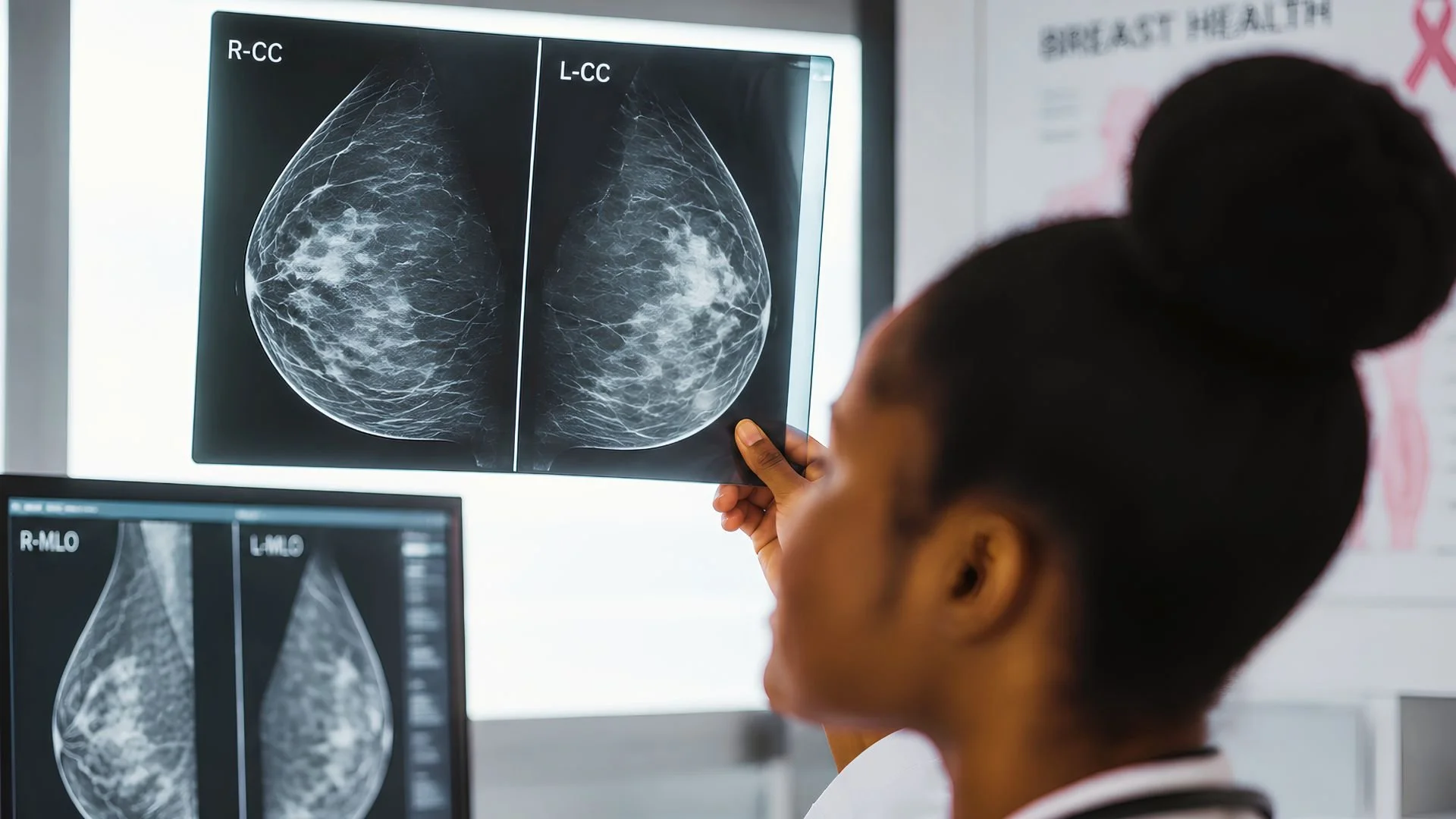
A clinician reviews mammogram images. Routine screening for women at average risk begins at 40, and breast imaging is safe during breastfeeding. (EEW Magazine Online file photo)
Money shaped Patterson’s delay. She was uninsured and worried about paying hundreds of dollars for tests she expected to come back clean. Within two months of her diagnosis, she had about $20,000 in medical debt, she told KOSU. In January 2021, she enrolled in SoonerCare, Oklahoma’s Medicaid program, which covered her chemotherapy, a double mastectomy with reconstruction, radiation and immunotherapy. “I wish I would have known that early detection can save your life,” Patterson told the station.
Her cancer was triple-positive, meaning its cells carried receptors for estrogen and progesterone and tested positive for HER2, a protein that can drive cancer growth. These cancers can be aggressive, but treatments exist that target each of those features.
The hardest stretch came after treatment ended. Patterson has written that she experienced anxiety, depression and post-traumatic stress disorder, including anxiety attacks when she returned to the cancer center. Early in her illness, she wrote a document she called “Aisha’s Code of Cancer,” listing more than 20 needs and boundaries for friends and family, and her mother served as her caregiver.
Support through diagnosis, treatment and recovery is the focus of Soon the Cure, the annual breast cancer awareness campaign of Empowering Everyday Women Ministries, Inc., the Buffalo, New York-based Christian nonprofit that publishes EEW Magazine Online. Now in its 15th year, the campaign advocates for early detection and better access to care for women in communities of color, who bear a disproportionate share of the disease’s toll. It delivers care packages and free faith-building resources and offers prayer and support to women facing screening, treatment and aftercare.
The campaign traces its roots to 2011, when ministry founder Dianna Hobbs’ mother, Annie Brinson, found a lump in her breast. Brinson, then 60, was diagnosed with stage 1 triple-negative breast cancer. She completed treatment and remains in remission. The campaign launched the following year and takes its name from “Soon,” a song Hobbs wrote in 2008.
The work reflects the instruction of Galatians 6:2: “Bear ye one another’s burdens, and so fulfil the law of Christ.”
This October, Soon the Cure set a goal of delivering 100 care packages to women entering treatment by Nov. 1. As of Oct. 22, 67 had been delivered. Readers can help close the gap through the Soon the Cure campaign. Gifts to Empowering Everyday Women Ministries, Inc., a 501(c)(3) nonprofit, are tax-deductible as allowed by law.
Patterson now uses her platform to push for earlier attention to breast health in young women, including making sure they are “represented in the guidelines,” as she has put it. Her own experience points to a simple step. A lump that does not go away deserves a doctor’s visit, whatever a woman’s age and whether or not she is nursing.