
The 35,000 people still eligible at Dzaleka will receive $8 a month each, which the World Food Programme says covers about half their food needs.
By EEW Magazine Online Editors
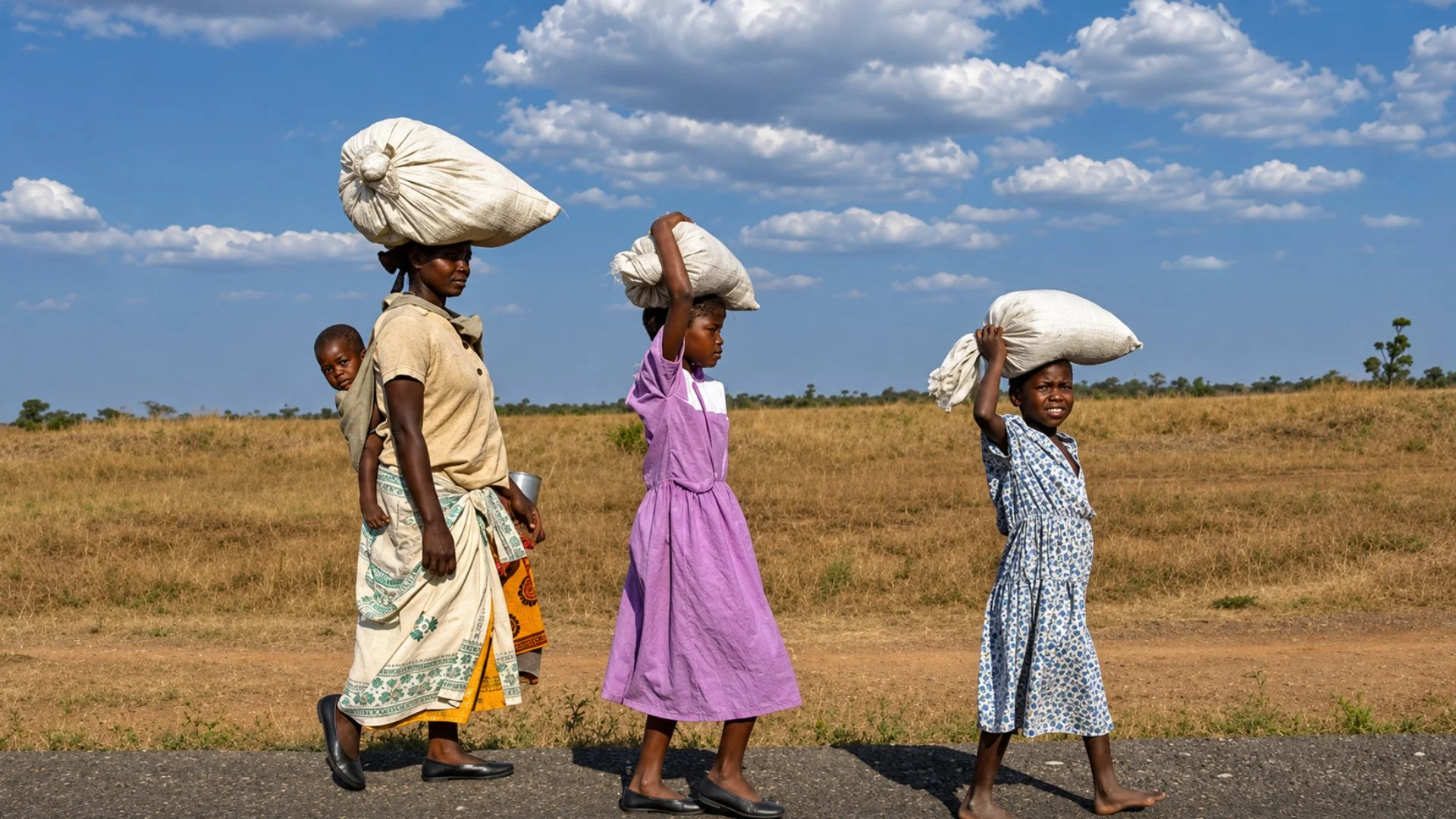
A woman and girls carrying maize home in Malawi, during a food shortage. (Getty Images/ EEW Magazine Online)
Hamida Hussein has six children to feed at Dzaleka Refugee Camp in central Malawi, and on some days there is not enough to go around. The 38-year-old mother told Malawi's Daily Times in September that her children need food, clothing and much more than she can provide in a camp where thousands of families depend on humanitarian aid. "Sometimes the food is not enough for all of us," she said.
She spoke two months before the aid shrank again. On Nov. 13, the U.N. World Food Programme announced that it can no longer provide food assistance to everyone at Dzaleka, which shelters more than 65,000 refugees and asylum seekers. Beginning this month, WFP will assist the 35,000 people judged most vulnerable in a needs assessment. Roughly 30,000 others will lose WFP food support.
Those who remain eligible will receive cash assistance worth $8 per person each month. The agency says that covers about half of their food needs.
The cuts follow years of shrinking aid at the camp. Since 2022, WFP had covered as much as 75 percent of refugees' food needs. With donor funding falling and the camp's population climbing, the agency says it can no longer sustain even that reduced level.
Hyoung-Joon Lim, WFP's representative and country director in Malawi, said the agency spent years cutting rations so it could reach as many people as possible. Now, he said, it is being forced to cut some people off food assistance altogether. "No one should have to decide which hungry family eats and which goes without," Lim said.
Dzaleka opened in 1994 to shelter about 12,000 people fleeing conflict in the region. The U.N. refugee agency says the camp now holds more than five times that number. Most residents come from the Democratic Republic of Congo, Burundi and Rwanda, and women and children make up the majority.
Families contend with overcrowding, poor sanitation and limited health care. Malawi's encampment policy requires refugees to remain in the camp unless they are authorized to leave, and restrictions on work leave them few ways to earn a living.
Brick homes crowd the hills of Dzaleka Refugee Camp in Dowa District, central Malawi, on Nov. 2, 2024. The camp now shelters more than 65,000 refugees and asylum seekers, according to the World Food Programme. (Amos Gumulira/AFP via Getty Images)
For mothers, the shortfall reaches well beyond a missed meal. Brenda Khamil, 29, told the Daily Times she worries about what her five children eat and the conditions in which they are growing up. She said she wants them to be healthy and to live in a clean place, and the camp does not always give her those things.
The cuts have sharpened calls to change Malawi's refugee laws. Innocent Magambi, executive director of the refugee rights group Inua Advocacy, has said the crisis shows the need to let refugees work and to expand programs that help them earn a living. Magambi has noted that Malawi has committed to reforming its restrictive refugee laws, and the country's Refugees Act is under review.
Inua Advocacy itself closed its office in the capital, Lilongwe, at the end of June because of funding shortages, though it continues to work inside Dzaleka.
Some efforts to expand those opportunities are underway. Japan has funded a $106,666 UN Women project that is training 300 refugee women to produce and supply bio-organic fertilizer. The project, run with Solidarity of Refugee Women for Social Welfare, a refugee women-led group, continues through February 2027. It reaches 300 women in a camp of more than 65,000 people.
WFP says its new eligibility system prioritizes households facing the greatest risk of hunger, malnutrition and protection concerns. The agency developed the criteria with Malawi's government, the U.N. refugee agency UNHCR and refugee representatives.
Refugees who no longer receive food assistance keep their refugee status and the rights that come with it. The government, UNHCR and WFP say they will monitor both assisted and unassisted households and strengthen the systems refugees use to report problems and seek help.
Helen Mebrahtu, UNHCR's acting representative for Malawi, Zambia and Zimbabwe, said the refugees' humanitarian and protection needs have not diminished, even as the resources available to meet them have.
Malawi's commissioner for refugees, retired Gen. Ignacio Maulana, said the country remains committed to protecting people who have fled conflict and persecution. He said the government is working with UNHCR and WFP to manage the transition with protection and dignity at the center.
WFP is seeking $7.2 million to provide full rations to the 35,000 prioritized refugees through April 2027.
Families at Dzaleka have spent years stretching assistance that covered up to three-quarters of their food needs. Those still on WFP's list must now make half last a month. The rest must find a way without it.
"These are mothers doing everything they can to feed their children," said Dianna Hobbs, founder and CEO of Empowering Everyday Women Ministries. "God sees every one of them, and He calls His people to see them too."
Ministry Note: Empowering Everyday Women Ministries, Inc., the 501(c)(3) nonprofit that publishes EEW Magazine Online, is focusing its GivingTuesday 2026 campaign, Hungry for Change, on hunger relief from Western New York to Haiti and Sudan. GivingTuesday is Dec. 1. Learn more on the ministry's GivingTuesday page. Gifts are tax-deductible as allowed by law.