
The danger of an improper understanding of divine election
Romans 9 is the go-to chapter in the debate over divine election. Read alongside Romans 10 and 11, it points to a mercy big enough for the whole world.
By Empowering Everyday Women Gospel Editors

“The chosen few” makes a catchy slogan. Scripture’s invitation reaches much further.Jesus taught as a Rabbi who expected to be answered. “Come to me, all who labor and are heavy laden, and I will give you rest” (Matt. 11:28, ESV). He offered that invitation to anyone within earshot and left the response to the listener. Yet some Christians teach a doctrine of election that turns His open invitation into a closed list.
That doctrine, often called unconditional election, holds that God chose a fixed number of people for salvation and left everyone else out. It is antithetical to Scripture as a whole. It also repeats the error the Gospels connect with the Pharisees: the belief that some people are special and chosen, and everyone else is shut out.
The Word of God extends an invitation to the whole world. God starts the work of salvation, calls every person, and makes it possible for each of us to respond. Then He holds us responsible for how we answer.
The confusion usually begins in Romans 9.
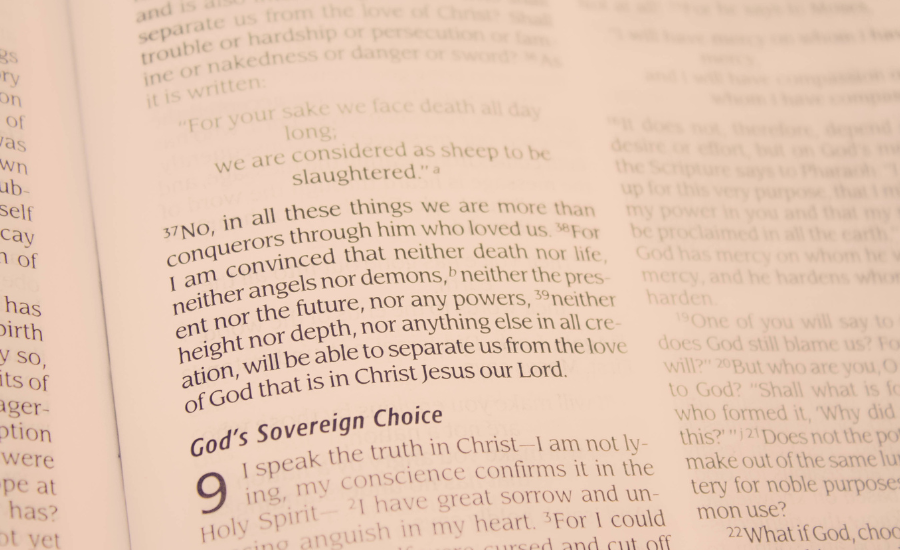
Translators added the heading “God’s Sovereign Choice.” Paul opens the chapter with grief for the lost.Many well-meaning believers have isolated verses there, built a theological system on them, and read that system into every passage where election appears. Paul did not stop at Romans 9. Read with Romans 10 and 11, his argument shows election directing God’s mercy toward everyone who believes.
An invitation to the world
Begin with John 3:16. God loves the world so much that He gives His only begotten Son, so that whoever believes in Him will have eternal life. His love is aimed at the world, and the promise belongs to whoever believes.
The apostles say the same. Paul writes that God desires all people to be saved and to come to the knowledge of the truth, and that Christ gave Himself as a ransom for all (1 Tim. 2:3–6). Peter writes that the Lord is patient, “not wishing that any should perish, but that all should reach repentance” (2 Pet. 3:9, ESV). Paul promises that “everyone who calls on the name of the Lord will be saved” (Rom. 10:13, ESV). Neither apostle leaves room for a God who has no desire to save certain people.
Jesus is just as plain. Whoever comes to Him will never be turned away (John 6:37). He does say no one can come unless the Father draws them (John 6:44). He also says that when He is lifted up, He will draw all people to Himself (John 12:32).
All people.
The invitation is open to everyone. The idea that God discards people because they were not “chosen” cannot be reconciled with the whole of Scripture.
God’s role, our responsibility
Grace always moves first. “We love because he first loved us” (1 John 4:19, ESV). Our choice is a response to His call, and each of us must still make it.
Jesus said as much in His lament over Jerusalem: “How often would I have gathered your children together as a hen gathers her brood under her wings, and you were not willing!” (Matt. 23:37, ESV). The Son of God wanted them, and they refused Him.

“All day long I have held out my hands to a disobedient and contrary people” (Rom. 10:21, ESV).Paul preaches with the same conviction, calling people to believe, confess, and call on the Lord, and promising salvation to those who do (Rom. 10:9–13).
Any teaching that says God has already decided, in a way no one can resist, exactly who will respond is false. It cannot stand under the full weight of Scripture, which from Genesis to Revelation treats our choice to accept or reject salvation as our own.
Does God know in advance who will believe? Yes. Paul speaks of those “whom he foreknew” (Rom. 8:29, ESV), and Peter writes that believers are chosen “according to the foreknowledge of God the Father” (1 Pet. 1:1–2, ESV). God sees who will believe and chooses them on that basis. Later, in their own lifetimes, they come to faith, just as He knew they would.
His foreknowledge and our freedom work together, and only by His grace are we able to choose at all. He is sovereign, and He gives us that ability even when someone uses it to reject Him.
The pattern begins in Eden. God gave Adam and Eve everything they needed, one command, and a choice (Gen. 2:16–17). They chose wrongly. God came looking for them, calling, “Where are you?” (Gen. 3:9, ESV), and then He held them responsible (Gen. 3:11–19).
Paul kept writing
Defenders of unconditional election lean hardest on Romans 9:16: “So then it depends not on human will or exertion, but on God, who has mercy” (ESV). Paul’s subject there is merit. He uses Jacob and Esau to show that God’s choice does not depend on human works or family lines.
Before the twins were born, God told Rebekah, “Two nations are in your womb” and “the older shall serve the younger” (Gen. 25:23, ESV). That was a sovereign decision about roles in His plan, and neither brother could earn it or claim it by birth order.
When Paul adds, “Jacob I loved, but Esau I hated” (Rom. 9:13, ESV), he is quoting Malachi 1:2–3, written centuries after both brothers died. There God is speaking about Edom, the nation descended from Esau. The judgment Malachi describes falls on that nation’s land and history (Mal. 1:3–4). The Hebrew word for “hated,” śānēʾ, describes the one loved less or passed over when two are set side by side. Genesis uses it for Leah, whom Jacob loved less than Rachel (Gen. 29:30–31).
Jesus, the Rabbi, taught in the same idiom. He told His followers they must “hate” father and mother (Luke 14:26). In Matthew, the same teaching reads, whoever “loves father or mother more than me is not worthy of me” (Matt. 10:37, ESV).
God even gave Esau’s descendants their own land (Deut. 2:5) and told Israel, “You shall not abhor an Edomite, for he is your brother” (Deut. 23:7, ESV). Esau was passed over for a role. Nothing in the text condemns him before he was born.
Paul then explains his own point. Israel pursued righteousness as if it came by works, while the Gentiles received it by faith (Rom. 9:30–32). Effort and pedigree earn nothing. Faith receives what God freely gives, and salvation comes by grace through faith so that no one can boast (Eph. 2:8–9).
And Paul kept writing. In Romans 10, he quotes God’s own words over Israel: “All day long I have held out my hands to a disobedient and contrary people” (Rom. 10:21, ESV).
In Romans 11, he says the branches broken off for unbelief can be grafted back in if they do not continue in unbelief, “for God has the power to graft them in again” (11:23, ESV). Their unbelief today does not seal their future. Then he concludes, “God has consigned all to disobedience, that he may have mercy on all” (11:32, ESV).
No reading of Romans 9 that leaves a permanently rejected class survives that ending.
Vessels of wrath
Few verses carry more weight in this debate than Romans 9:22. Paul mentions “vessels of wrath prepared for destruction,” and defenders of unconditional election assume God prepared them. The text does not say so.
Paul sets those vessels beside the “vessels of mercy,” which he says God “has prepared beforehand for glory” (Rom. 9:22–23, ESV). In verse 23, Paul names God as the one who prepared. In verse 22, he names no one. The Greek verb, katērtismena, a form of katartizō, “to prepare,” is passive. It says the vessels were prepared and leaves the preparer unstated. Anyone who insists God prepared them for destruction must show it from the text. Verse 22 alone cannot show it.
The verses around it fill in what verse 22 leaves out. The potter and the clay in the verses just before (Rom. 9:20–21) echo Jeremiah 18, where God sends the prophet to watch a potter rework a spoiled pot. Then God explains. If a nation He has warned turns from its evil, He will relent of the disaster He planned. If a nation He meant to bless turns to evil, He will relent of the good (Jer. 18:7–10). The Potter’s authority is absolute, and in the very passage Paul draws from, it responds to repentance.
The rest of Romans agrees. We are all born into sin (Rom. 5:12). Sin entered the world through one man, death came through sin, and death spread to everyone because everyone sinned. Sin is what brings judgment, and Paul never describes God preparing individual people for destruction. To the hard and unrepentant heart he writes, “you are storing up wrath for yourself on the day of wrath” (Rom. 2:5, ESV). The person does the storing.
Romans 1 shows how people become vessels of wrath. Three times Paul writes that “God gave them up” (Rom. 1:24, 26, 28). Each time, the people moved first. They “exchanged the truth about God for a lie” (1:25, ESV) and refused to acknowledge Him, so God gave them up to a “debased mind” (1:28, ESV), which the King James Version calls a “reprobate mind.” The Greek adokimos describes something tested and found worthless.
Pharaoh followed the same path. God foretold the hardening from the start (Exod. 4:21), and in the plagues Pharaoh hardened his own heart (Exod. 8:15, 32) before the text says the Lord hardened it (Exod. 9:12).
Unbelief comes first. God turned them over. He did not make them over.
Room for mystery
God’s thoughts and ways are higher than ours (Isa. 55:8–9). Those verses appear in a chapter that calls everyone who is thirsty to come, urges people to seek the Lord while He may be found, and promises abundant pardon to the wicked who return (Isa. 55:1, 6–7). His higher ways stand inside His open invitation. What we cannot fully understand never gives us license to contradict what He has plainly said.
Paul uses the word “mystery” in the middle of this very discussion: “Lest you be wise in your own sight, I do not want you to be unaware of this mystery, brothers: a partial hardening has come upon Israel, until the fullness of the Gentiles has come in” (Rom. 11:25, ESV). In Paul’s letters, mystērion means something God kept hidden for ages and has now made known (Rom. 16:25–26). What He revealed here is a hardening that is partial and temporary, Gentiles being gathered in, and a plan that extends mercy to Jew and Gentile alike. Paul reveals it to keep believers humble.
Then he shows us what to do with what remains hidden. He breaks into praise: “Oh, the depth of the riches and wisdom and knowledge of God! How unsearchable are his judgments and how inscrutable his ways!” (Rom. 11:33, ESV). “Inscrutable” translates anexichniastos, from the Greek word for a footprint. God’s ways leave a trail we cannot follow to the end.
The man who wrestled hardest with these questions ended in worship.
What’s at stake
Souls are at stake.
A distorted doctrine of election can breed pride in those who believe they made the list. It can persuade others there is no use coming to God at all. It can cool the urgency of evangelism, since there seems little point in pleading with someone whose fate is already sealed. Worst of all, it can paint God as One who discards people, when Scripture reveals a Father who wants none to perish.
Defenders of this teaching often cite the Westminster Confession of Faith, a foundational statement of Presbyterian and Reformed belief. It calls for “special prudence and care” in teaching predestination and says the doctrine should produce “humility, diligence, and abundant consolation” (WCF 3.8).
Even so, the doctrine is wrong.
Every teaching has to answer to the full testimony of Scripture, not the full legacy of our tradition. Jesus warned that human tradition can make void the Word of God (Mark 7:13).
Our assignment is clear, and Jesus gave it: make disciples of all nations (Matt. 28:19–20), call people to repentance, love our neighbors, and stay humble. Tell the lost that Jesus looks on them with compassion.
His compassion runs so deep that He delays the day of the Lord, yearning for people to repent (2 Pet. 3:9). Through Ezekiel, He asks whether He takes any pleasure in the death of the wicked, and He says He would much rather they turn and live (Ezek. 18:23; 33:11). That is what God wants: repentance and life.
May we reject error and tear down every barrier we have built between people and God’s Kingdom. May His compassion dwell in us and move us toward grace, prayer, humility, faith, and the Gospel.
And where His trail runs past what we can follow, may we rest in what Moses told Israel: ‘The secret things belong to the LORD our God, but the things that are revealed belong to us’ (Deut. 29:29, ESV).
More on EEW Magazine Online:





The EEW Weekly Digest
Get EEW in Your Inbox
Our weekly digest brings the latest reporting on faith, culture, health, and the news that matters to Black Christian women straight to your inbox.
Subscribe FreeFree to join. Unsubscribe anytime.
Reader-Supported Journalism
Help Keep EEW Free and Growing
EEW Magazine Online is free for every reader, and we plan to keep it that way. Your support helps us expand our reporting on faith, culture, health, and the news that matters to Black Christian women. Become a monthly supporter today.
Support EEWGive once or monthly through PayPal. Gifts are tax-deductible to the extent allowed by law.

Six powerful Bible stories for women facing impossible odds. From the walls of Jericho to the empty tomb, Scripture proves that God specializes in situations that look finished.