
How Can God Be Sovereign and Not the Author of Evil?
Samson, Joseph, Pharaoh, divine election, and the Cross all answer the same question. A biblical exploration of God's sovereignty, human responsibility, and the problem of evil.
By EEW Magazine Online Staff

A potter shapes clay with steady hands, the image Paul reaches for to describe God's sovereign purpose. Photo by Prashant Bhatnagar/Getty Images. Illustration by EEW Magazine.
How can a sovereign God rule over a world filled with evil without becoming the author of it?
Christians have wrestled with that question for centuries, and Scripture answers it not with an argument but with a pattern.
God's sovereignty never requires forcing a man's sin into being.
Every ruler who defied Him, every brother who sold one of their own into slavery, every disciple who fled the garden, made a free choice, born of an individual heart. God reigned completely over each one, and each one remained fully responsible for what he chose.
That pattern surfaces in Judges, in a story most people know only as the tale of a strong man.
Samson: A Hidden Hand Behind a Foolish Marriage
Most people remember Samson for his supernatural strength.
He tore apart a lion with his bare hands. He carried away the gates of Gaza. Then he lost his strength after revealing the secret of his Nazarite vow to Delilah. He died pulling down the pillars of a Philistine temple.
These feats made him famous. What made him useful to God happened earlier, before he ever raised a fist, in a story that belongs to his parents.
In Judges 13, Manoah receives astonishing news. His wife, who has been unable to bear children, will give birth to a son set apart to God from the womb. Wanting to honor the heavenly messenger standing before him, Manoah prepares a sacrifice. Only afterward does Scripture reveal what Manoah himself did not yet understand: "Manoah knew not that he was an angel of the LORD."
Samson sees a Philistine woman in Timnah and tells his parents to arrange the marriage. They object immediately. Why choose a wife from among Israel's enemies when there are women among God's own people?
Judges 14:4 says his parents "knew not that it was of the LORD."
The word "it" refers back to the marriage itself, the union with the Philistine woman, not to Samson's wanting her in the first place. Scripture is precise here. God worked through the marriage. Samson supplied the wanting.

The road to Timnah, where a father and mother could not see the purpose behind a marriage they hated. Photo by Leon Derrick/500px/Getty Images.
God did not need to plant a desire in Samson's heart to accomplish His purpose.
Samson already had the desire, wrong as it was. God simply directed where that desire, once acted on, would lead: straight into an occasion against the Philistines. It was the opening He used to begin breaking their hold over Israel.
Manoah could not recognize the One standing in front of him at the burning altar. His son could not recognize the One working behind a marriage he'd chosen for all the wrong reasons. Neither father nor son saw the hand moving through their story while it was moving.
Again and again, Samson follows what looks right to him. He sees. He desires. He insists. He ignores wise counsel. By the time Delilah appears, his choices have become frustratingly familiar.
Samson's worst decisions remained within God's providence, and the book lays the blame entirely where it belongs, on Samson himself.
God did not need to create Samson's weakness in order to accomplish His purpose through Samson's life.
He only governed where that weakness would lead.
The same hidden hand appears again in Genesis, this time behind a decision far crueler than a bad marriage.
Joseph: Evil Intended, Good Accomplished
Genesis gives Joseph's brothers every reason to fear him.
He has the power of Egypt's throne behind him. Sold into slavery as a teenager, falsely accused, imprisoned, forgotten, he now stands before the very men who betrayed him.
When Jacob dies and Joseph's brothers fall before him in terror, certain he will finally take revenge, Joseph tells them what he has known for some time.
"Ye thought evil against me; but God meant it unto good, to bring to pass, as it is this day, to save much people alive" (Genesis 50:20).
Joseph names the evil without flinching and names God's purpose in the same breath. His brothers are guilty. God is sovereign. Both stand true, and Joseph feels no need to soften either one to make room for the other.
The famine that drove the brothers to Egypt was already serving God's design. The years Joseph spent forgotten in prison were preparing the very deliverance his family would one day depend on.
Betrayal, slavery, false accusation, imprisonment, and exaltation. The whole sequence became the means by which God preserved the very family that had tried to erase Joseph from it.
Joseph's brothers never had to act righteously for God's purpose to stand. Their sin never had to disappear from the account. It did not need to be softened into misunderstanding or excused as youthful cruelty.
Scripture names it exactly what it was: evil, and lets it stay named that way through every chapter that follows.
Their hatred was theirs. The purpose it served was God's.
Their motive in throwing their brother into a pit was never to save a nation from famine. Yet saving a nation from famine is precisely what their choice accomplished.
A man does not need to intend the outcome for God to accomplish His purpose. He only needs to choose, and God carries that choice into His design.
Pharaoh: A Heart Confirmed, Not Created
The same governing hand appears again in Exodus, this time confirming a heart already set against God.
A king rises over Egypt who does not remember Joseph (Exodus 1:8-22). He looks at the Israelites multiplying in his land and sees a threat to his throne. He enslaves them. He works them with rigor. When that fails to slow their population growth, he orders Hebrew midwives to kill every son born to Israel. When the midwives refuse, he commands his own people to throw Hebrew infants into the Nile.
That king dies before Israel's deliverance comes. His son inherits both the throne and the cruelty.
Before Scripture ever speaks of a hardened heart, it shows us a hardened house. When Moses stands before this new Pharaoh demanding release for Israel, the king has already shown the world who he is. He says so himself. "Who is the LORD, that I should obey his voice to let Israel go? I know not the LORD, neither will I let Israel go" (Exodus 5:2).
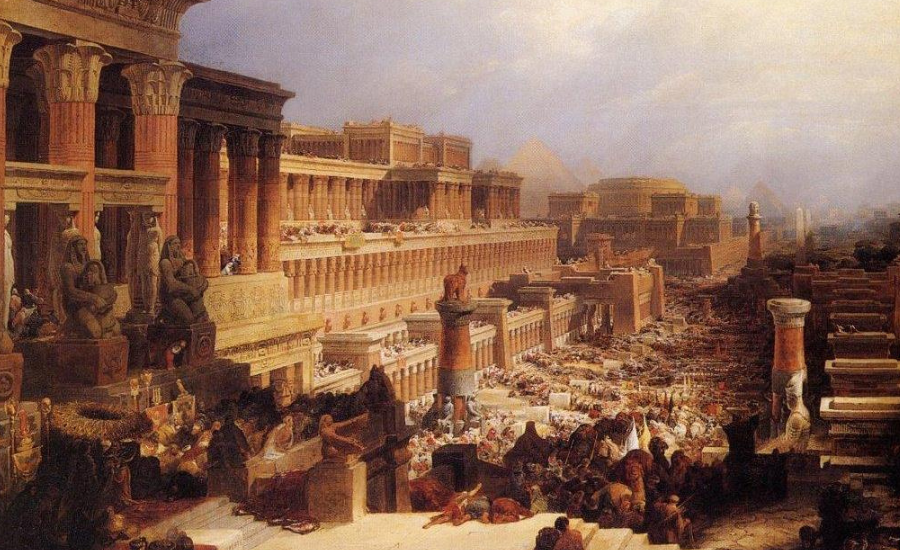
Nine plagues came before Pharaoh's heart was ever confirmed in its rebellion. Painting by David Roberts, 1828. Wikimedia Commons.
What follows is a cycle that repeats nine times. Moses asks. Pharaoh refuses. A plague comes. Pharaoh relents. The plague lifts. Pharaoh changes his mind again.
Through the first several plagues, the text is specific about whose heart is at work. Pharaoh hardened his own heart. He saw the plague of blood and the plague of frogs lifted, and Exodus says plainly that Pharaoh hardened his heart and did not listen, just as the LORD had said.
Only later, after Pharaoh has hardened his own heart again and again, does the text begin to say that the LORD hardened it. God confirmed the direction Pharaoh had already chosen, against clear evidence and repeated mercy.
Pharaoh wanted the plagues to stop without freeing the people he had no right to enslave. Each time judgment came, he sent for Moses with the same request: intreat the LORD for me. He never once asked what he should do differently. He wanted relief, not repentance, the consequences lifted while the rebellion stayed intact.
It is one of the oldest habits of the human heart.
Every plague eventually passed. Pharaoh's heart never changed, and the same pattern that hardened one ruler in Egypt would one day gather itself into a single afternoon outside Jerusalem.
Jesus: The Wicked Hands and the Determinate Counsel
One of Jesus's own disciples betrays Him for the price of a slave. The others scatter into the night. He is led from one hearing to another until He stands before Pilate, who repeatedly says he finds no fault in Him and still delivers Him to be crucified.
The crowd demands Barabbas instead. Soldiers mock Jesus, strike Him, and nail Him to a cross. Darkness covers the land from the sixth hour to the ninth, and in that darkness, the sinless Son of God dies before the eyes of those He came to save.
Every actor in that story bears guilt.
Judas chose betrayal. The religious leaders chose envy. Pilate chose convenience over justice. The soldiers chose cruelty.
No one forced any of them.
Weeks later, standing before a crowd in Jerusalem, Peter states plainly what they did.
"Him, being delivered by the determinate counsel and foreknowledge of God, ye have taken, and by wicked hands have crucified and slain" (Acts 2:23).
Peter proclaims both truths without attempting to explain away either one. The hands that crucified Jesus were wicked. The counsel that delivered Him was God's.
The Cross answers the question this article opened with. How can a sovereign God rule over a world filled with evil without becoming the author of it?
If God could govern the crucifixion of His own Son, carried out by wicked hands acting in full freedom, without ever forcing their hands to move, then no evil in any story lies beyond His sovereign rule.
Not Pharaoh's cruelty. Not a brother's betrayal. Not whatever evil you bring to these pages.
The Cross is not the exception to how God works. It is the proof of how far His reach goes.
The same sovereign hand is evident in Paul's letter to the Romans, where he speaks to his own people's rejection of Christ.
Paul: The Potter and the Clay
By the time Paul writes to the Romans, he is wrestling with a personal grief. His own people, Israel, have largely rejected the Messiah they were waiting for.
Paul carries that rejection as great heaviness and continual sorrow in his heart for his kinsmen according to the flesh. Out of that grief, Paul asks whether God's word has failed. If Israel was chosen and Israel has rejected her Messiah, has God's promise collapsed (Romans 9:6)?
Paul is not yet talking about individual salvation.
He is establishing that the promise itself never passed automatically to every physical descendant of Abraham. It moved through Isaac, not Ishmael. It moved through Jacob, not Esau.
"As it is written, Jacob have I loved, but Esau have I hated" (Romans 9:13).
This is a line Paul quotes from the book of Malachi, written centuries after both men had died, where it describes two nations, Israel and Edom, not God's private affection toward two individual souls.
Scripture uses "love" and "hate" this way elsewhere to express covenant standing, not merely feeling. It is the same sense behind Jesus saying a disciple must "hate" his own family, meaning to love them less by comparison, not to despise them. Paul is identifying which family carried the covenant forward, not declaring how God regarded Esau's soul.
Establishing that the promise never depended on bloodline alone proves Israel's present unbelief does not mean the promise collapsed. It means the promise is running the course it has always run, through the ones God calls to carry it, while every man remains free to answer or refuse the call laid before him.
Then Paul does something striking. He goes to Pharaoh.
"For the scripture saith unto Pharaoh, Even for this same purpose have I raised thee up, that I might shew my power in thee, and that my name might be declared throughout all the earth" (Romans 9:17).
God governed Pharaoh's rebellion without needing to coerce it into being.
Exodus presents Pharaoh making his own evil choices, then shows God accomplishing His purpose through those choices.
The text never asks the reader to pick one truth over the other. It simply presents both, and the mind strains to hold them at once. Paul feels that strain too and asks, "Why doth he yet find fault? For who hath resisted his will?"
It is the question every honest reader eventually asks, and Paul does not resolve it the way a philosopher would.
He answers by reorienting who has standing to ask it. "Nay but, O man, who art thou that repliest against God? Shall the thing formed say to him that formed it, Why hast thou made me thus?" The Potter owes the clay no explanation for its shape, and that silences the objection without dissolving it.
The tension stands here exactly as Paul left it.
Then comes the verse that has convinced some readers God assigns certain souls to hell before they draw breath: vessels of wrath, "fitted to destruction," set beside vessels of mercy God "afore prepared unto glory" (Romans 9:22-23).
Let’s examine the two verbs, because Paul was not careless with them.
For mercy, he uses an active verb with God named as the one doing the preparing. For wrath, he switches to a passive form with no one named as the one doing the fitting. Paul will say plainly that God prepared the vessels of mercy. He will not say God prepared the vessels of wrath. The one hand is named. The other is not.
That same verse says God bears with the vessels of wrath "with much longsuffering," the identical word Paul uses elsewhere for the patience God extends toward sinners to lead them to repentance (Romans 2:4).
Patience is not a word that fits souls already sealed for damnation with no path ever open to them. It is a word for time extended, mercy withheld from judgment a little longer, the same mercy Pharaoh received through nine plagues before the tenth one fell.
Whatever one concludes about this passage, that conclusion must still be able to stand beside Peter's declaration that God is "not willing that any should perish, but that all should come to repentance" (2 Peter 3:9), and the final invitation of Scripture, "Whosoever will, let him take the water of life freely" (Revelation 22:17).
Interpretations are tested not only by the verses that seem to support them, but also by the passages they must faithfully explain.
What Paul says next confirms his own reading. He does not name individual souls chosen for hell. Instead, he quotes Hosea, where God calls a people who were not His people "my people," and Isaiah, who declares that only a remnant of Israel would be saved.
In both cases, Paul's focus remains on the covenant people as a whole, not isolated individuals.
The point is the same in both passages: God's promise was never secured by inherited privilege. Many within the nation fell away through unbelief, while the remnant remained by God's mercy, obtained by faith.
God's promise continued through those who believed, while unbelief left many outside the blessing they had presumed upon.
Both passages are about groups entering or falling short of the promise. It is the same argument Paul has carried since Isaac and Ishmael, Jacob and Esau.
Bloodline saves no one. Law-keeping obligates God to no one. Mercy was never a debt owed.
Notice, too, what word Paul uses the moment he names the vessels of mercy: "even us, whom he also called" (Romans 9:24).
Called.
Not forced.
Paul will explain in the next chapter how that calling is answered: "whosoever shall call upon the name of the Lord shall be saved," and faith comes by hearing the word of God (Romans 10:13, 17).
God prepares. God calls. The vessel still answers.
This is where the word Paul planted earlier in Romans does its work. "Whom he did foreknow, he also did predestinate to be conformed to the image of his Son" (Romans 8:29). For Paul, predestination has one purpose: shaping a people who bear the likeness of Christ, a purpose God set in motion before He ever called them and is still carrying out in them now.
The purpose is preordained.
The person chooses.
Samson chose Timnah. Pharaoh hardened his own heart nine times before God ever confirmed it. Judas chose the thirty pieces of silver. Israel chooses, every day, whether to call upon the name of the Lord. The purpose being fixed removes nothing from the choosing.
This is why Paul can say the Potter forms vessels for glory and, two chapters later, say whosoever shall call upon the name of the Lord shall be saved, without contradicting himself. The vessel does not unmake itself. But the vessel still answers, or refuses to answer, when it is called.
Of Israel, Paul writes that God has "all day long stretched forth his hands unto a disobedient and gainsaying people" (Romans 10:21). A people called into the same mercy just described, flowing to vessels prepared beforehand.
By the time Paul reaches Romans 11, the mystery remains.
But one thing has become unmistakable. God's sovereign purpose has always included humanity's responsibility to believe.
Where Logic Ends and Worship Begins
Paul brings this long journey through hardened hearts, mercy, and divine choosing to a close with words as instructive as everything that came before: "O the depth of the riches both of the wisdom and knowledge of God! how unsearchable are his judgments, and his ways past finding out!" (Romans 11:33).

Where logic ends, worship begins. Photo by Design Pics/Don Hammond/Getty Images.
Some things Scripture lets us know plainly.
God reigns over every choice a man makes, without exception. Man remains responsible for every choice he makes, without excuse. Mercy was never owed and grace was never earned. Whosoever will may come.
Other things Scripture leaves unresolved.
How sovereignty and freedom occupy the same moment without canceling each other. What happens in the space between a heart hardening itself and a heart being confirmed in that hardness.
Paul never answers these. Neither will we.
On both sides of that mystery stands the same call: believe, trusting the One who holds what we cannot resolve. That is what Paul did when the logic reached its limit. He fell at the feet of the Potter and worshiped.
So should we.
More on EEW Magazine Online:






Manifestation is everywhere, even in Christian circles. Here is the line between New Age practice and biblical faith, and why the difference matters.