A new Lifeway Research study reveals troubling gaps in churchgoers' Bible knowledge. Paul's instruction to Timothy offers a practical path toward deeper understanding of Scripture.
By EEW Magazine Online Editors
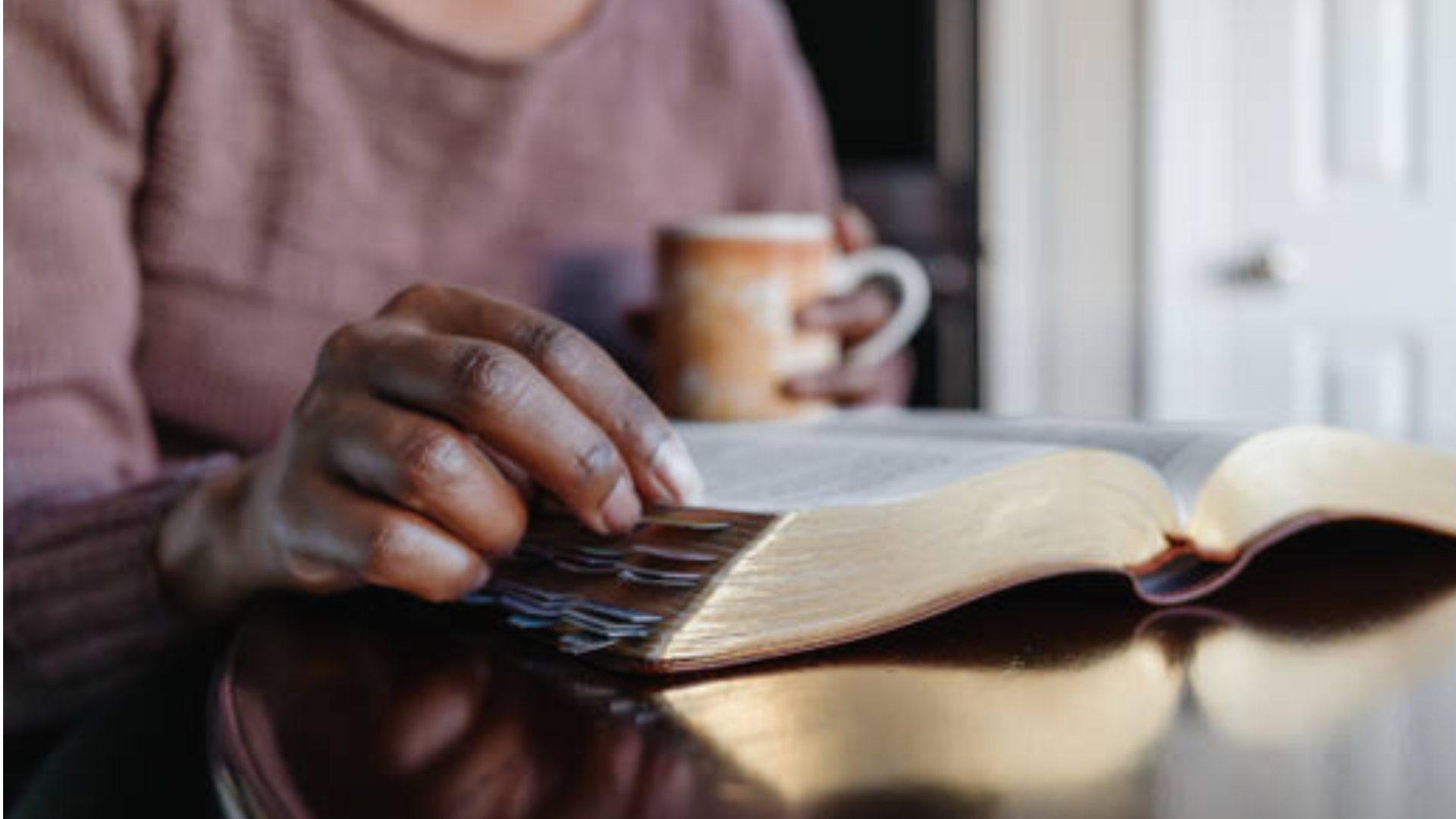
Daily Bible reading was tied to the biggest gain in scores in a new Lifeway Research study. (Credit: Grace Cary/Getty Images)
Picture it. The pastor calls out the book of Habakkuk, and the pages around you start to rustle. You flip toward the back, then the middle, hoping no one notices how long it is taking. Plenty of women who have sat in church for decades know that subtle embarrassment, and a new Lifeway Research study suggests they have a lot of company.
Asked to name Israel’s first king, fewer than half of the American churchgoers in the study chose Saul. Nearly a third picked David, the shepherd God raised up to take his place. Only 35% knew that Saul’s anointing is recorded in 1 Samuel.
The findings, released Nov. 3 and reported by Baptist Press, show how easily regular churchgoers lose their way in the Old Testament story.
Lifeway surveyed more than 2,000 Protestant, nondenominational, Catholic and Orthodox churchgoers who attend services at least once a month. The quiz covered eight areas of Bible knowledge, and researchers graded it on a standard academic scale. The average score was 51. About 65% scored below 60, a failing grade, and only 17% earned a B or higher.
The weakest areas involved the Bible’s structure and storyline. Only 11% could put four Old Testament events in order, from Deborah judging Israel to Esther delivering her people. Two-thirds identified Hezekiah, a king of Judah, as a book of the Bible. Familiar verses fared better, and four in five filled in the missing word in John 3:16.
Reading habits tracked closely with the scores. About 21% of respondents read the Bible every day, and they averaged 66%. The 22% who rarely or never read it averaged 36%. Sermons led the list of ways churchgoers learn Scripture, with 56% naming their pastor’s preaching and 38% naming devotional material.
Men and women scored about the same, and the study found no statistical differences by ethnicity. Churchgoers ages 50 to 64 averaged 48%, below the 54% posted by those 30 to 49. Seventy-one percent of the older group failed.
If that number stings, the next finding offers hope. Of every factor Lifeway measured, daily Bible reading was tied to the biggest gain in scores. It asks for nothing more than an open Bible and a few quiet minutes.
EEW Magazine Online · The Gospel Beat
Inside the Bible Literacy Quiz
How more than 2,000 American churchgoers scored on Lifeway Research's test of Bible knowledge.
Who was Israel's first king?
This question tripped up more churchgoers than any other. Pick an answer to see how they responded.
Share of churchgoers choosing each answer. Saul, the correct answer, is shown in black.
Two in three churchgoers failed
Lifeway graded the quiz on a standard academic scale. Any score below 60 counted as an F.
Share of churchgoers earning each grade.
Average score by group
Men and women scored about the same, and the study found no statistical differences by ethnicity. Among churchgoers ages 50 to 64, 71% failed.
Familiar verses held up. The storyline did not.
Share of churchgoers answering each question correctly. Hover or tap a bar for the full question.
Dashed line marks 60%, the passing mark on Lifeway's scale.
Daily readers scored 30 points higher
How often churchgoers say they read the Bible on their own, and how that tracked with their scores.
How often churchgoers read the Bible
How they learn the Bible in a typical week
Respondents could choose more than one approach.
One habit was tied to the biggest gain
Lifeway's analysis estimated how much each factor raised or lowered a churchgoer's score, in points.
Points added to or subtracted from a score. These factors are associated with scores; the study does not show they cause them.
Average score by church attendance
Scott McConnell, executive director of Lifeway Research, said the study confirms most churchgoers “haven’t learned or don’t remember many things in the Bible.” He urged church leaders to help people understand individual passages and the larger story those passages belong to.
Lifeway has posted a 25-question quiz online, built on the same eight categories, for readers curious to see where they stand.
Those gaps reach past trivia. A believer unfamiliar with the Bible’s larger story may be less equipped to recognize when a sermon, a social media clip or a well-meaning friend pulls a verse out of context.
“Touch not mine anointed” has been quoted to shut down questions about a church leader. In context, Psalm 105 recalls God protecting Abraham, Isaac and Jacob from kings who would have harmed them.
Twisting Scripture is nothing new. False teachers were already bending the truth in the first century, and Paul addressed it in a letter to a young pastor: “Study to shew thyself approved unto God, a workman that needeth not to be ashamed, rightly dividing the word of truth” (2 Timothy 2:15).
Paul wrote this letter from a Roman prison, near the end of his life. Most of his companions had left him, and only Luke remained. Even then, he asked his protégé Timothy to bring his books and parchments.
The charge in verse 15 went first to Timothy, whom Paul had left at Ephesus to stop false teaching. Its principle, however, reaches every believer in the pews.
The Greek word translated “study” is spoudazō, meaning to be eager, diligent, or wholehearted in one’s effort. When the King James Bible was published in 1611, the English word “study” meant earnest application.
Paul uses spoudazō twice more in this letter, both times urging Timothy to come to him promptly (2 Timothy 4:9, 21). In both instances, the King James translators rendered it “do thy diligence.”
Here in 2 Timothy 2:15, Paul calls for that same diligence in presenting himself approved to God and handling His Word correctly. “Rightly dividing” describes keeping the Word on a straight course. A few lines later, Paul names two men who pulled it off course.
Hymenaeus and Philetus taught that the resurrection of believers had already taken place. That left no future resurrection to hope for, and it overturned the faith of some.
Paul’s answer to teachers like these was to point Timothy back to what he had known since childhood. Long before Timothy led a congregation, the Scriptures were part of his home. His faith had lived first in his grandmother Lois and his mother Eunice (2 Timothy 1:5).
Many EEW readers are the Lois or Eunice of their families, passing the Word to children and grandchildren. Others are opening the Bible on their own for the first time, returning after years away or discovering it later in life. The same Scriptures that shaped Timothy are open to each woman, wherever she starts.
Diligence in the Word can begin with small, consistent steps. Read an entire book of the Bible so you can understand each verse within its larger context. Keep a good study Bible nearby for the questions that come up.
Approach each passage with a desire to learn. Who wrote it, to whom, and under what circumstances? What do the surrounding verses reveal? What does the passage teach about God, and how should that truth shape the way you live?
Devotionals can provide valuable encouragement and insight, especially when they inspire you to spend more time exploring Scripture for yourself.
Paul reminded Timothy that all Scripture is given by inspiration of God, so that the servant of God may be “perfect, throughly furnished unto all good works” (2 Timothy 3:16-17).
“Throughly furnished” means fully equipped. That equipping happens one passage at a time, as the Holy Spirit deepens a believer’s understanding of what God has spoken. So open your Bible and search the Scriptures for yourself.
The next time a pastor calls out Habakkuk, you may find the book a little faster or not. Long after the service ends, what matters most is that you can keep growing, grounded in truth and equipped to live by the Word you have learned to rightly divide.