

When Good Things Become gods
The most dangerous idols never look like sin. They look like blessings. A marriage. A career. A child. A Scripture-rooted look at how good things become gods, and the one foundation that has never once moved.
By EEW Magazine Online Editors

You can lose something good and feel like you lost God Himself.
That is the first clue that something has gone wrong. When a marriage ends, a career collapses, or a child walks away, and the ground disappears beneath your entire sense of self, the loss has uncovered something most of us never knew was there. Somewhere along the way, a good thing quietly became a god.
Nobody thinks they are an idolater. We picture a golden statue in a pagan temple, something obviously wicked, and we are certain it has nothing to do with us. But remember who built the golden calf. Not pagans who had never known God. It was Israel, fresh out of Egypt, who had watched the sea split open and walked across on dry ground.
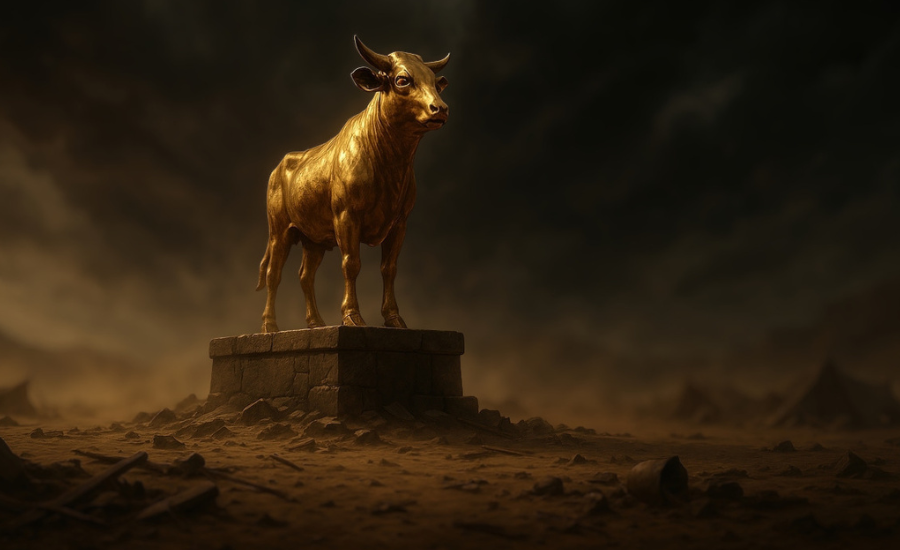
While Moses was on the mountain with God, they melted down their gold and bowed to it, calling it the god who brought them out of Egypt (Exodus 32:4). The people closest to the miracle made the idol. That is how subtle this is. Idolatry is not the sin of the obviously wicked. It is the sin of the human heart, and the most dangerous idols never look like sin at all. They look like blessings. A marriage. A career. A ministry. A child. A calling that once felt like a gift straight from God's hand. That is exactly why we never see them coming.
An idol is anything we trust, need, fear losing, or lean on more than we lean on God. It is anything we ask to carry the weight that belongs to Him alone. By that definition, the most dangerous idols in a believer's life are rarely sinful things. They are good things we have quietly lifted into the place reserved for God.
And good things make terrible gods. A career can provide an income, but it cannot tell you who you are. A marriage can offer companionship, but it cannot become your ultimate security. Children can bring deep joy, but they were never meant to be the reason your soul feels it has worth. The moment we ask a created thing to define us, secure us, and tell us we are enough, we have set a weight on it that it was never built to hold. Eventually that weight crushes both the idol and the person bowing to it.

This is the real reason so many capable, accomplished women come apart when one thing collapses. It is not simply that they lost a role. It is that the role had quietly become a god, and when it fell, it took their whole sense of self down with it. What looks on the surface like an identity crisis is very often a worship crisis underneath. The question was never only who am I. The deeper question was always what am I living for, and what have I been trusting to do for me what only God can do.
Jesus told two short stories that diagnose this exactly.
The first is about two builders. A wise man built his house on rock, and a foolish man built his on sand. From the outside the two houses may have looked identical. The difference stayed hidden until the storm came. "And the rain descended, and the floods came, and the winds blew, and beat upon that house; and it fell: and great was the fall of it" (Matthew 7:27). Jesus said the wise builder is the one who hears His words and does them. The foundation was never the house itself. It was a life built on Christ and submitted to Him, which is why it stood when everything came against it.
The second is about a sower scattering seed. Some fell on rocky ground where the soil was shallow, and it sprang up quickly with great promise. But when the sun rose and beat down, it withered, because it had "no root in itself" (Mark 4:6). Jesus explained that this is the person who receives the Word with joy but has no depth, so the moment trouble or persecution comes, they fall away (Matthew 13:20-21). The plant did not fail because the sun was unusually cruel. It failed because nothing underneath it went deep.
One image is about a foundation. The other is about roots. They are two sides of the same coin. A house with no foundation collapses in the flood. A plant with no root withers in the heat. Either way, what looked alive and stable on an ordinary day cannot survive the day the pressure comes, because the strength was only ever on the surface. The storm did not create the weakness. It revealed where our trust had been resting all along.
This is where the Gospel does its deepest work. It does not begin by telling you to think more highly of yourself or to find your inner worth. It begins much further back, with God and what He has done. Through faith in Jesus Christ, sinners who were separated from God are reconciled to Him, forgiven, and adopted into His family. "But as many as received him, to them gave he power to become the sons of God" (John 1:12). That restored relationship is the rock. Everything else, including a settled sense of who you are, flows out of belonging to Him.

And the proof of His love is the cross. You did not earn your way into God's family by becoming impressive enough to deserve it. "But God commendeth his love toward us, in that, while we were yet sinners, Christ died for us" (Romans 5:8). Read that carefully, because it is not mainly a verse about how valuable you are. It is a verse about grace. God loved His enemies. He set His love on people who had nothing to offer Him and every reason to be turned away, and He paid for them with the life of His Son. A standing established that way, by His grace and not your merit, is a standing no employer can grant and no breakup can revoke, because you never earned it to begin with.
So what do you do with the good things, the marriage, the work, the children, the calling? You do not throw them away. You put them back in their proper place, beneath God rather than in His seat. Be a devoted wife, a present mother, an excellent worker. Build, achieve, love. Simply stop asking those things to tell you who you are, and stop handing them the worship that belongs to God alone. Let them be gifts you hold with open hands, not gods you cannot live without. A good thing, kept in its place, blesses you. A good thing enthroned will eventually break your heart.
If you are reading this in the rubble of something that fell, a marriage, a career, an image of yourself you can no longer hold up, hear this. The collapse is painful, but God often uses these very losses to draw us back to what cannot be shaken. Sometimes He lets the idol fall because He loves us too much to let us keep worshiping it. What felt like the end of you may turn out to be the moment the false god finally loosened its grip, and you found the true One still standing there, exactly where He always was.
The goal was never to find yourself. It was to belong to Him. And when you belong to Him, you are standing on the one foundation that has never once moved.
More on EEW Magazine Online:





Jesus taught His disciples to forgive without limits, and He also showed discernment about whom to trust. When harmful patterns keep returning, wisdom may call for boundaries, distance, or a permanent separation.