Ebola Outbreak in Congo Raises Alarm Across East Africa as Uganda Closes Its Border
A rare, vaccine-resistant strain of Ebola is spreading in eastern Congo, overwhelming health workers and crossing into Uganda. Get the facts on what's happening, who is most at risk, and what officials are doing to stop it.
Written By EEW Magazine Global Health Editors
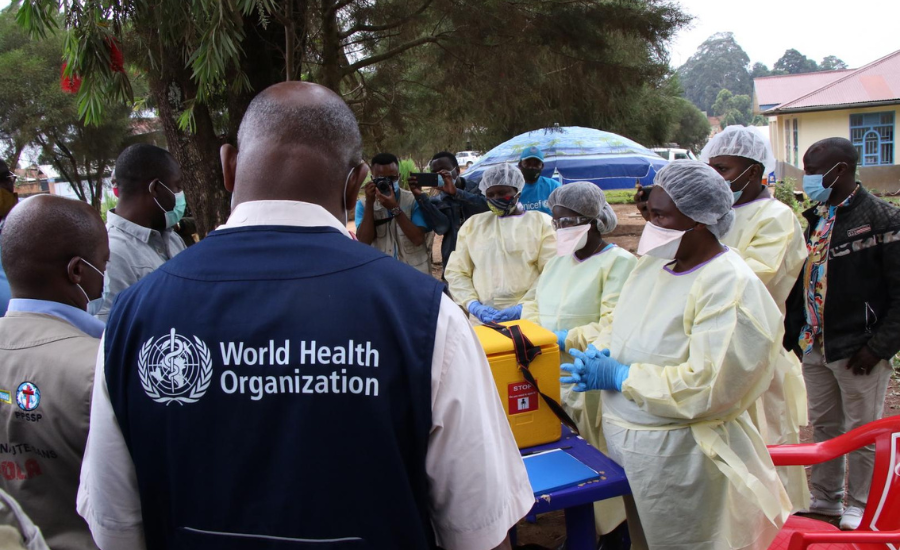
WHO steps up efforts to curb Ebola outbreaks in Guinea and the Democratic Republic of the Congo (Credit: World Health Organization)
An Ebola outbreak in eastern Democratic Republic of Congo is growing faster than responders can contain it, and the ripple effects are now being felt across the border in Uganda, where officials shut down the shared crossing this week in a move that reflects both urgency and fear.
The strain driving this crisis is Bundibugyo, a rare type of Ebola for which no approved treatment or vaccine exists. It was confirmed weeks later than it should have been because early tests were run for a more common type. That delay cost precious time, and health workers in the region are still trying to make up for it.
Suspected cases in eastern Congo are approaching 1,000, with at least 220 suspected deaths and more than 101 confirmed infections as of Tuesday. Congolese health officials are tracking over 3,000 possible contacts, a number that reflects both the scale of the outbreak and the enormous task ahead.
Uganda has confirmed seven cases so far, including the death of a 59-year-old man in Kampala on May 14. The case count itself is not what is alarming officials most right now. It is the growing number of people who have been exposed through healthcare workers, the very people who showed up to help.
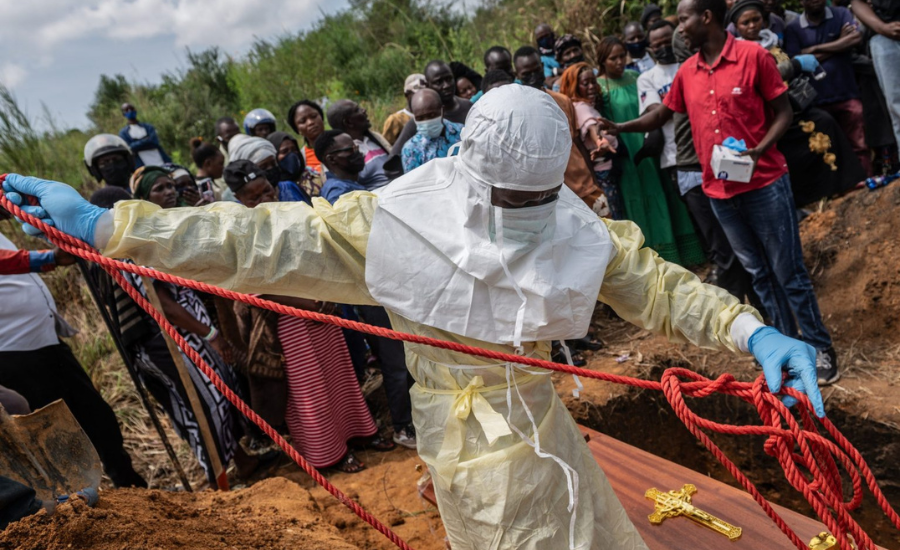
Red Cross workers prepare a coffin containing the body of a Ebola victim for burial at the Rwampara Cemetery, in Bunia, Congo, Saturday, May 23, 2026. (AP Photo/Moses Sawasawa)
"They have families, and so the number has been increasing," said Dr. Diana Atwine, permanent secretary of Uganda's Ministry of Health.
That reality sits at the heart of why this outbreak is so sobering. Ebola spreads through direct contact with the bodily fluids of someone who is sick or has died. The people most at risk are not strangers to the patient. They are the nurse adjusting an IV line, the mother holding her child, the neighbor who prepared a body for burial according to the customs of their community. Contact tracing, which means finding and isolating every person an infected individual has been near, is the most critical tool available. And in eastern Congo right now, doing that work is nearly impossible.
Why This Outbreak Is So Difficult to Fight
Armed conflict is active in the region. Hundreds of thousands of people are displaced, moving constantly and unpredictably. Infrastructure is poor. Aid organizations say they are underprepared and underfunded, short on the basics: face shields, protective suits, testing kits, body bags for safe burials. Health experts point directly to aid cuts made last year by the United States and other wealthy nations as a contributing factor to the depleted response capacity.
Then there is the distrust. Communities in eastern Congo have been living in conflict for years. Outside intervention has not always meant safety. Some residents have responded to this outbreak by attacking clinics and confronting the volunteers trying to explain how the virus spreads. WHO Director-General Tedros Adhanom Ghebreyesus called Wednesday for a ceasefire so that health workers could move safely through the region, noting that attacks on health facilities are making it nearly impossible to track cases and their contacts.
That sentence alone tells you something about what health workers there are walking into every day.
What the Border Closure Means
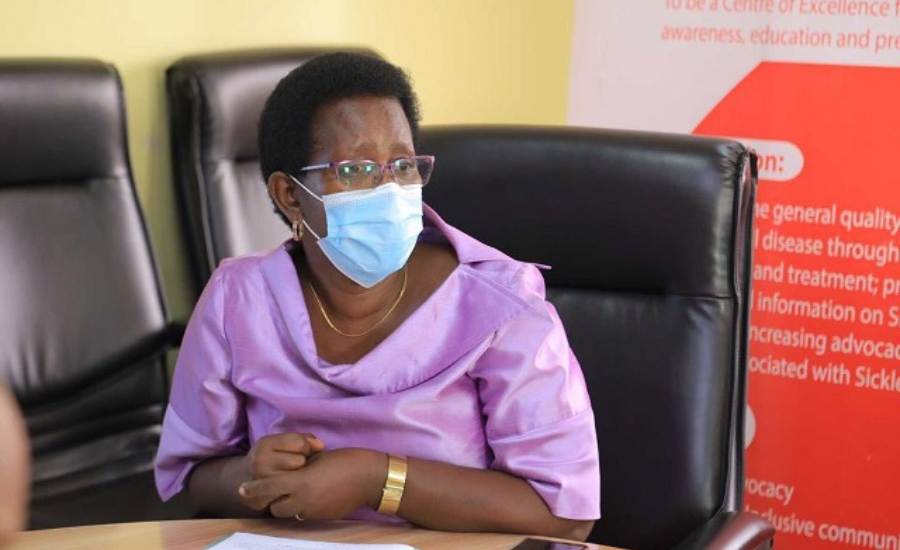
Dr. Diana Atwine Kanzira, MBChB, MMed, is the Permanent Secretary for Uganda's Ministry of Health (Credit: AP/File Photo)
The World Health Organization has declared this a public health emergency of international concern, its highest alert level, while simultaneously advising against border closures. The concern is practical: shutting formal crossings tends to push movement to informal footpaths and unmonitored routes, which are far harder to track. The Uganda-Congo border spans several hundred miles and includes countless crossing points used daily by families and traders.
Uganda moved forward with the closure anyway. Travel is now authorized only for emergency response, cargo, or security, and anyone entering under those circumstances faces mandatory 21-day self-isolation. It is a decision that reflects how seriously officials are taking the risk, even when the path forward is not perfectly clear.
For those not living near the outbreak zone, the immediate risk remains low. But health officials are asking communities to stay alert, skip handshakes, use hand sanitizer, and avoid large gatherings. Dr. Atwine made that last point this week when she expressed open frustration over crowds of Ugandans celebrating Arsenal's Premier League title.
"I don't understand," she said.
It is a small moment in the middle of a large crisis, but it captures something real: the difficulty of asking people to hold fear and ordinary joy at the same time, to stay careful when life keeps pulling them back toward normal.
Health experts are watching this outbreak closely. We will continue to update this story as it develops.
Sources: Associated Press; World Health Organization
More on EEW Magazine Online:




The EEW Weekly Digest
Get EEW in Your Inbox
Our weekly digest brings the latest reporting on faith, culture, health, and the news that matters to Black Christian women straight to your inbox.
Subscribe FreeFree to join. Unsubscribe anytime.
Reader-Supported Journalism
Help Keep EEW Free and Growing
EEW Magazine Online is free for every reader, and we plan to keep it that way. Your support helps us expand our reporting on faith, culture, health, and the news that matters to Black Christian women. Become a monthly supporter today.
Support EEWGive once or monthly through PayPal. Gifts are tax-deductible to the extent allowed by law.
Six powerful Bible stories for women facing impossible odds. From the walls of Jericho to the empty tomb, Scripture proves that God specializes in situations that look finished.