

Defenders of polygyny point to the laws Moses gave Israel. Jesus pointed His listeners back to Genesis, and Paul set a one-woman standard for the men who lead the church.
By EEW Magazine Online Gospel Editors

Israel Ford with his wives, Lydia Ford, left, and Shakayla Ford, right. In October 2026, Israel announced his second marriage on Instagram and called monogamy “unbiblical.” (Photo: Israel Ford/Facebook)
Pastor Lydia Ford stood before her congregation at LifeWorks Church in the Cleveland area on Sunday, Oct. 25, and introduced another woman as her husband’s wife. Her husband, Israel T. Ford, founded the church in 2009 and is known to members as Prophet Israel. The woman Lydia introduced was Shakayla Talley, a congregant and friend who now goes by Shakayla Ford.
Lydia told the church that she and her husband are living in what she called a polygynous marriage, a form of polygamy in which one man has more than one wife. “Y’all know her. Y’all love her,” she said, before introducing Shakayla as “prophet’s wife and my sister in marriage, Minister Shakayla.”
The announcement was captured in a video circulated by Protestia, which first reported the story. Some members applauded and cheered, while others appeared stunned.
Israel then introduced Shakayla to his Instagram followers as his second wife and rejected the long-standing Christian teaching that marriage joins one man and one woman.
“As a nation we have been taught that a man should have one wife only. This is unbiblical,” he wrote.
He called his position an unpopular truth that many pastors will not preach. He said he would not choose pleasing people over what God had revealed to him, and he told followers who disagreed that they were free to disconnect. He also urged them to watch his full sermon, which he said would be uploaded later in the week.
On its website, LifeWorks describes itself as a church without walls modeled on the church in the book of Acts. Its mission includes helping families love Christ through obedience in lifestyle. Israel’s biography says he was born and raised in the Cleveland area, traveled with gospel artists as a musician and was called to teach the Word of God at 20. Lydia’s biography traces her Pentecostal roots to a small church pastored first by her grandmother and later by her mother. Many members affectionately call her Mom.
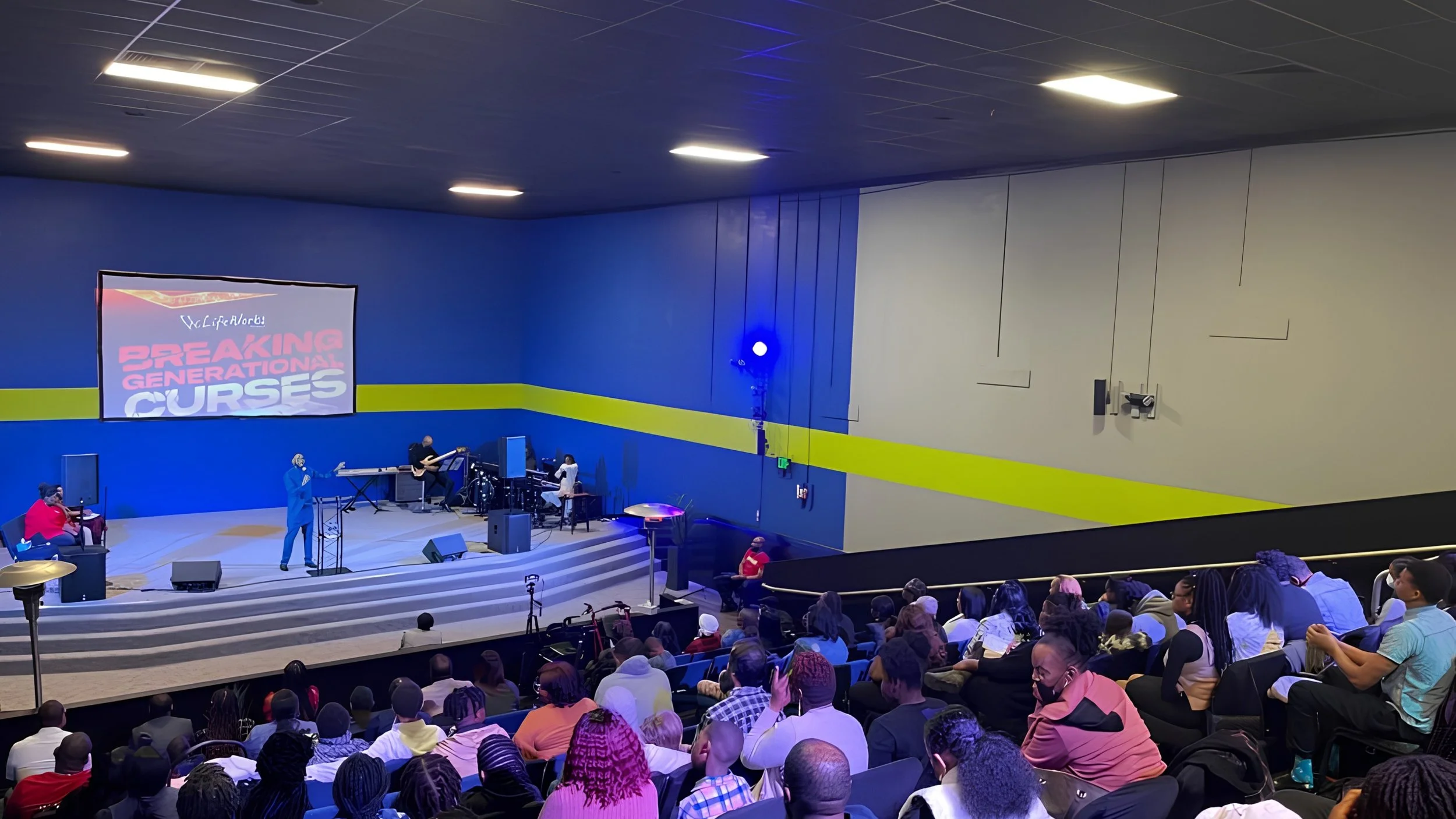
A worship service at LifeWorks Church in the Cleveland area, where Pastor Lydia Ford introduced her husband’s second wife to the congregation. (Photo: LifeWorks Church/Facebook)
The public disclosure has prompted questions of legality. Ohio classifies bigamy as a first-degree misdemeanor. Under Ohio Revised Code Section 2919.01, a married person may not marry another person or continue to cohabit with that other person in the state. It is unclear whether Israel’s second marriage involved a civil marriage license, exists solely as a religious covenant or includes living arrangements relevant to the statute.
No criminal proceedings have been identified in connection with the announcement.
The Fords’ public reveal comes about a year after Missouri pastor Rich Tidwell announced a second marriage and published a lengthy defense of what he calls plural marriage.
A Deeper Discussion
As ChurchLeaders reported in November 2025, Tidwell argues that God lawfully regulated the practice under the Mosaic law. He also asserts that Paul’s requirement for an overseer to be “the husband of one wife” is better rendered “the husband of his first wife.” In his reading, the verse disqualifies men who divorce to remarry. “Paul is not addressing polygyny,” Tidwell wrote.
Exodus 21:10 sits near the center of that case. Tidwell cites it along with Deuteronomy 21:15-17 and Leviticus 18:18. The verse reads, “If he take him another wife; her food, her raiment, and her duty of marriage, shall he not diminish” (KJV).
The law appears in a passage governing a female servant who has been designated for marriage. If another wife is taken, it requires that her existing rights to food, clothing and marital relations be maintained. Deuteronomy 21:15-17 addresses a man who has two wives, one loved and the other hated. It protects the inheritance of the firstborn son regardless of his mother’s standing.
These laws recognized plural households and imposed obligations to protect the vulnerable people inside them. Scripture records polygyny openly among its own people. Abraham had Sarah and Hagar, though Hagar’s status as an enslaved woman given to Abraham makes that relationship especially complicated. Jacob married Leah and Rachel and fathered children with their servants Bilhah and Zilpah. David had multiple wives, and 1 Kings 11:3 credits Solomon with 700 wives and 300 concubines.
Those marriages are part of the biblical record. The open question is whether God’s regulation of an existing practice makes that practice His design for marriage.
Tidwell goes further with 2 Samuel 12:8. In that chapter, the prophet Nathan confronts David over his sin with Bathsheba and relays God’s words: “I gave thee thy master’s house, and thy master’s wives into thy bosom” (KJV). Tidwell counts the verse among the cases in which he says God “divinely ordained” plural marriage, actively giving wives to David.
Historians and commentators note that inheriting a former king’s household often meant taking responsibility for the dependent royal women in it. That responsibility involved housing, provision and protection, and it did not necessarily involve marriage or a sexual relationship.
Scripture never names a wife of Saul whom David took for himself. David’s own later conduct shows what that kind of care looked like. After Absalom’s revolt, David returned to Jerusalem and placed ten of his concubines in a guarded house. There he “fed them, but went not in unto them” (2 Samuel 20:3 KJV). Nathan’s words also come inside a rebuke. He recounts God’s generosity to expose David’s sin, and the judgment that follows declares that the sword will never depart from David’s house (2 Samuel 12:10).
The same Mosaic law that regulated plural households restricted Israel’s kings from multiplying wives. Deuteronomy 17:17 warned, “Neither shall he multiply wives to himself, that his heart turn not away.” Solomon became the very example the warning anticipated. First Kings 11:4 records that his wives turned his heart after other gods.
Jesus drew a line between permission and design when the Pharisees tested Him on divorce, another practice the law of Moses allowed. They asked whether a man could put away his wife for every cause, and He answered from Genesis.
“Have ye not read, that he which made them at the beginning made them male and female, And said, For this cause shall a man leave father and mother, and shall cleave to his wife: and they twain shall be one flesh?” (Matthew 19:4-5 KJV).
The Hebrew of Genesis 2:24 speaks of a man cleaving to ishto, “his wife.” In Matthew’s Greek, Jesus says hoi duo, “the two,” shall be one flesh. His answer, rooted in creation, became the foundation of the historic Christian understanding of marriage as the covenant union of one man and one woman.
When the Pharisees pressed Him about why Moses permitted divorce, Jesus said the concession was made because of the hardness of their hearts. Then He added, “but from the beginning it was not so” (Matthew 19:8 KJV).
With those words, Jesus separated what the law accommodated in a fallen world from the union God formed at creation. A practice can appear in Israel’s history, and even fall under Israel’s laws, without becoming the pattern God set for His people.
The Bible also records what happened inside many of those homes. Lamech, the first man described as having two wives, boasted to them about killing a man (Genesis 4:19-23). Sarah and Hagar became rivals after Hagar conceived (Genesis 16), and Leah and Rachel competed for Jacob’s affection and for children (Genesis 29-30). First Samuel 1:6 calls Peninnah, who provoked Hannah over her barrenness, Hannah’s “adversary,” from the Hebrew tsarah, a word also used for a rival wife.
Scripture tells the jealousy, unequal affection, competition and suffering in several of its best-known plural homes without softening any of it.
The New Testament speaks to marriage directly in its qualifications for church leadership. Paul instructed Timothy, “A bishop then must be blameless, the husband of one wife” (1 Timothy 3:2 KJV). He gave Titus the same requirement for elders (Titus 1:6).
The Greek phrase in 1 Timothy 3:2 is mias gynaikos andra, commonly rendered “a one-woman man.” Mias is the feminine genitive of the cardinal number “one.” Scholars debate how the phrase applies. Some emphasize marital faithfulness. Others read the phrase as excluding polygamy, certain remarriages or both.
Tidwell’s reading asks the word for “one” to carry the meaning “first.” Greek can use the cardinal number in certain expressions of sequence. In Matthew 28:1, for example, “the first day of the week” translates mian sabbaton. That idiom gives no warrant for reading Paul’s qualification as a requirement that a pastor stay married to his first wife while remaining free to marry others. When Paul means “first,” he has the ordinal protos at hand. In the same letter, he uses it to call himself the chief of sinners (1 Timothy 1:15).
Nothing in the ordinary wording of 1 Timothy 3:2 grants an overseer permission to keep more than one wife at a time.
Paul carries the meaning of marriage further in Ephesians 5, where marriage reflects the covenant between Christ and His people. The church is presented collectively as His bride, loved sacrificially by one Bridegroom. Paul issues no separate ruling on polygyny in the passage. He returns to the same creation pattern Jesus cited, a husband and wife joined in one flesh. Christians who hold monogamy as God’s design build that conviction on the line running from Genesis 2 through Matthew 19 to Ephesians 5.
A roll call of Old Testament men with multiple wives cannot close the question. Any answer has to account for the whole counsel of Scripture, including the words of Christ and the apostolic instructions for His church.
Israel closed his Instagram post by saying this life will be over soon and everyone can laugh about it in Heaven.
The Mosaic law recognized and regulated certain plural marriages. A pastor who takes a second wife still has to answer for the creation account, the teaching of Jesus and the standard Paul set for those who lead the church.
When Jesus faced a question about what Moses allowed, He took His listeners back to the beginning.
“From the beginning it was not so.”