

Nearly two years into a sweeping campaign against diversity programs, voters in both parties elected leaders whose victories took generations to arrive.
By EEW Magazine Online Editors
From left, Juliana Stratton, Sen. Angela Alsobrooks and Sen. Lisa Blunt Rochester. In January, they will become the first three Black women to serve in the Senate at the same time. (Getty Images/Illustration by EEW Magazine Online)
In March, after Juliana Stratton captured the Democratic Senate nomination in Illinois, Sen. Angela Alsobrooks of Maryland spoke candidly about the mood among Black women. “I think Black women felt attacked this past year,” Alsobrooks told CNN. Stratton’s nomination, she said, “encourages us to keep moving forward.”
On Tuesday, Illinois voters sent Stratton to the Senate. In January, she will join Alsobrooks and Lisa Blunt Rochester of Delaware, and for the first time in history, three Black women will serve in the Senate at once.
Illinois Lt. Gov. Juliana Stratton speaks to voters at a campaign stop in Chicago on March 13, 2026, days before winning the Democratic Senate primary. On Tuesday, voters elected her to the seat being vacated by Sen. Dick Durbin. (Scott Olson/Getty Images)
Georgia delivered another first. For 250 years, no Black woman had been elected governor of an American state. Stacey Abrams won the Democratic nomination in Georgia twice and fell short both times. On Tuesday night, Keisha Lance Bottoms, the former mayor of Atlanta, broke through and returned the state’s top office to Democrats for the first time since 1998.
Before Tuesday, only three Black Americans had ever been elected governor of a state. Voters elected four more in a single night: Bottoms, Aaron Ford in Nevada, David Crowley in Wisconsin and Republican Byron Donalds in Florida. The barrier fell in both parties at once.
From left, Democrats Aaron Ford of Nevada and David Crowley of Wisconsin and Republican Byron Donalds of Florida each became his state’s first Black governor on Tuesday. (Getty Images/Illustration by EEW Magazine Online)
At least 18 Black women will hold statewide executive office next year, up from a previous record of 11, according to Rutgers University’s Center for American Women and Politics. Michigan elected the Senate’s first Muslim member. Minnesota elected the first Native American woman to the Senate, and New Mexico elected the nation’s first Native American woman governor.
All of it happened after nearly two years of an aggressive federal campaign against diversity programs. In January 2025, in his first two days back in office, President Donald Trump signed executive orders to dismantle diversity, equity and inclusion efforts across the federal government and among contractors and grant recipients. In March 2026, he required federal contractors to promise they would not engage in what his order calls “racially discriminatory DEI activities.” Universities, including Columbia, began scrubbing diversity language from their websites.
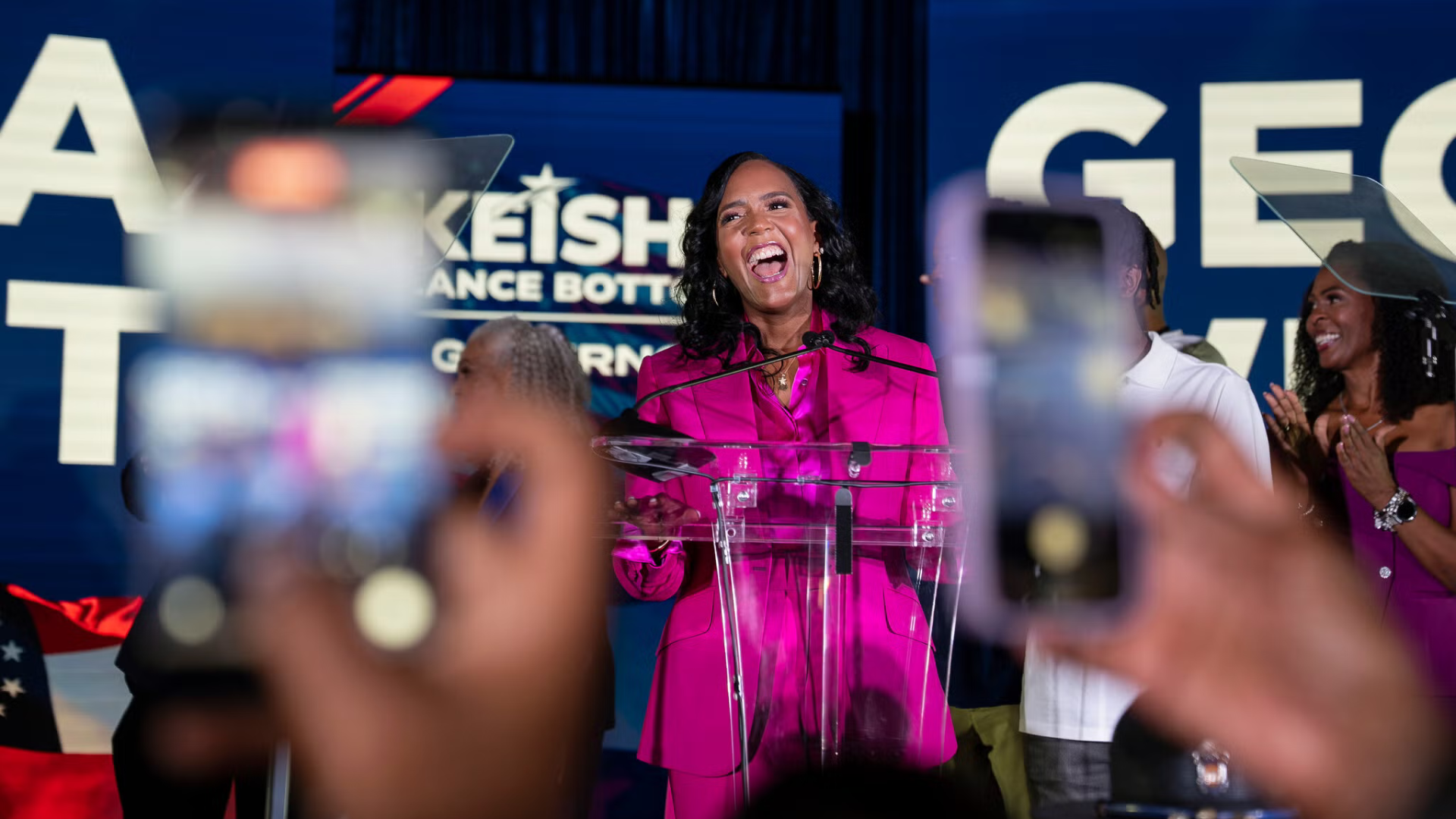
Georgia Gov.-elect Keisha Lance Bottoms celebrates onstage at her election night watch party at the Atlanta Marriott Marquis on Tuesday, Nov. 3, 2026. Bottoms defeated Republican Rick Jackson to become the first Black woman elected governor in U.S. history. (Paras Griffin/Getty Images)
The administration says its orders target illegal preferences, and the title of one promises to restore “merit-based opportunity.” Bottoms, a Democrat, and Donalds, a Republican and Trump ally, won the way every candidate does, by persuading more voters than their opponents.
In February 2026, a federal appeals court allowed the anti-DEI orders to take effect. Target scaled back its diversity commitments in early 2025, rode out a yearlong boycott led in part by Black pastors and has not restored them. The effects have reached well beyond Washington, into companies, campuses and grant programs that depend on federal money.
Voters went to the polls with grocery bills on their minds. In CBS News exit polling, 89% called the cost of living a major or crucial factor in their vote. The barriers fell in an election dominated by bread-and-butter concerns.
Seventy-two percent of Americans now call promoting DEI an important priority for businesses, up from 69% a year earlier, according to a Bentley University-Gallup survey released in September. The figure is 95% among Democrats, 71% among independents and 37% among Republicans. Republican views shifted on a related question. The share who say diverse workforces are more profitable climbed 11 points, to 41%.
When the new Congress convenes in January, Hakeem Jeffries, a Black congressman from Brooklyn, is in line to take the speaker’s gavel. Across the Capitol, three Black women will sit in the Senate together for the first time. In Atlanta, Keisha Lance Bottoms will take the oath as governor.
No executive order put them there, and no executive order can take that history back.