
Federal authorities arrested three activists after a protest disrupted a St. Paul church service. A judge later ordered their release, while efforts to charge journalist Don Lemon stalled.
By Ani Adams // EEW Magazine Online News Editor
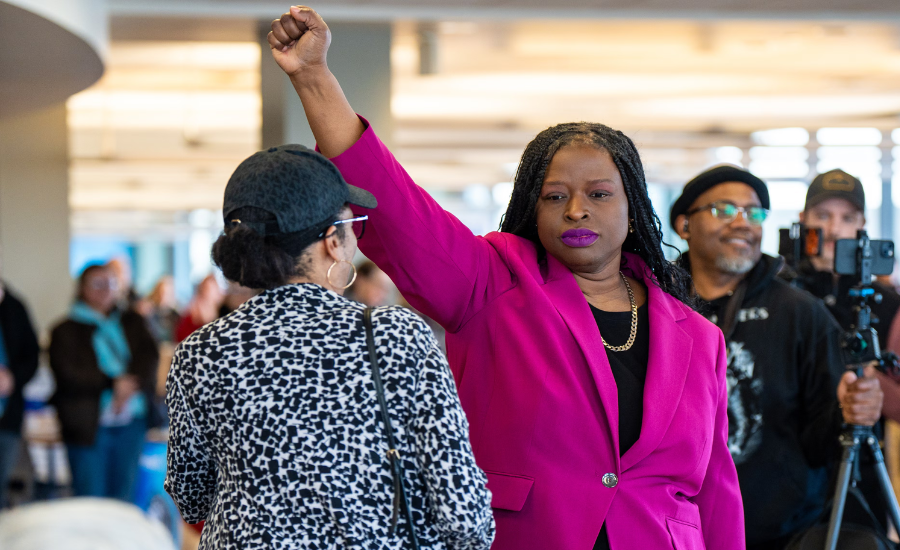
Nekima Levy Armstrong (Credit: Angelina Katsanis/AP)
Federal authorities have arrested and released three prominent activists in connection with a protest at a St. Paul, Minnesota church that disrupted a worship service and drew national attention, even as efforts to bring charges against independent journalist Don Lemon have stalled for now.
Nekima Levy Armstrong, a Minneapolis civil rights attorney and organizer, and Chauntyll Louisa Allen, a St. Paul school board member, and William Kelly were taken into federal custody Jan. 22 following a protest at Cities Church in St. Paul, where demonstrators challenged the role of a pastor who also serves as an official with U.S. Immigration and Customs Enforcement.
Attorney General Pam Bondi announced the arrests on social media, saying federal authorities do not tolerate “attacks on places of worship.” FBI officials confirmed that a third individual, William Kelly, was also arrested in connection with the protest.
The demonstration, held Jan. 18, brought together activists opposed to aggressive immigration enforcement, including the fatal shooting of Minneapolis resident Renée Nicole Good by an ICE officer earlier in the month. Protesters chanted slogans and pressed church leaders about the dual role of the pastor involved with ICE.
Levy Armstrong and Allen were released from federal detention the following day after a judge ordered they not be held in custody while facing federal charges. According to a report obtained by EEW Magazine, U.S. District Court Magistrate Judge Shannon Elkins determined there was insufficient justification for continued detention, and all three arrested demonstrators were subsequently ordered freed.
Levy Armstrong’s own organization, the Racial Justice Network, said in social media statements that the judge’s order mandated the “immediate release” of her and Allen. The group also published video reviewed by EEW Magazine of Levy Armstrong’s arrest showing her being handcuffed by federal agents, countering imagery previously shared by government accounts that her supporters say was manipulated to cast her in a more dramatic light. In a later statement accompanying her video, Levy Armstrong criticized the government’s actions, alleging political persecution and defending the protest as an exercise of constitutional rights.
Allen did not issue a public statement at the time of her release, and attorneys for both women have not provided additional comment to reporters.
Federal prosecutors have signaled that the litigation is not complete. Charges brought against the protest organizers include allegations under laws designed to protect worshippers and houses of worship, and federal authorities have indicated they are prepared to pursue the case through the courts.
In a related development, the Justice Department’s attempt to bring criminal charges against journalist Don Lemon for his presence at and coverage of the same protest was rejected by a federal magistrate judge in Minnesota. Prosecutors had sought a misdemeanor complaint, alleging Lemon’s actions went beyond reportage, but the judge refused to authorize that charging document, effectively blocking the initial effort to indict him.
Lemon, a former CNN anchor now working as an independent journalist, defended his conduct in public statements. In a video posted on social media, he said that once the demonstration began inside the church, he “did an act of journalism which was report on it and talk to the people involved, including the pastor, members of the church and members of the organization. That’s it. That’s called journalism.” His attorney, Abbe Lowell, said the judge’s decision confirms that Lemon’s work was protected by the First Amendment.
Despite the magistrate’s rejection of the complaint, Justice Department officials have not ruled out further legal action. Prosecutors could seek to present evidence to another judge or take the matter before a federal grand jury to pursue an indictment. The Department of Justice has publicly stated that it may continue its efforts to bring charges in the case.
As the cases move forward, the outcomes will hinge on how courts interpret the limits of federal authority in protest activity and newsgathering, questions that judges have already begun to test in early rulings.
More on EEW Magazine Online:


Jesus taught His disciples to forgive without limits, and He also showed discernment about whom to trust. When harmful patterns keep returning, wisdom may call for boundaries, distance, or a permanent separation.