Halftime Politics: TPUSA’s Alternate Super Bowl Show and America’s Cultural Divide
As backlash and praise followed the conservative counterprogramming, the moment highlighted deeper questions about media loyalty, faith, and cultural identity in the United States.
Written By Jennifer Ellis // EEW Magazine Online
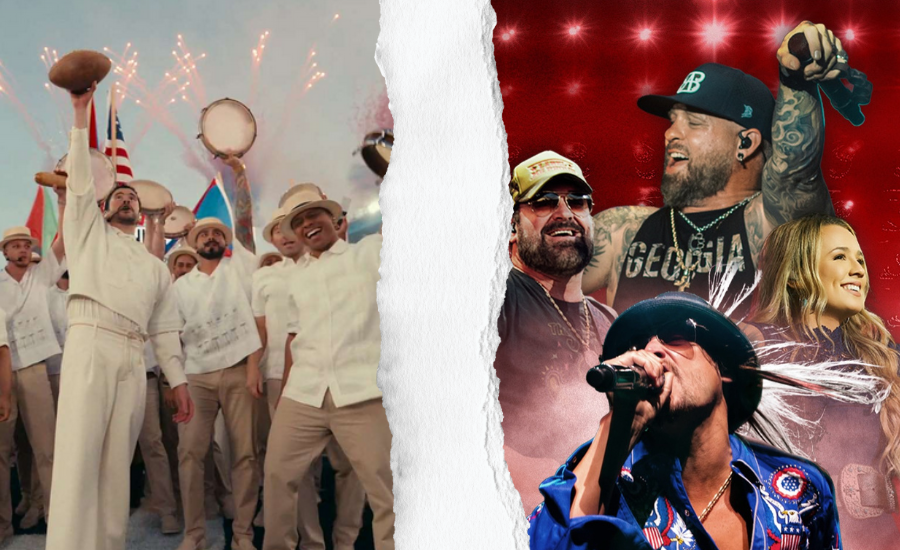
NFL’s official Super Bowl halftime performance and Turning Point USA’s alternative “All-American Halftime Show” aired simultaneously and drew millions of viewers across digital platforms. (Illustration: EEW Magazine)
As tens of millions of Americans watched the Super Bowl halftime show on Feb. 8, a sizable minority chose not to. Instead, millions tuned into an alternative broadcast produced by Turning Point USA, a conservative organization that has increasingly positioned itself as a cultural counterweight to progressive politics and entertainment.
The decision was deliberate. Turning Point USA scheduled its “All-American Halftime Show” to air simultaneously with the NFL’s official halftime performance, headlined by Bad Bunny, the first Spanish-language artist to serve as a solo Super Bowl halftime headliner. The contrast between the two offerings was striking, but the more revealing development came after the game ended.
Independent reporting by The New York Times estimated that the Turning Point USA broadcast reached approximately 6.1 million concurrent viewers across streaming channels. By the morning after the game, the stream had accumulated more than 19 million views across platforms, based on publicly visible metrics.
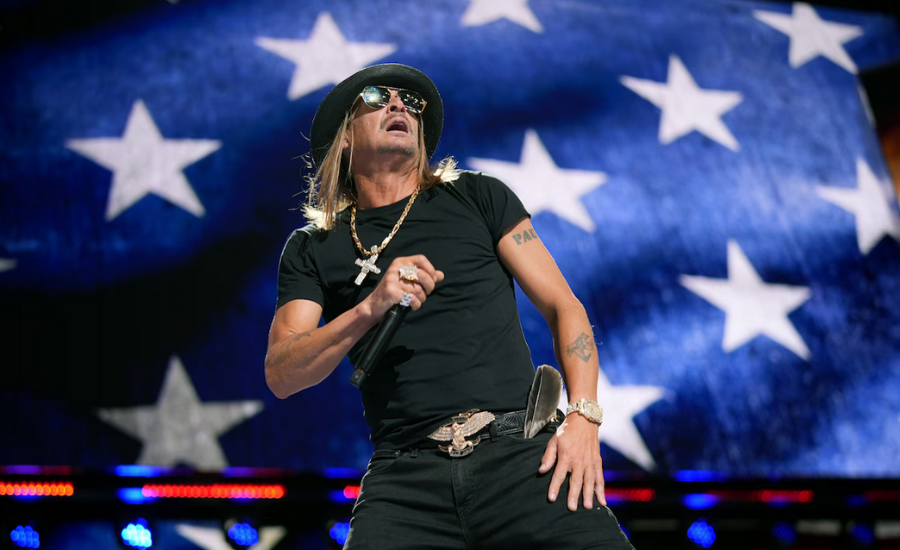
Kid Rock, headlining performer, appears on stage during Turning Point USA’s “All-American Halftime Show,” which aired online as an alternative to the NFL’s official Super Bowl halftime broadcast. (Getty)
However, Turning Point USA now says the audience was substantially larger.
Andrew Kolvet, a spokesperson for the organization and Executive Producer of The Charlie Kirk Show, said the alternative halftime show drew approximately 10 million concurrent viewers across all live streaming channels, including YouTube and affiliated conservative media platforms. Kolvet added that total viewership across social platforms has since surpassed 25 million views.
Media analysts note that even the lower, third-party estimates place the broadcast among the largest non-televised counterprogramming efforts ever mounted against a major live entertainment event.
Headlined by Kid Rock and several country artists, the alternative show was presented as a values-oriented event centered on faith, family, and patriotism, with overt Christian themes, including repeated references to Jesus, and without sexualized imagery, provocative choreography, or explicit lyrics.
Turning Point USA described it as an option for viewers who felt increasingly alienated by the direction of mainstream entertainment.
That sense of alienation had already been visible in the public debate surrounding the NFL’s halftime selection. Bad Bunny’s performance was widely praised by mainstream outlets as a celebration of cultural diversity and global influence. At the same time, conservative criticism of the show was met with swift backlash on social media, where dissenting viewers were often labeled intolerant or accused of racial or xenophobic motives.
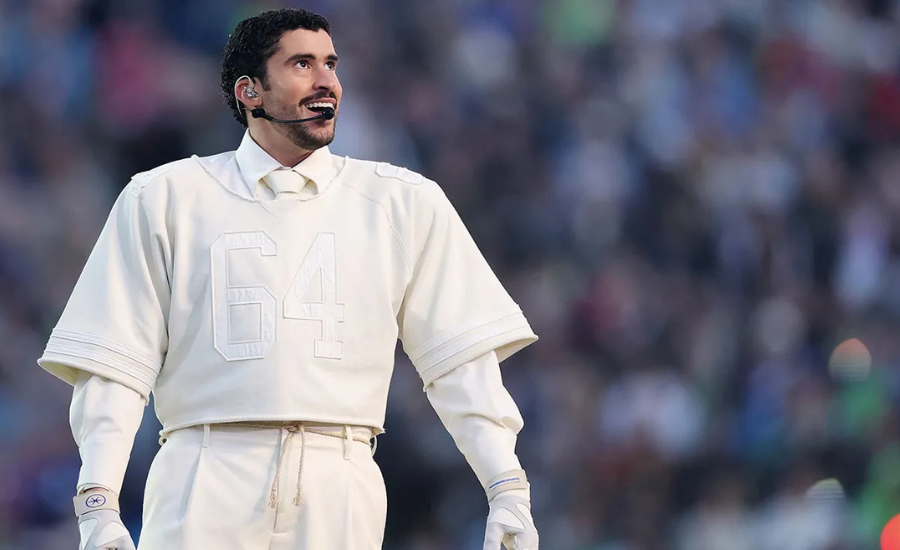
Bad Bunny, the Super Bowl halftime headliner performs during the NFL’s official halftime show at Super Bowl LX in Santa Clara, California. (Credit: Kevin C. Cox/Getty Images)
What emerged was not simply disagreement over taste, but a broader social dynamic around choice. Critics of the NFL halftime show were not only challenged on the merits of their objections, but frequently criticized for opting out altogether. The act of choosing an alternative was itself treated as a statement.
In that sense, participation appeared to be expected. Disagreement was framed less as personal preference and more as a moral or political violation. Opting out became a social risk.
This dynamic plays out against the backdrop of extraordinary institutional loyalty. The National Football League is not simply a sports organization. It is one of the most powerful cultural institutions in the United States, generating more than $18 billion in annual revenue and commanding an audience unmatched by any other entertainment property.
Polling data helps explain the intensity of the reaction, particularly the way institutional trust has become increasingly partisan. Surveys from Pew Research Center and Gallup over the past decade show widening partisan divides in trust toward media, corporations, and cultural institutions, alongside an overall decline in confidence. In that environment, loyalty is more tightly enforced, and dissent is more easily interpreted as defection rather than difference.
Turning Point USA has long positioned itself as an alternative infrastructure for conservatives who believe mainstream institutions no longer take them seriously. The organization was co-founded by the late Charlie Kirk, whose name continues to function as a cultural flashpoint even after his death. During the alternative halftime broadcast, a brief tribute to Kirk spotlighted his continued symbolic significance to supporters and critics alike.
The deeper question raised by the Bad Bunny halftime controversy is not whether the NFL made the right artistic choice, but who gets to define loyalty in a fragmented media environment. For much of the last century, mass culture operated on shared attention and limited alternatives. Today, shared moments still exist, but shared meaning does not.
Institutions built on scale have been slow to adjust to that shift.
The alternative halftime show did not threaten the NFL’s dominance, but it drew an audience large enough to be impossible to dismiss. Its importance lay in demonstrating that a large and motivated audience no longer views participation in mainstream culture as obligatory. Conservative viewers who felt unrepresented did not simply complain. They left, organized, and engaged on their own terms.
That is the message embedded in the numbers. Not a culture war victory or defeat, but a clear market signal in an era where loyalty is no longer automatic and consensus cannot be enforced by scale alone.
More on EEW Magazine Online:




The EEW Weekly Digest
Get EEW in Your Inbox
Our weekly digest brings the latest reporting on faith, culture, health, and the news that matters to Black Christian women straight to your inbox.
Subscribe FreeFree to join. Unsubscribe anytime.
Reader-Supported Journalism
Help Keep EEW Free and Growing
EEW Magazine Online is free for every reader, and we plan to keep it that way. Your support helps us expand our reporting on faith, culture, health, and the news that matters to Black Christian women. Become a monthly supporter today.
Support EEWGive once or monthly through PayPal. Gifts are tax-deductible to the extent allowed by law.
Waiting on God can be painful, but Scripture reveals purpose in the delay.