
The Gerrymandering Wars and the Language of Political Fear
As battles over gerrymandering intensify across America, political rhetoric has grown increasingly emotional and apocalyptic. Both parties have resorted to using fear-based language to mobilize supporters, blur the line between fact and framing, and shape public perception.
Written By Beverly St. John // EEW Magazine Online
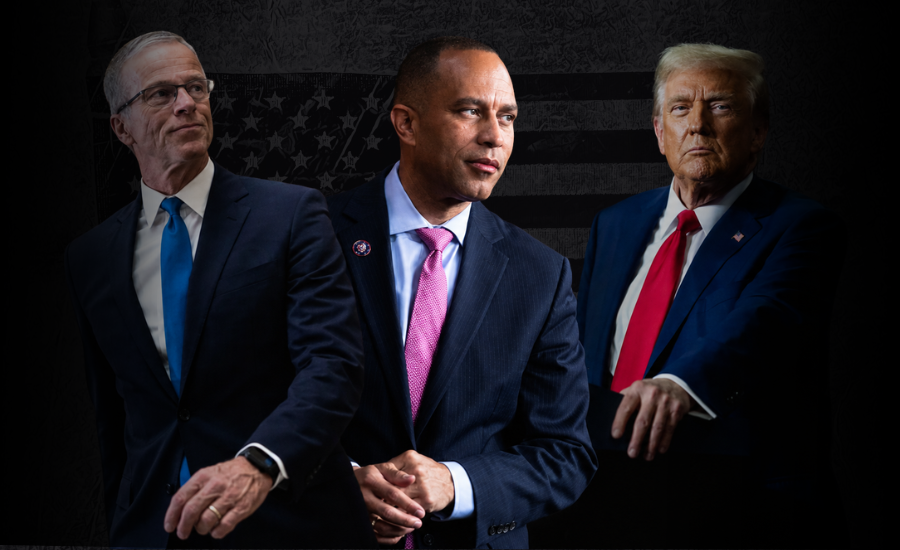
From left: John Thune, the top Republican in the Senate; Hakeem Jeffries, the top Democrat in the House; and Donald Trump, the Republican President of the United States. (Credit: EEW Magazine Online)
For many Americans, following politics no longer feels like the simple act of gathering information. It feels more like entering a permanent state of alarm.
Election seasons now arrive with warnings of collapsing democracy, stolen freedoms, rigged systems, corrupt courts, and national catastrophe. Politicians issue dire statements. Cable panels escalate them. Social media magnifies them. Fundraising emails sharpen them into emotional calls to action. Before long, voters trying to understand a policy dispute or court ruling find themselves sorting through a haze of outrage, fear, and partisan accusation.
The battles over gerrymandering offer one of the clearest examples of how modern political language operates.
Words like “extremist,” “suppression,” “rigged,” “threat to democracy,” and “cheating” have become standard vocabulary in speeches, press releases, campaign ads, and online discourse from both Republicans and Democrats. The result is a political environment where ordinary Americans are often asked to emotionally experience an issue before they have had the opportunity to fully understand it.
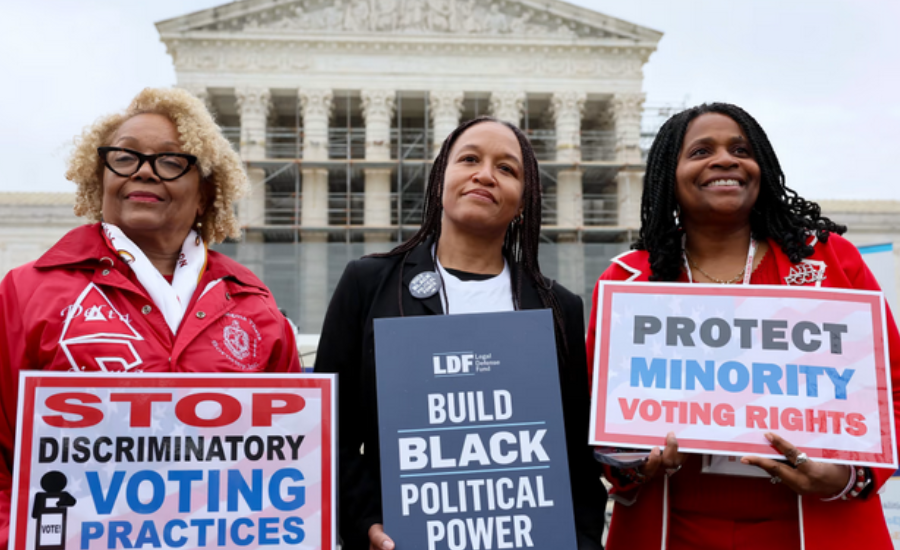
Photo Credit: Getty
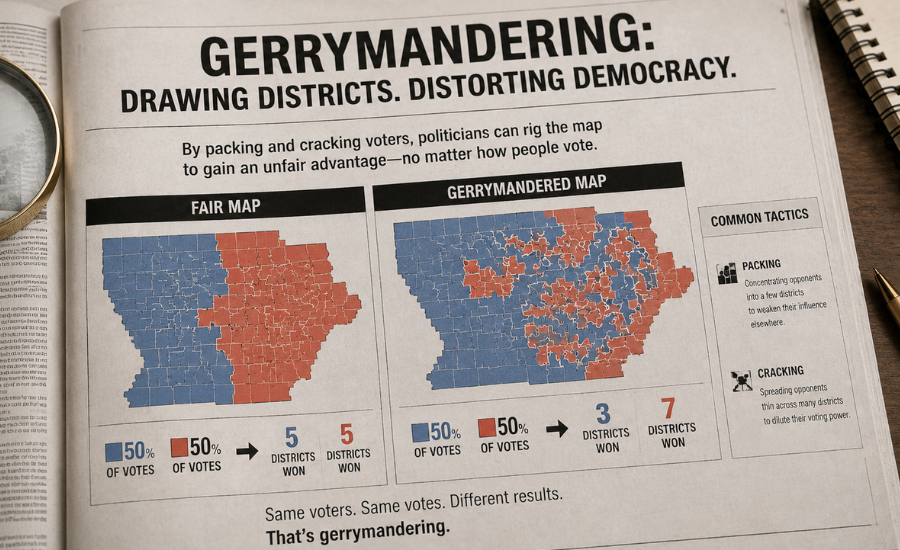
At its most basic level, gerrymandering is the practice of drawing political district lines in ways that advantage one group over another. The tactic is older than the modern Republican and Democratic parties themselves. Both parties have used it when controlling state legislatures and redistricting processes.
The strategy is neither especially mysterious nor subtle. District maps can be drawn to cluster large numbers of opposing voters into a small number of districts or divide communities across several districts to dilute their influence. Since congressional representation depends on district boundaries, those maps can significantly affect who wins elections and which party controls legislative power.
The fiercest legal fights tend to emerge when race intersects with redistricting.
In Southern states especially, civil rights organizations and Democratic officials have argued that some district maps weaken Black political representation by splitting heavily Black communities apart. Republicans have often responded that the maps reflect political geography rather than racial targeting and point out that Democratic-led states also aggressively redraw districts to preserve partisan advantage.
The disputes themselves are legitimate and longstanding. The language surrounding them has changed.
Credit: EEW Magazine Online
Modern political rhetoric increasingly treats procedural battles as existential conflicts. A court ruling is rarely described as simply a court ruling. It becomes an attack on democracy or a defense of constitutional order. A district map is no longer merely politically advantageous. It is evidence of authoritarianism, corruption, suppression, or institutional collapse.
The escalation predates the current political era.
The contested 2000 election between George W. Bush and Al Gore deepened distrust surrounding elections and judicial intervention. The Iraq War intensified ideological division. Hurricane Katrina exposed sharp political and racial tensions over government competence and media coverage. The presidencies of Barack Obama and Donald Trump widened existing cultural and political fractures that had already been building for years.
Trump’s entrance into national politics accelerated the tone and intensity of partisan communication in ways difficult to ignore. Supporters viewed him as a disruptive outsider confronting a broken political establishment. Opponents viewed him as a uniquely dangerous figure whose rise posed serious risks to democratic norms and institutions. Political rhetoric adapted accordingly. Every election became historic. Every loss became catastrophic. Every victory became proof of either national salvation or national decline.
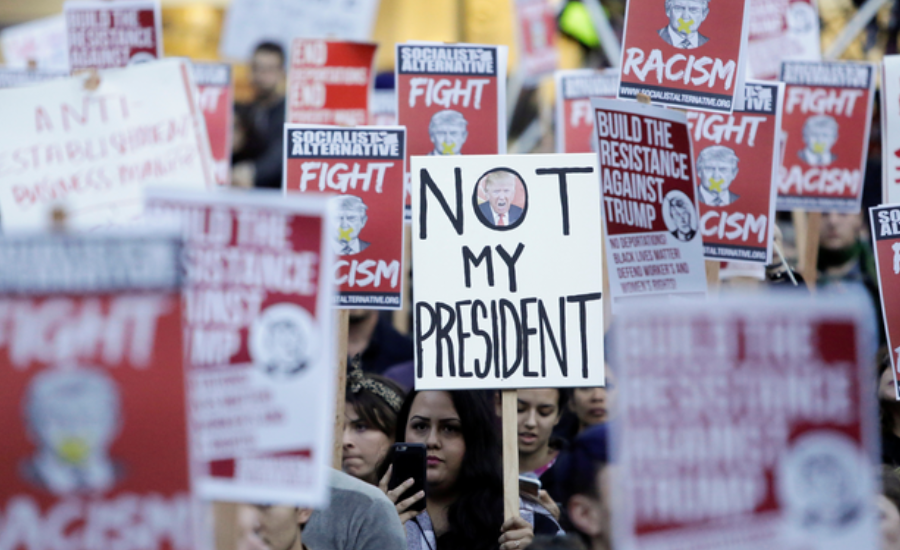
Photo Credit: Reuters
In that environment, the distinction between factual reporting and political framing often becomes difficult to separate.
Consider the difference between these statements:
“A state legislature approved new congressional district maps.”
“Lawmakers rigged the system to silence voters.”
Or these:
“The Supreme Court upheld the maps.”
“The Supreme Court enabled an assault on democracy.”
The underlying event remains the same. The emotional interpretation changes completely.
Political language has always involved persuasion. Candidates and parties are not neutral observers. They are advocates competing for power, attention, money, and public support. Emotion has long been central to political organizing.
What has changed is the saturation level.
The modern voter now encounters political messaging almost continuously. News alerts arrive by phone. Social media feeds reward outrage and conflict. Podcasts, influencers, campaign emails, partisan commentary, and algorithm-driven platforms compete for attention by presenting events in the starkest possible terms. Escalation performs well. Moderation rarely goes viral.
The cumulative effect can be emotionally exhausting.
Research has increasingly linked heavy political media consumption to anxiety, anger, stress, and emotional fatigue. Voters often absorb political conflict less as civic information and more as a running emotional crisis. The constant framing of elections as existential emergencies leaves little room for proportion, patience, or ambiguity.
None of this means the underlying issues are unimportant. Gerrymandering carries real consequences. Voting rights disputes matter. Representation matters. Court decisions matter. Political power shapes policy, law, and daily life.
But understanding those realities requires enough distance to separate the event itself from the rhetoric built around it.
That distinction has become harder to maintain in a political culture where emotionally loaded language functions as both communication strategy and identity signal. Terms like “extremist,” “traitor,” “fascist,” “communist,” “threat,” and “enemy” do more than describe opponents. They divide the political landscape into moral camps, rewarding loyalty while intensifying distrust.
The public response often follows predictably. Fear fuels engagement. Engagement fuels algorithms. Algorithms amplify conflict. Conflict drives fundraising, media attention, and voter turnout. The cycle sustains itself.
For voters trying to remain informed without becoming consumed by political anxiety, the most useful questions are often the simplest ones.
What objectively happened?
What part of the statement is verifiable fact?
What part is interpretation?
What emotional response is the language attempting to produce?
Political conflict is not new in America. Fierce disagreements over power, representation, race, and ideology have shaped the country since its founding. The current battles over gerrymandering are part of that long tradition.
What feels newer is the emotional temperature surrounding nearly every political dispute. The rhetoric no longer merely argues a position. Increasingly, it demands emotional enlistment.
For many Americans, learning to recognize that distinction may be one of the most important civic skills of the modern political age.
More on EEW Magazine Online:





The EEW Weekly Digest
Get EEW in Your Inbox
Our weekly digest brings the latest reporting on faith, culture, health, and the news that matters to Black Christian women straight to your inbox.
Subscribe FreeFree to join. Unsubscribe anytime.
Reader-Supported Journalism
Help Keep EEW Free and Growing
EEW Magazine Online is free for every reader, and we plan to keep it that way. Your support helps us expand our reporting on faith, culture, health, and the news that matters to Black Christian women. Become a monthly supporter today.
Support EEWGive once or monthly through PayPal. Gifts are tax-deductible to the extent allowed by law.
Waiting on God can be painful, but Scripture reveals purpose in the delay.