
Redistricting Efforts Face Setbacks in South Carolina, Alabama
Legal and political disputes over congressional maps continue to unfold across multiple states ahead of the 2026 midterm elections.
By EEW Magazine Online News Editors
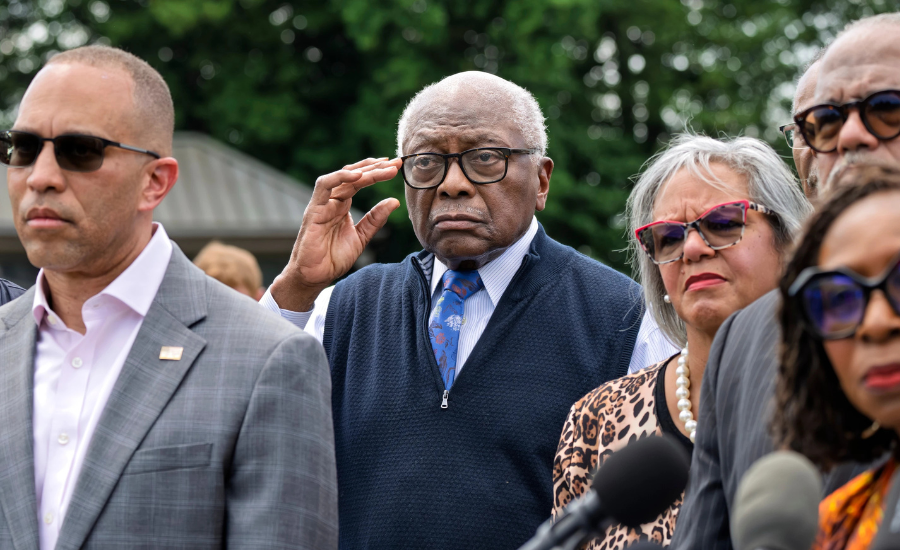
Rep. Jim Clyburn, D-S.C., center, joined by House Minority Leader Hakeem Jeffries, D-N.Y., left, and members of the Congressional Black Caucus, stands outside the Capitol in Washington on Tuesday, May 19, 2026. (AP Photo/J. Scott Applewhite)
The South Carolina Senate on Tuesday declined to advance a proposal to redraw the state’s congressional districts ahead of the November midterm elections, while a federal court in Alabama temporarily blocked a newly approved congressional map from taking effect.
The developments come amid ongoing redistricting efforts in several states following recent court rulings affecting voting rights and district boundaries.
In South Carolina, lawmakers debated a Republican-backed proposal that would have canceled existing congressional primary elections and scheduled new primaries under revised district maps. The proposed changes were intended to alter the configuration of districts currently represented by Democrats, including longtime U.S. Rep. Jim Clyburn.
Some Republican senators opposed moving forward with the proposal because early voting in the state’s primaries had already begun.
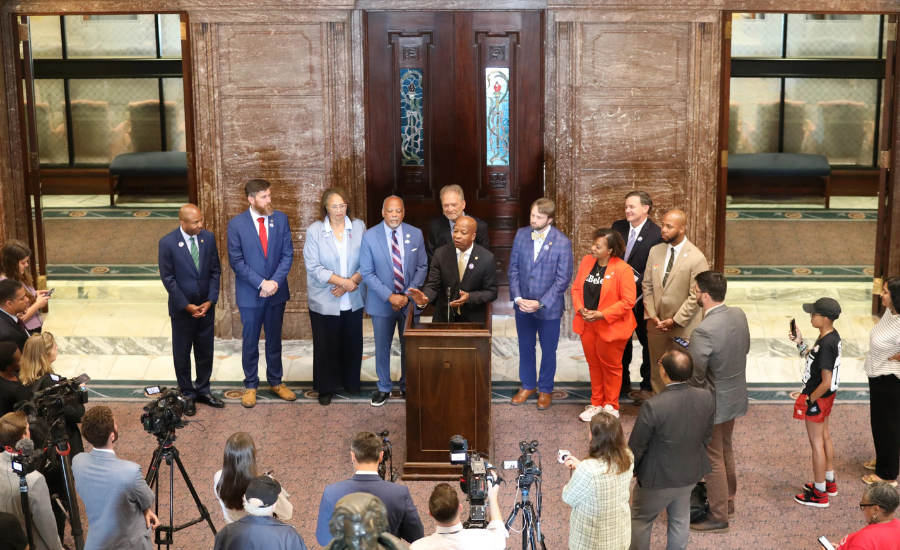
Democratic South Carolina senators speak at a news conference after a redistricting bill was killed on Tuesday, May 26, 2026, in Columbia, S.C. (AP Photo/Jeffrey Collins)
“South Carolina citizens are going to the polls today,” Republican state Sen. Richard Cash said during a debate. “Neither my conscience or common sense is going to let me stop an election that is already underway.”
More than 32,000 ballots had been cast by early Tuesday afternoon, according to figures cited during the debate.
President Donald Trump had publicly encouraged Republican-led states to reconsider congressional maps ahead of the midterm elections. According to the Associated Press, Trump discussed the South Carolina proposal with Republican legislative leaders and publicly supported the effort on social media.
Democrats opposed the proposal, while some Republican lawmakers also expressed concern that additional redistricting could create unintended political consequences in some GOP-held districts.
In Alabama, a three-judge federal panel issued a preliminary injunction preventing the state from using a recently approved congressional map in upcoming elections. The court ruled that the map likely violated constitutional protections by discriminating on the basis of race.
The panel ordered Alabama to continue using a court-drawn map that includes two districts with substantial Black populations while litigation continues. Alabama Attorney General Steve Marshall said the state plans to appeal the ruling to the U.S. Supreme Court.
Legal disputes over congressional maps are also continuing in several other states.
In Florida, a state judge declined to block new congressional districts approved by the Republican-controlled Legislature. Voting rights organizations challenging the map said they intend to appeal.
In Tennessee, a federal court denied a request for a temporary restraining order against newly approved congressional districts that are also facing legal challenges related to allegations of racial discrimination.
Redistricting typically occurs after each decennial census. However, multiple states have revisited congressional maps ahead of the 2026 midterm elections following legal and political challenges to existing district boundaries.
In Louisiana, lawmakers are continuing discussions over possible congressional map revisions after a federal appeals court struck down one of the state’s majority-Black districts earlier this year.
Meanwhile, members of the Congressional Black Caucus on Tuesday called on corporations to publicly oppose redistricting efforts they say reduce Black voting representation.
More on EEW Magazine Online:





The EEW Weekly Digest
Get EEW in Your Inbox
Our weekly digest brings the latest reporting on faith, culture, health, and the news that matters to Black Christian women straight to your inbox.
Subscribe FreeFree to join. Unsubscribe anytime.
Reader-Supported Journalism
Help Keep EEW Free and Growing
EEW Magazine Online is free for every reader, and we plan to keep it that way. Your support helps us expand our reporting on faith, culture, health, and the news that matters to Black Christian women. Become a monthly supporter today.
Support EEWGive once or monthly through PayPal. Gifts are tax-deductible to the extent allowed by law.
Waiting on God can be painful, but Scripture reveals purpose in the delay.