
The Problem With Calling Modern America “Jim Crow 2.0”
From the violent overthrow of Black political power in Wilmington in 1898 to the murder of Black voter Maceo Snipes in 1946, the historical record reveals a level of racial exclusion and terror that modern America, for all of its tensions and inequities, no longer structurally resembles.
Written By Dianna Hobbs // EEW Magazine Online
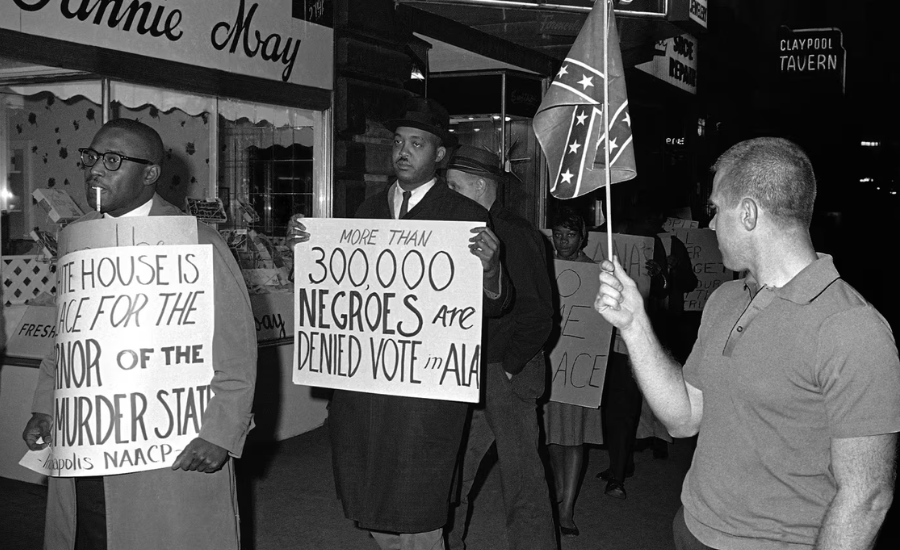
Civil rights demonstrators protest Black voter disenfranchisement in Alabama during the Jim Crow era. (Credit: Bob Daugherty/AP)
In November 1898, white supremacists in Wilmington, North Carolina overthrew a legitimately elected interracial local government through violence. Armed mobs burned Black-owned businesses, drove elected officials from office and terrorized Black residents throughout the city.
Newspaper accounts described Black citizens fleeing into nearby swamps and woods as armed white men patrolled the streets. Historians now recognize the Wilmington Massacre as the only successful coup d’état in American history.
The purpose was not hidden. It was announced openly.
Black political participation had expanded during Reconstruction, and Wilmington had developed into one of the South’s most economically successful Black communities. To white supremacists determined to reestablish racial control, that progress itself had become intolerable. The coup was designed to reverse it.
Nearly fifty years later, in July 1946, a Black World War II veteran named Maceo Snipes cast a ballot in Taylor County, Georgia. Historians believe he was the only Black man to vote in the county’s Democratic primary that year. The following day, white men arrived at his family’s home and shot him. Snipes later died after delayed treatment at a segregated hospital.
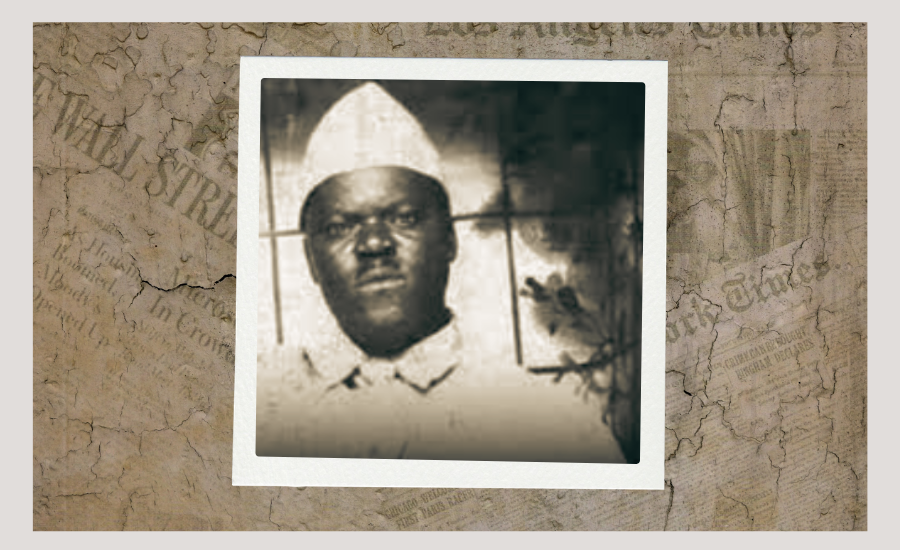
Maceo Snipes, a Black World War II veteran, was shot in 1946 after casting a ballot in a Georgia Democratic primary. Historians widely regard the killing as retaliation for voting during the Jim Crow era.
It is difficult to read accounts like these and not understand why the language surrounding voting rights still carries emotional force inside many Black communities. The memory of exclusion was not abstract. In large sections of the country, Black political participation carried genuine personal risk. Citizens who attempted to organize, register or vote often did so understanding the consequences could extend well beyond the ballot box.
That history still hangs over modern political arguments, particularly as debates surrounding voting laws, redistricting and election procedures increasingly borrow the language of Jim Crow.
During a recent CNN panel discussion on race, congressional maps and voting rights, Democratic commentator Bakari Sellers argued that modern America differs little from the segregationist South of the late nineteenth century.
“If somebody fell asleep in 1896 and woke up today in 2026,” Sellers said, “they would simply say the only difference is now Negroes have a TV show and we wear nice suits. They swapped out Klan hoods for Brooks Brothers suits.”
Sellers’ reference to 1896 was not random. That was the year the Supreme Court decided Plessy v. Ferguson, the ruling that gave constitutional protection to segregation under the doctrine of “separate but equal.” For generations afterward, Jim Crow laws governed nearly every aspect of public life across much of the South.
The reference sparked controversy, and the exchange soon deteriorated. Fellow panelist Kevin O'Leary, the businessman and “Shark Tank” investor, argued that the dispute amounted to ordinary “map wars” between political parties and told viewers to “get over it,” insisting that states have constitutional authority over redistricting.
Sellers responded by invoking the civil rights movement and his own family history, recalling that his mother helped desegregate schools and that his father had once been shot for his involvement in civil rights activism.
As O’Leary repeatedly interrupted the former South Carolina state representative, Sellers eventually snapped, “Don’t be a d*ck,” prompting Phillip to caution the panel and call for “a modicum of respect at this table.”
Sellers is hardly alone in drawing the comparison. Senate Democratic Leader Chuck Schumer recently referred to the SAVE Act as “Jim Crow 2.0.”
Former President Joe Biden repeatedly described Republican-backed voting laws as “Jim Crow in the 21st Century.”
The comparison resonates because it grows from a recognizable reading of American history. Many Black Americans understand racial progress and racial backlash as recurring features of the national story. Reconstruction produced Black officeholders and Black political participation, followed by segregation and violent suppression.
The civil rights movement produced landmark legislation, followed by decades of political realignment, battles over affirmative action, law-and-order politics and renewed fights over voting access. The election of Barack Obama was followed by the rise of populist grievance politics and renewed conflict over election law and national identity.
Within that framework, modern disputes over congressional maps, voter-identification requirements and Voting Rights Act enforcement can appear less like isolated policy disagreements and more like familiar struggles over race and political power. There is seriousness underneath some of those concerns, even when the political framing stretches beyond what the historical comparison can reasonably support.
RELATED:The Gerrymandering Wars and the Language of Political Fear
Race still shapes American political life, and court decisions still carry enormous consequences for representation and voting rights. Gerrymandering can alter political influence in ways that are neither imaginary nor insignificant. Historical memory does not disappear simply because legislation changes.
Yet the comparison begins to strain once modern America is placed beside the actual mechanics of Jim Crow itself.
Jim Crow was not simply racial polarization or campaign-season hyperbole. It was a legal and social order organized around racial exclusion. Black Americans across large sections of the country were denied meaningful access to democratic participation through poll taxes, literacy tests, intimidation campaigns and violence. Segregation governed schools, transportation, hospitals, housing and public accommodations. Lynchings functioned as instruments of terror and social control. In many communities, local authorities either refused to intervene or actively participated in maintaining the system.
Modern America contains racial tensions and political conflict over race. Jim Crow America was constructed around formal racial subordination backed by law and violence.
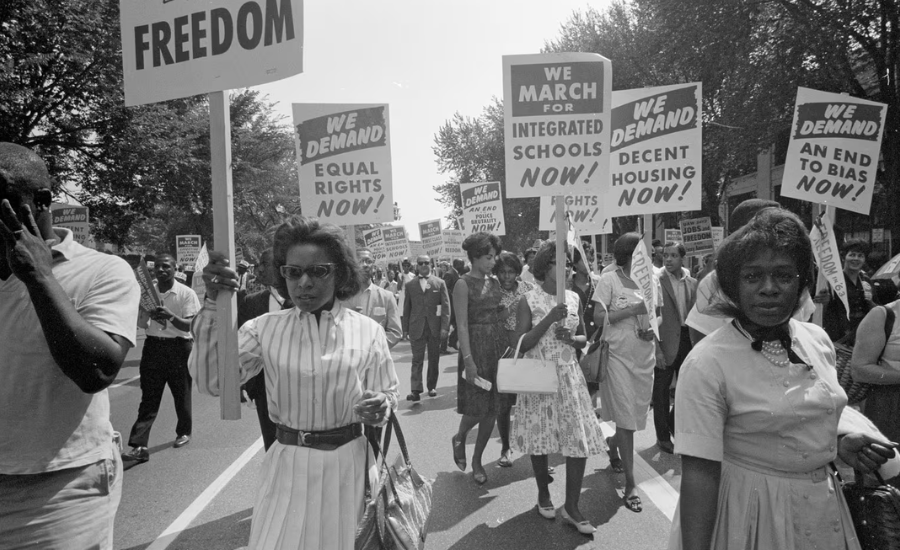
Civil-rights demonstrators march for voting rights, school integration and fair housing during the civil-rights era. (Credit: OER Commons/Creative Commons)
The current debate often becomes muddled around the language of “disenfranchisement,” a word that now carries a broader meaning than it once did. Historically, disenfranchisement referred to the deliberate removal of political participation itself. Black citizens were prevented from voting through systems intentionally designed to keep them outside democratic life altogether.
Today, the term is frequently used to describe policies that may weaken turnout, reduce electoral leverage or alter political representation. Those concerns can be legitimate subjects for debate. A congressional map that dilutes Black voting strength deserves scrutiny. Election procedures should be examined carefully to ensure fairness and equal access.
Still, there remains an enormous historical distance between a Black voter navigating a modern identification requirement and a Black voter in the Jim Crow South risking violence for attempting to cast a ballot at all.
One reality involves disputes within a constitutional system where Black Americans possess legal recourse, institutional influence and national political power. The other involved systematic exclusion enforced through fear.
The United States twice elected a Black president. Kamala Harris served as vice president. Ketanji Brown Jackson now sits on the Supreme Court. Hakeem Jeffries currently leads Democrats in the House of Representatives. Black Americans serve as governors, mayors, federal judges, military leaders, university presidents and chief executives of major corporations. Black political influence in modern America is not symbolic or marginal. It is woven directly into the structure of national life.
Jim Crow existed precisely to prevent that reality from emerging.
None of this requires pretending racism disappeared. It did not. The country still wrestles with disparities in education, wealth, criminal justice and health outcomes. Historical wounds continue shaping modern institutions and communities in visible ways. America remains imperfect, uneven and historically unsettled on matters of race.
But if every modern racial controversy becomes Jim Crow, the phrase eventually loses historical meaning.
There is another cost as well, one that receives far less attention in political commentary. Racial trauma is real. The memory of segregation is real. The inheritance of fear, humiliation and exclusion still lives inside families and communities. Public figures should handle that inheritance carefully. When modern America is repeatedly described as functionally indistinguishable from the era of lynching, legalized segregation and violent voter suppression, younger generations can inherit a view of the country that flattens genuine historical differences into a single continuous story of oppression.
Black Americans do not need exaggerated comparisons in order to recognize injustice. The country does not need historical distortion in order to confront unresolved racial problems honestly. America can acknowledge continuing inequities without pretending nothing has changed since 1896.
The American story has always been harder to tell than modern politics would prefer. The nation that produced Wilmington also produced the Civil Rights Act. The nation that allowed Maceo Snipes to die after voting also produced generations of Black lawmakers, judges, scholars, activists and institutional leaders who transformed the country from within.
Both histories belong to the American story.
Modern political discourse rewards emotional urgency. Sharp analogies travel faster than careful analysis. Fear mobilizes audiences more effectively than restraint. That temptation exists across the political spectrum.
Still, movements built around justice eventually weaken themselves when they abandon proportion. History demands enough discipline to distinguish between echoes of the past and the past itself.
Dianna Hobbs is founder and publisher of EEW Magazine.
More on EEW Magazine Online:



The EEW Weekly Digest
Get EEW in Your Inbox
Our weekly digest brings the latest reporting on faith, culture, health, and the news that matters to Black Christian women straight to your inbox.
Subscribe FreeFree to join. Unsubscribe anytime.
Reader-Supported Journalism
Help Keep EEW Free and Growing
EEW Magazine Online is free for every reader, and we plan to keep it that way. Your support helps us expand our reporting on faith, culture, health, and the news that matters to Black Christian women. Become a monthly supporter today.
Support EEWGive once or monthly through PayPal. Gifts are tax-deductible to the extent allowed by law.
Waiting on God can be painful, but Scripture reveals purpose in the delay.