
Texas Becomes First State to Make Bible Passages Mandatory Reading in Public Schools
Texas just made history. The state's education board voted to make Bible passages required reading for over 5 million public school students, making Texas the first in the nation to mandate a full literary canon including Scripture.
By EEW Magazine Online News Staff
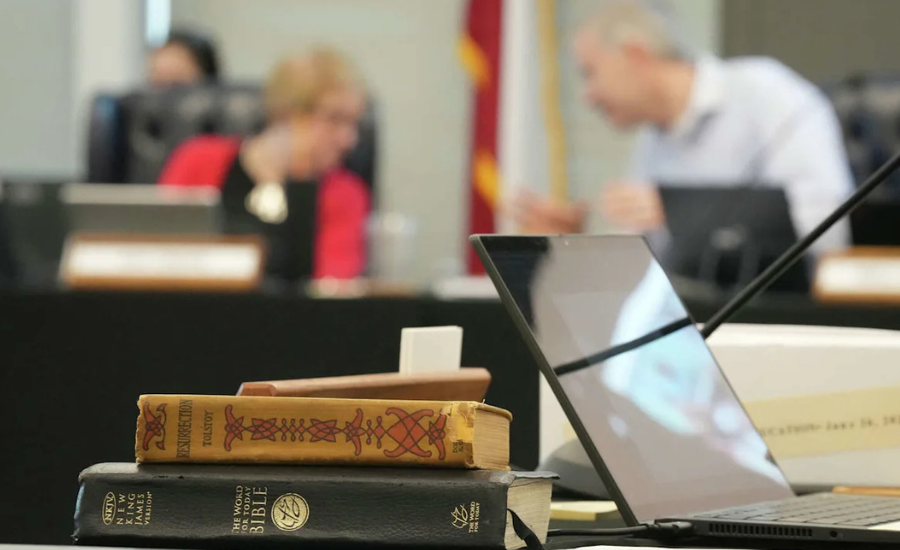
A Bible and a copy of Leo Tolstoy's "Resurrection" rest on the desk of State Board of Education member LJ Francis during the June 22, 2026, meeting in Austin where the board was considering the statewide required reading list that would add Bible passages to public school curriculum. Photo Credit: Jay Janner/Austin American-Statesman
The Texas State Board of Education voted Friday to require more than 5 million public school students to read Bible passages as part of a sweeping new statewide reading list, a move education experts say appears to be a national first.
The Republican-controlled board passed the list 9-5-1, making Texas the first state in the country to mandate a literary canon for every public school student from kindergarten through twelfth grade.
The new list contains around 200 texts, including Bible passages, essays, and books, far exceeding a 2023 state law that required at least one mandatory literary work per grade level.
The passages are embedded within an English Language Arts curriculum alongside classic literary works, not taught as a standalone Bible class or devotional exercise.
The new standards, known as Texas Essential Knowledge and Skills (TEKS), received final approval Friday and will take effect beginning in the 2030-31 school year.
The list includes a picture-book adaptation of the David and Goliath story for elementary students and Bible passages about Adam and Eve for older students, among other references.
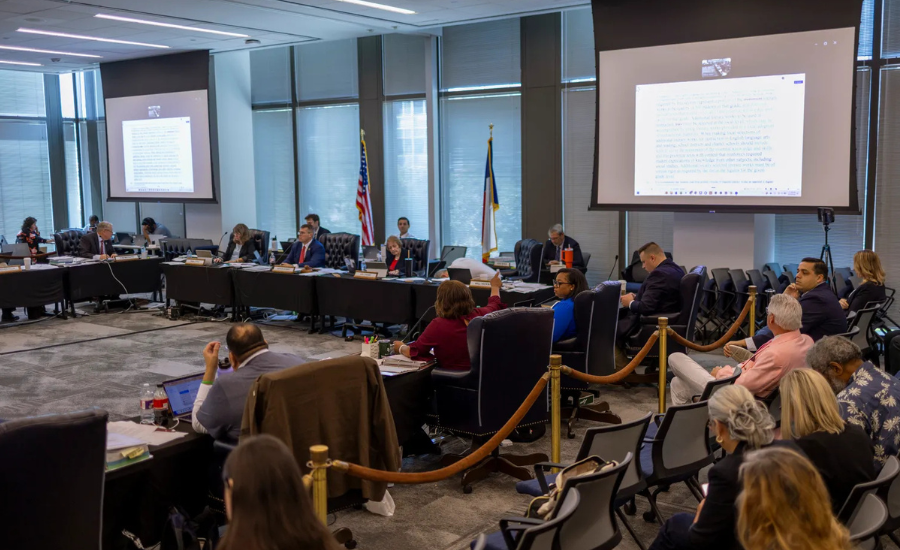
Members of the Texas State Board of Education debate amendments during the June 26, 2026, meeting in Austin where the board voted to add Bible passages to a statewide required reading list affecting more than 5 million public school students. Photo Credit: Leila Saidane/The Texas Tribune
By fourth grade, students will encounter passages about Jesus in the New Testament.
In middle school, students will be expected to read passages about Jesus, including his most famous sermon and another where he instructs people to cast aside earthly anxiety and seek the kingdom of God.
The King James Version is specifically cited in the standards.
The board also approved rewritten K-8 social studies lessons that narrow the view of history from a global one to a focus on U.S. and Texas history.
Supporters of the measure framed the Bible passages as essential to understanding Western civilization. Board member Julie Pickren, a Republican, said the readings are intended to give students "important insight into the moral and philosophical traditions that have shaped Western civilization."
Board member Evelyn Brooks, however, opposed the list on constitutional grounds. Brooks argued the mandate stripped teachers of autonomy they have exercised for decades in selecting books, and called the list "unconstitutional."
Critics raised pointed concerns about what the new list excludes. Antero Garcia, president of the National Council of Teachers of English and a professor at Stanford University, noted that no other religious texts appear on the list alongside the Bible, and said prolonged, exclusive exposure to a single religious text across a student's entire public school career could potentially steer children toward Christianity.
Kasey Meehan, director of PEN America's Freedom to Read program, described the strict requirements as amounting to "almost de facto censorship," saying the list "leans ideologically more conservative" and "excludes a lot of diverse voices."
Carisa Lopez, deputy director of the Texas Freedom Network, said religion "absolutely has a place in education" if taught without bias toward any particular faith, but argued that teaching "a very particular type of Christianity" in a biased way "belongs at home, and belongs in the religious institutions."
The vote is the latest in a series of moves by Texas to bring Christian content into public schools. Texas last year became the largest state to require classrooms to display the Ten Commandments, a law recently upheld in federal court. In 2023, the state became the first to allow chaplains to counsel students, and the following year approved a measure that offered more funding to schools that teach an optional Bible-infused elementary school curriculum.
Garcia warned that Texas's influence on other states could be significant. "Oftentimes, where Texas goes, other states will follow," he said, describing the decision as a move he could "imagine other states picking up and moving forward with as a possibility."
Supporters pushed back on that framing. Former public school administrator Nancy Barker told the board that Bible readings would give students the background knowledge needed to understand "the books, the speeches, poems and important documents that have shaped our civilization."
One board member predicted the new list would lift reading scores and help children "just learning and loving to read again."
Legal challenges are widely anticipated, though none have been filed as of this report.
More on EEW Magazine Online:




The EEW Weekly Digest
Get EEW in Your Inbox
Our weekly digest brings the latest reporting on faith, culture, health, and the news that matters to Black Christian women straight to your inbox.
Subscribe FreeFree to join. Unsubscribe anytime.
Reader-Supported Journalism
Help Keep EEW Free and Growing
EEW Magazine Online is free for every reader, and we plan to keep it that way. Your support helps us expand our reporting on faith, culture, health, and the news that matters to Black Christian women. Become a monthly supporter today.
Support EEWGive once or monthly through PayPal. Gifts are tax-deductible to the extent allowed by law.
Scripture holds two truths without strain. God reigns completely. Man chooses freely. A study through Samson, Joseph, Pharaoh, the Cross, and the Potter and the Clay.