
Forgiveness Did What Revenge Couldn't: A Review of Netflix's "The Polygamist"
Netflix's South African hit "The Polygamist" is messier than it is great. But what it says about bitterness, revenge, and forgiveness is worth your time.
By Alicia Derwin // EEW Magazine Entertainment Editor

Gugu Gumede as Joyce Gomora at her husband's funeral in Netflix's "The Polygamist," the South African drama that drew 19.1 million viewing hours in its first week. (Credit: Netflix)
Content note: "The Polygamist" is rated TV-MA and contains frequent sexual content, strip club scenes, and adult themes throughout. Viewer discretion is advised.
Every act of revenge in Netflix's South African drama "The Polygamist" belongs to Joyce Gomora. She planned it. She executed it. She waited years for it to deliver what years of patience could not. The woman who walks away with something that looks like freedom, though, is not Joyce.
It is Mpume, her daughter, who forgave a man who never apologized.

Noluthando Shabalala as Mpume Gomora in Netflix's "The Polygamist." The character's quiet decision to forgive her dying father without an apology is the moral turning point of the series. (Credit: Netflix)
Joyce spent 22 episodes pursuing justice through revenge. Mpume found freedom through forgiveness in 30 seconds.
That is what makes "The Polygamist" worth examining, more than the scandal, more than the spectacle, more than the body count of broken relationships surrounding Jonasi Gomora.
The series has clearly struck a chord. All 22 episodes arrived on Netflix on June 12, and within 24 hours the show entered the platform's Top 10 in South Africa and debuted at No. 4 on the global Non-English TV chart, pulling 19.1 million hours of viewing in its first week.

Gugu Gumede as Joyce Gomora and Kwanele Mthethwa as Matipa in Netflix's "The Polygamist." Matipa, an ambitious corporate climber who became Jonasi's third wife and the mother of his twins, sits at the center of the family scandal that unravels his carefully constructed double life. (Credit: Netflix)
The social media conversations surrounding it have centered less on Jonasi himself than on Joyce, whose marriage has become a mirror many women recognize. That recognition explains why the show has generated conversations far beyond entertainment, including a public statement from the Gauteng Department of Health using the storyline to promote HIV and STI awareness.
Those conversations deserve a more honest show than the one Netflix delivered.
Showrunner Akin Omotoso and head writer Busisiwe Zwane have adapted Zimbabwean author Sue Nyathi's 2012 novel with visible ambition and a premium production budget. The series looks expensive. It also feels, around its midpoint, like a story that lost confidence in what it was saying and decided to say more things instead.
Twenty-two episodes is a long commitment, and the middle section earns the fatigue it produces. The writing too often reaches for dramatic escalation where character development would have served better.
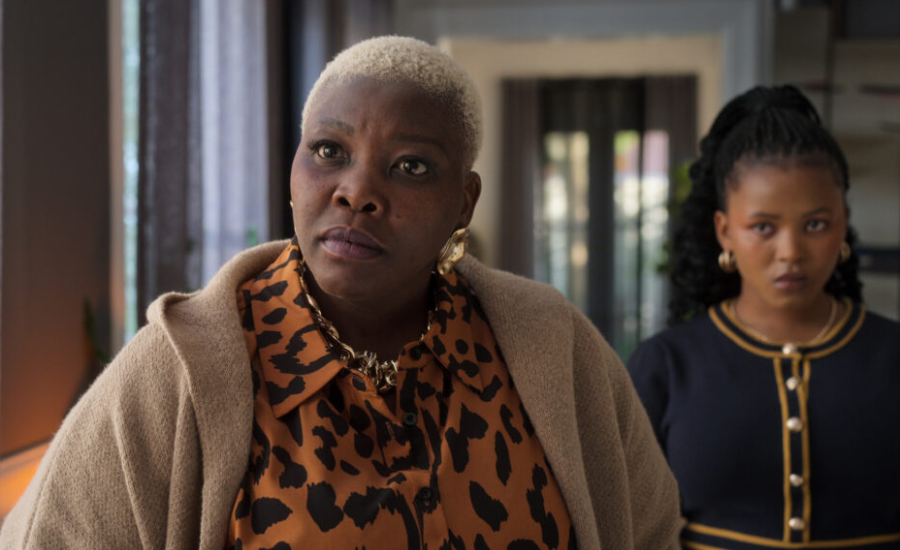
Celeste Ntuli as Essie, Jonasi Gomora's secret wife, and Lwazie Keith Tsebesha as their daughter Sarah in Netflix's "The Polygamist." (Credit: Netflix)
The performances hold it together when the writing cannot. Gugu Gumede as Joyce carries the series and never drops it. She plays a woman who decided long ago that managing the narrative was the only form of power her marriage allowed, and every scene shows exactly when she made that decision and what it cost her.
Noluthando Shabalala as Mpume delivers the series' quietest and most powerful performance, a daughter navigating loyalty to a father who keeps failing to earn it. She is the moral conscience of a story that often forgets to have one.
S'dumo Mtshali as Jonasi deserves separate attention.

S'dumo Mtshali as Jonasi Gomora in Netflix's "The Polygamist." The character's serial deception, unchecked entitlement, and refusal to accept accountability have made him one of the most talked-about villains in recent streaming television. (Credit: Netflix)
He is frightening precisely because he is believable. Jonasi rarely sees himself as the villain. Every betrayal arrives wrapped in self-justification.
Every deception gets framed, in his own mind, as a reasonable response to what everyone else failed to give him. That moral blindness makes him far more unsettling than a cartoon tyrant ever could. The series wisely trusts viewers to recognize how ordinary selfishness, left entirely unchecked and never confronted, can devastate generations.

S'dumo Mtshali as Jonasi Gomora and Gugu Gumede as Joyce in Netflix's "The Polygamist." Mtshali, a SAFTA Award winner, plays a man whose charm and self-justification make him more unsettling than any cartoon villain could. (Credit: Netflix)
That generational devastation is what the show is actually about. The story opens at Jonasi's funeral and spends 22 episodes answering how it came to this. The more compelling question the series does not realize it is asking: what did years of living inside Jonasi's world turn Joyce into?
That is the tragedy the show cannot quite bring itself to state. Joyce spent two decades absorbing his deception, manipulation, and abuse. By the final movement, she is executing a revenge scheme of surgical precision. She is patient. She is calculated. She reads her target perfectly. She plays the long game. She wins.
Those are exactly the qualities Jonasi used to build his empire and destroy his family.

The volatile relationship between Joyce and Jonasi, marked by emotional twists, mounting tension, and undeniable chemistry, captivated millions of viewers around the world. (Credit: Netflix)
Jonasi taught Joyce how to be him. Bitterness is a discipline. Given enough time, it shapes the wounded into the image of the one who wounded them.
Hebrews 12:15 warns against precisely this: "lest any root of bitterness springing up trouble you, and thereby many be defiled." Jonasi died. The bitterness he cultivated in Joyce did not.
Mpume's encounter with her dying father, on the other hand, is 30 seconds of pure theology.
She tells him plainly, "Gomora, from today onward I want you to know that I forgive you," and walks out. The scene functions first as a character moment, but it carries unmistakable theological weight.
Romans 12:19 is clear: "Vengeance is mine; I will repay, saith the Lord." Scripture never asks the wounded to pretend evil never happened. It simply refuses to let vengeance become their calling. Mpume trusted that enough to let the offense go.

Noluthando Shabalala as Mpume (L), Gugu Gumede as Joyce Gomora (M), and Wonder Ndlovu as Menzi Gomora (R) at Jonasi's funeral in Netflix's "The Polygamist." Two children of the same man, each facing a choice about which part of his legacy to carry forward. (Credit: Netflix)
Jonasi's patterns, the deception, the entitlement, the inability to love without consuming, were always going to find a new vessel in that house. The finale names it. Joyce maneuvered Jonasi on his deathbed into signing his empire over to their son Menzi, believing he would carry things differently.
The series' final revelations suggest he carries them all too well.
What Jonasi modeled, Menzi absorbed. The wealth transferred. So did the pattern. Mpume's forgiveness is her refusal of that same inheritance. She cannot prevent the cycle from continuing in her brother. She can only decide it ends with her.
"The Polygamist" is uneven television held together by strong lead performances and a central dramatic question more theologically loaded than its creators appear to recognize.
Watch it with that question in mind.
Watch what revenge costs Joyce and what forgiveness returns to Mpume.
Revenge finally buried Jonasi. Forgiveness finally freed Mpume. What lingers after the credits roll is not who won or who lost, but which inheritance each generation chooses to keep.
All 22 episodes of "The Polygamist" are streaming now on Netflix.
More on EEW Magazine Online:





The EEW Weekly Digest
Get EEW in Your Inbox
Our weekly digest brings the latest reporting on faith, culture, health, and the news that matters to Black Christian women straight to your inbox.
Subscribe FreeFree to join. Unsubscribe anytime.
Reader-Supported Journalism
Help Keep EEW Free and Growing
EEW Magazine Online is free for every reader, and we plan to keep it that way. Your support helps us expand our reporting on faith, culture, health, and the news that matters to Black Christian women. Become a monthly supporter today.
Support EEWGive once or monthly through PayPal. Gifts are tax-deductible to the extent allowed by law.
Scripture holds two truths without strain. God reigns completely. Man chooses freely. A study through Samson, Joseph, Pharaoh, the Cross, and the Potter and the Clay.