
U.S. Captures Venezuela’s Maduro in Military Operation, Citing Long-Standing Criminal Charges
U.S. officials say the operation was carried out to enforce federal criminal indictments against Venezuelan President Nicolás Maduro, escalating tensions and raising legal and international questions.
Written By EEW Magazine News Desk // EEW Newswire
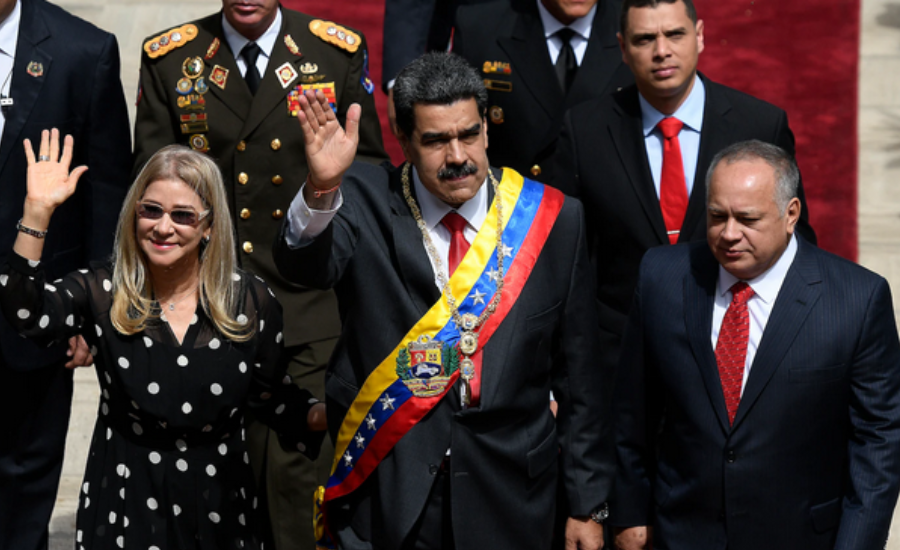
Venezuelan President Nicolás Maduro (center) and first lady Cilia Flores (left) and National Constituent Assembly President (Matias Delacroix/AP)
CARACAS, Venezuela — U.S. forces captured Venezuelan President Nicolás Maduro and his wife, Cilia Flores, early Saturday in a predawn military operation that U.S. officials said was carried out to enforce long-standing federal indictments accusing Maduro of drug trafficking, corruption and narco-terrorism.
U.S. President Donald Trump announced the capture shortly after dawn, saying Maduro had been taken into custody during a coordinated raid on his residence in Caracas and was being transported to the United States to face prosecution in federal court. Trump said the operation was conducted in coordination with U.S. law enforcement and military special operations forces and lasted less than 30 minutes.
“This was a law-enforcement action to execute existing indictments,” Trump said earlier Saturday, describing the mission as targeted and limited in scope. He said there were no American fatalities, though a U.S. helicopter took fire during the operation and several U.S. personnel were injured.
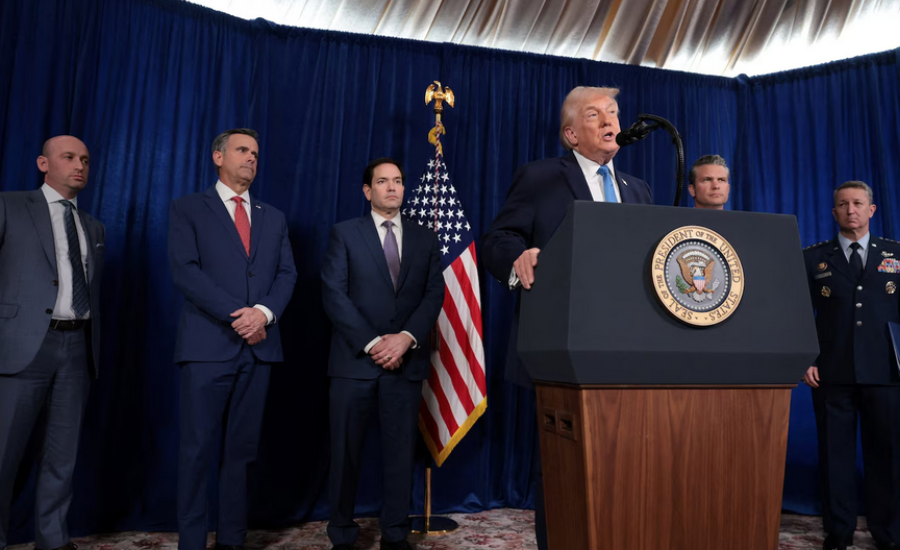
President Donald Trump addresses the media during a news conference at his Mar-a-Lago club on Jan. 3, 2026, in Palm Beach, Fla. (Credit: Joe Raedle/Getty)
Residents of Caracas reported explosions and the sound of low-flying aircraft in the early morning hours as the operation unfolded, with power outages reported in parts of the capital. Venezuelan authorities did not immediately confirm Maduro’s whereabouts. Senior officials in his government denounced the raid as a violation of national sovereignty and characterized it as a foreign military attack on Venezuelan territory.
Speaking later Saturday during a news conference at his Mar-a-Lago estate in Florida, Trump described the operation in sweeping terms, calling it an “assault like people have not seen since World War II” and saying no other nation “could achieve what America achieved yesterday.”
“This was one of the most stunning, effective and powerful displays of American military might and competence in American history,” Trump said. The news conference began nearly 40 minutes after its scheduled start time.
Standing alongside Trump were Defense Secretary Pete Hegseth, Secretary of State Marco Rubio, CIA Director John Ratcliffe, and senior White House adviser Stephen Miller, who oversees homeland security matters. Trump said the United States would “run” Venezuela until a transition of power is completed, without providing details on how that process would unfold.
AP
Maduro has been under U.S. indictment since 2020, when federal prosecutors, during the administration of then-President Joe Biden, charged him and more than a dozen current and former Venezuelan officials with leading what they described as the “Cartel of the Suns,” an alleged drug-trafficking network. Prosecutors accused the group of facilitating large-scale cocaine shipments toward the United States in coordination with Colombia’s Revolutionary Armed Forces of Colombia, or FARC.
The Justice Department alleged that Maduro used proceeds from drug trafficking to enrich political allies, finance political repression and entrench his grip on power amid Venezuela’s economic collapse. U.S. authorities offered a reward of up to $15 million for information leading to his arrest, a designation that remained in place across administrations.
Attorney General Pam Bondi said Maduro and Flores are expected to appear in federal court in New York, where prosecutors may seek additional charges. U.S. officials said the couple was removed from Venezuela aboard a U.S.-controlled vessel.
The operation immediately raised legal and constitutional questions in Washington and abroad. Trump administration officials framed the action as the execution of standing criminal indictments rather than an act of war, arguing that it did not require prior congressional authorization under the War Powers Resolution.
Some lawmakers challenged that interpretation, arguing that the use of military force on foreign soil to seize a sitting head of state falls under Congress’s constitutional authority to declare war. Congressional leaders from both parties said briefings on the operation were expected in the coming days.
The United States has previously conducted military actions against foreign leaders without explicit congressional authorization. In 1989, under President George H.W. Bush, U.S. forces invaded Panama in Operation Just Cause and captured military ruler Manuel Noriega, who was later tried and convicted in the United States on drug-trafficking charges.
In 1983, President Ronald Reagan ordered the invasion of Grenada following a coup, citing threats to U.S. citizens. Presidents Bill Clinton and Barack Obama also authorized military actions in Iraq, Kosovo and Libya without prior congressional approval, citing national security and humanitarian concerns.
International reaction to the Maduro capture was swift. Brazil said the United States had crossed an “unacceptable line,” while Russia and China condemned the operation as a violation of international law and Venezuelan sovereignty. The United Nations expressed concern over the escalation and urged restraint, warning of potential consequences for regional stability.
Maduro, a former bus driver and labor organizer, assumed the presidency in 2013 following the death of Hugo Chávez. His tenure has been marked by disputed elections, economic collapse, mass migration and years of U.S. sanctions. His reported capture introduces uncertainty over Venezuela’s governance as officials inside the country contest the legitimacy of the U.S. action.
The president called Maduro an "illegitimate dictator" and alleged he "was the kingpin of a vast criminal network responsible for trafficking colossal amounts of deadly and illicit drugs into the United States."
The president said, "Now, Maduro will never again be able to threaten an American citizen or anybody from Venezuela."
"The dictator and terrorist Maduro is finally gone in Venezuela," the president said. "People are free."





The EEW Weekly Digest
Get EEW in Your Inbox
Our weekly digest brings the latest reporting on faith, culture, health, and the news that matters to Black Christian women straight to your inbox.
Subscribe FreeFree to join. Unsubscribe anytime.
Reader-Supported Journalism
Help Keep EEW Free and Growing
EEW Magazine Online is free for every reader, and we plan to keep it that way. Your support helps us expand our reporting on faith, culture, health, and the news that matters to Black Christian women. Become a monthly supporter today.
Support EEWGive once or monthly through PayPal. Gifts are tax-deductible to the extent allowed by law.
Waiting on God can be painful, but Scripture reveals purpose in the delay.