

Following the White House Correspondents’ Dinner shooting, reactions to Erika Kirk exposed how quickly grief can become politicized, scrutinized, and dehumanized in today’s online culture.
Written By Kristi Brown // EEW Magazine Online
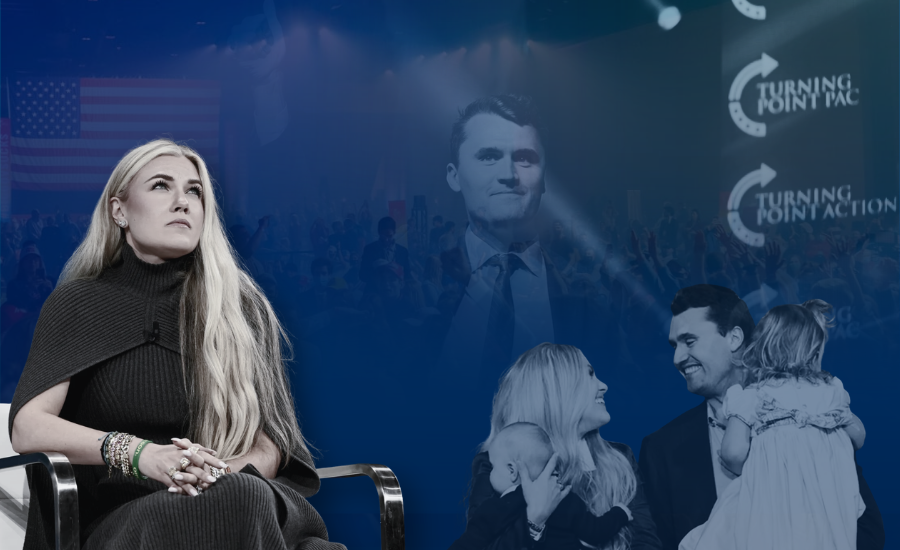
Less than 24 hours after gunfire disrupted the White House Correspondents' Dinner on April 25, one video kept circulating. Erika Kirk is seen being led out of the Washington Hilton, visibly shaken, her voice breaking as she says she wants to go home.
Footage reviewed by EEW Magazine shows the scene inside, where staff moved with urgency. Kirk was crying in a back hallway as people consoled her and ushered her out of view, marking a swift, procedural response to a moment that had turned volatile.
Online, the reaction moved just as fast, but toward something colder.
Commentary on the incident gave way quickly to speculation, dismissiveness, and in some cases outright cruelty directed at her.
Some questioned whether her reaction was real. Others called it performance. Many used the moment to revisit grievances that had nothing to do with the shooting itself. They merely folded her into political arguments that made little distinction between the event and the woman living through it. The behavior showed up across ideological lines, familiar and, often, unrestrained.
That response reflects a trend around Erika in the months since her husband, Charlie Kirk, was shot and killed while speaking at a Turning Point USA event at Utah Valley University on September 10, 2025.
He was a deeply polarizing figure, admired by supporters and sharply criticized by detractors. His most ardent critics accused him of advancing ideas they viewed as harmful or exclusionary while his supporters saw him as a forceful advocate for their beliefs.
When he was killed, the public response mirrored that divide. Condemnation was widespread, but not universal. Some minimized the violence. A smaller number expressed open satisfaction, treating a man's death as a political win rather than a human loss.
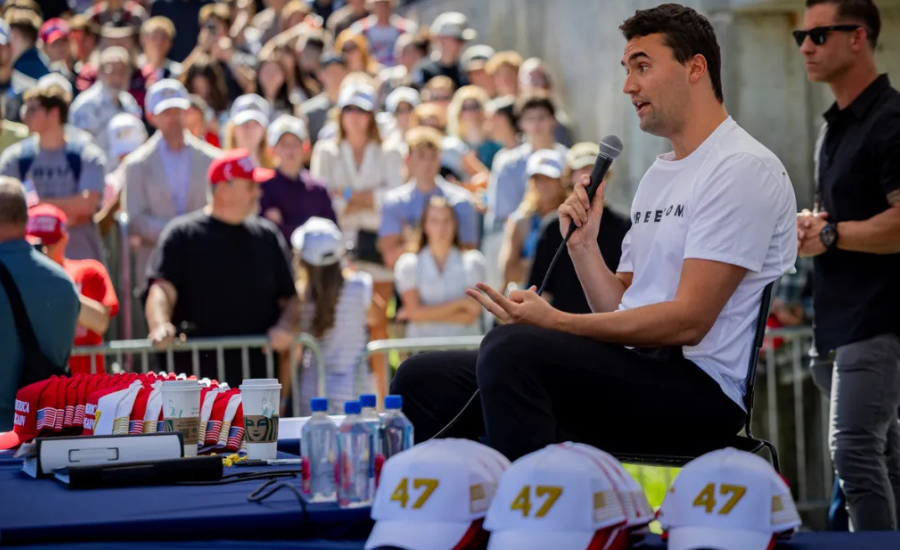
Charlie Kirk speaks at a Turning Point USA event at Utah Valley University in Orem on Wednesday, Sept. 10, 2025, shortly before he was shot. (AP)
Erika now sits at the helm of Turning Point USA, one of the most influential youth organizations within the modern conservative movement. Her leadership brings visibility and influence, and it has also intensified the scrutiny directed at her. The criticism she faces is often inseparable from the legacy she inherited, shaped by the same divisions that defined her husband's public life.
In that environment, perception hardens quickly. The conversation around Charlie’s death has, in some corners, moved past established facts, drawing in conjecture, misidentifications, and a steady stream of online theories. Some of those claims have extended to Erika without evidence, amplified by Turning Point's public alignment with Israel at a time when tensions are high and antisemitic rhetoric has grown more common online.
Within that ecosystem, individuals get absorbed into larger conflicts, and the line between scrutiny and targeting narrows. Criticism can shift into something closer to targeting. Attention, influence, and engagement tend to reward the most extreme interpretations over the most careful ones.
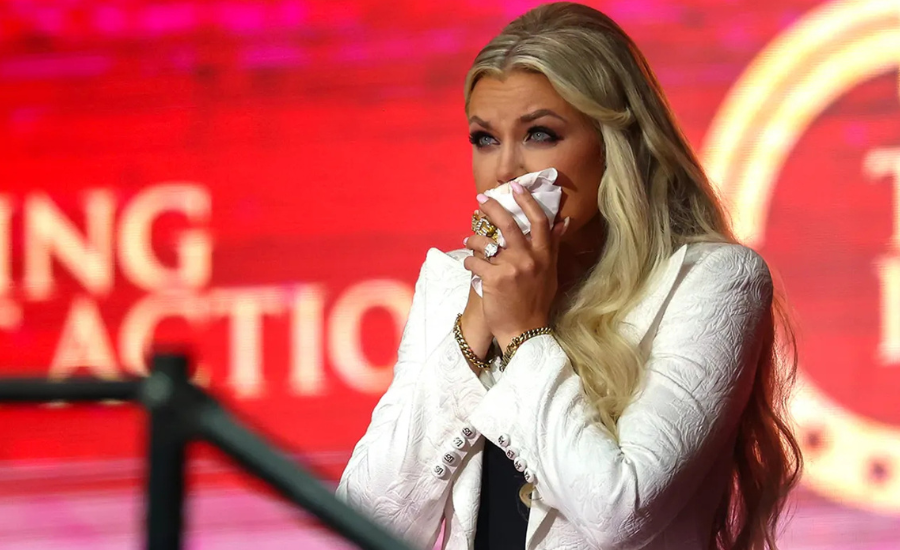
Erika Kirk speaks at a memorial for her husband, conservative activist Charlie Kirk, on Sept. 21, 2025, at State Farm Stadium in Glendale, Arizona. (AP Photo/Julia Demaree Nikhinson)
The shift in how the public responds to moments like this is hard to ignore. There was a time when visible distress, especially in the aftermath of violence, introduced at least a brief pause. It didn't resolve disagreement or change deeply held views. It just imposed a moment of restraint, a signal that something had happened that warranted one.
That pause is less reliable now. Reactions come faster and colder. People watch, comment, and move on. Grief, when it shows up in public, rarely slows anyone down. It gets observed, questioned, and rolled into whatever existing narrative is already in motion.
The scene at the Washington Hilton briefly disrupted that harmful pattern. In the hallway, there was no outside chatter or scrutiny, just a person responding to fear layered on top of an already public loss. It was unfiltered, and for a moment, separate from the interpretations that usually follow someone in her position.
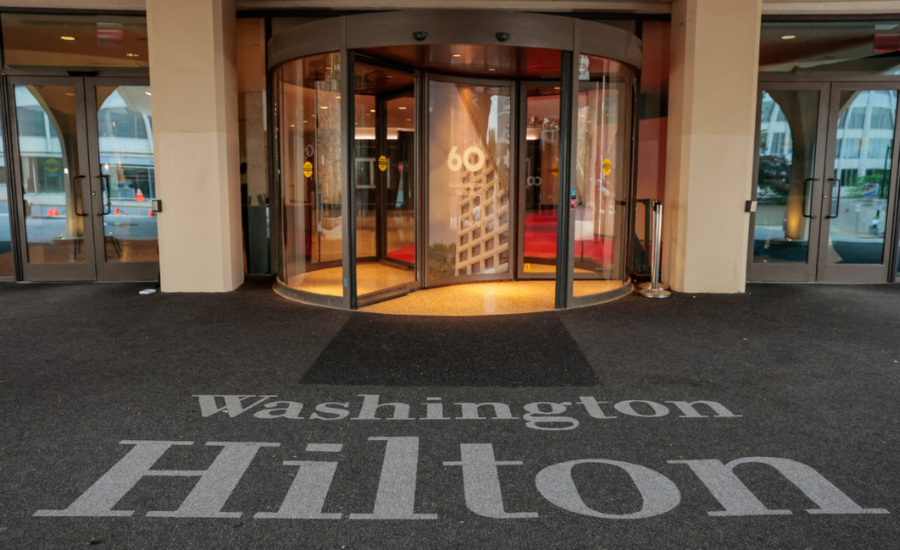
The entrance of the Washington Hilton in Washington, D.C., where a shooting disrupted the White House Correspondents' Association dinner on April 26, 2026. (Kylie Cooper/Reuters)
That separation didn't hold. The commentary resumed with little change in tone, and in some corners it sharpened. The polarization attached to her husband, and now to her leadership, makes it easy to treat her as an extension of an ongoing conflict rather than as someone living through a single, discrete moment.
While public figures invite scrutiny, and scrutiny is part of civic life, there's a point where scrutiny gives way to something harder to defend.
The response in the hours after the shooting crossed that point. It showed up less in any single remark than in the repetition, the tone, and how quickly things moved past basic decency.
What stands out is how normalized that tone has become.
More on EEW Magazine Online:




Jesus taught His disciples to forgive without limits, and He also showed discernment about whom to trust. When harmful patterns keep returning, wisdom may call for boundaries, distance, or a permanent separation.