

When a Woman’s Dress Becomes a Cultural Flashpoint: The Karri Bryant Controversy
A dress worn by Karri Turner Bryant at a UNCF gala ignited a public clash between two powerful pastors and exposed a deeper divide over holiness, marriage, and authority in Black Christianity.
By EEW Magazine News // Cultural Analysis
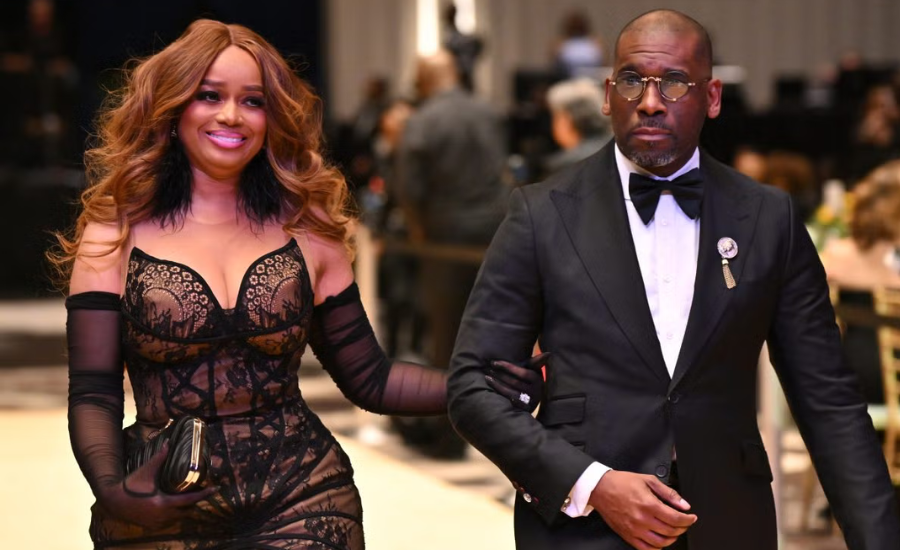
Karri Turner Bryant and Jamal Bryant arrive at the 2025 UNCF Atlanta Mayor’s Masked Ball at Signia by Hilton Atlanta on December 20, 2025 in Atlanta, Georgia. (Photo by Paras Griffin/Getty Images)
A single dress, worn at a charity gala in Atlanta, has become the center of one of the Black church’s most heated theological debates.
Dr. Karri Turner Bryant’s black lace gown, photographed at the United Negro College Fund’s Atlanta Mayor’s Masked Ball on Dec. 20, has exposed deep divisions over modesty, marriage, and male authority within Christian life.
Within hours, images of the dress spread across social media. Some praised her elegance. Others condemned what they saw as immodesty. But the fiercest response did not come from anonymous critics online. It came from a pulpit.

Photo by Paras Griffin/Getty Images
Bishop Patrick Wooden, the Raleigh, North Carolina pastor of Upper Room Church of God in Christ, used his platform to publicly rebuke Turner Bryant’s husband, Jamal Harrison Bryant, the prominent Atlanta pastor of New Birth Missionary Baptist Church.
Wooden said Bryant had presented his wife to the public “like a two-dollar whore.” He later doubled down, insisting his remarks were not aimed at Turner Bryant but at her husband.
“My statement isn’t about her,” Wooden said. “My statement is about him. He said he bought the dress.”

Bishop Patrick Wooden is the outspoken pastor of Upper Room Church of God in Christ in Raleigh, North Carolina (Photo Credit: Upper Room Facebook/EEW Magazine
That distinction, in Wooden’s telling, is not rhetorical. It is theological.
Wooden was not merely reacting to a dress. He was asserting a doctrine.
He speaks from within the Church of God in Christ, the largest Pentecostal denomination in the United States and one of the most influential Holiness traditions in the world. Founded in 1907 by Bishop Charles Harrison Mason, COGIC theology emphasizes sanctification, separation from worldliness, and the authority of male spiritual headship. In that framework, a husband is not simply a partner. He is a covering. He is spiritually accountable for how his wife represents herself, the ministry, and God in public.
This view is not unique to COGIC. It runs through much of conservative Christianity, particularly within Black Holiness and Pentecostal traditions, where interpretations of Scripture link modesty, female sexuality, and male authority to the stability of the church itself.
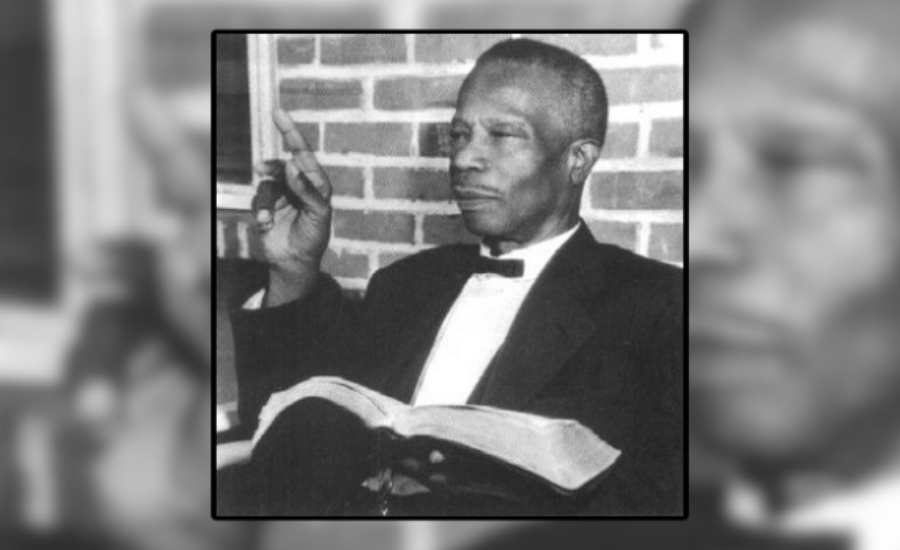
Charles H. Mason (1864-1961), founding bishop of the Church of God in Christ.
Sensuality is not merely personal in this framework. It is understood as spiritually dangerous.
The biblical figure of Jezebel looms large in this theology. She is remembered not only as immoral but as disruptive, seductive, and corrosive to male authority and divine order. In that tradition, women perceived as provocative, even unintentionally, are often cast as undermining the church’s moral witness. To reject modesty is, in this context, to flirt with rebellion against God.
So when Wooden condemned Bryant, he was not acting as a lone moralist. He was enforcing a widely held theological worldview in which a pastor’s wife is part of the church’s public testimony and a husband is charged with guarding it.
Bryant responded from a different universe.
Appearing on the Tamron Hall Show with Turner Bryant, he made clear that he did not see his role as a regulator but as an admirer. He said Turner Bryant had chosen the dress herself and that he had paid for it. He described her as “drop dead gorgeous” and joked that seeing her in it made him want to stay home with his wife rather than attend the event.
He addressed the controversy not in the context of sanctification, but of validation.
“It doesn’t matter what my wife has on,” Bryant said. “She is just amazing in everything she puts on, and I thought it was complementary and alluring.”
It was not a throwaway defense, but an expression of a different philosophy.
Bryant’s remarks reflect a more progressive model of Christian marriage shaped by therapeutic culture, emotional affirmation, and personal autonomy. In this model, a husband’s highest duty is not to guard his wife’s reputation for the church but to affirm her sense of self. Love is expressed through validation. Desire is not treated as dangerous. A wife’s body belongs first to her, and then to her partner, not to the congregation.
Turner Bryant’s dress became the site where these two systems collided.
While Wooden’s language was severe, according to his ideology, the issue was not simply Turner Bryant’s attire but her husband’s role as both covering and pastor.
For generations, Black Christian women have navigated expectations shaped by both respectability politics and theology. Their bodies have been read as symbols of holiness or rebellion. Their clothing has been treated as spiritual messaging. Their sexuality has been viewed as a force that must be contained for the good of the faith and the institution.
What Turner Bryant did, intentionally or not, was expose that architecture.
By standing beside a husband who declined to apologize for her appearance, Turner Bryant came to symbolize a challenge to long-standing ideas about how women, pastors, and public witness are connected. That helps explain the intensity of the backlash. It was about the dress, but also about what the moment was understood to represent.
The Black church is now navigating a widening tension between different ways of understanding holiness, authority, and personal freedom in Christian life. For some, spiritual order and moral boundaries remain central. For others, intimacy, affirmation, and individual conscience have taken on greater weight.
Neither side is going away.
But Turner Bryant’s body, draped in black lace under ballroom lights, made visible a conflict that has long been buried beneath Sunday sermons and marital ideals.
More on EEW Magazine Online:





The EEW Weekly Digest
Get EEW in Your Inbox
Our weekly digest brings the latest reporting on faith, culture, health, and the news that matters to Black Christian women straight to your inbox.
Subscribe FreeFree to join. Unsubscribe anytime.
Reader-Supported Journalism
Help Keep EEW Free and Growing
EEW Magazine Online is free for every reader, and we plan to keep it that way. Your support helps us expand our reporting on faith, culture, health, and the news that matters to Black Christian women. Become a monthly supporter today.
Support EEWGive once or monthly through PayPal. Gifts are tax-deductible to the extent allowed by law.
Waiting on God can be painful, but Scripture reveals purpose in the delay.