
Karmelo Anthony Verdict: The Jury Took Two Hours. The Internet Took Less.
EEW Magazine looks at the Karmelo Anthony verdict alongside the Covington Catholic controversy and the Duke lacrosse case, and asks what discernment looks like when a story arrives already wearing a label we recognize.
By EEW Magazine Online Editorial Staff


Austin Metcalf, left, and Karmelo Anthony, right, in a composite photo illustration combining individual portraits with a separate image of the track meet where Metcalf was fatally stabbed in April 2025. A Collin County jury convicted Anthony, now 19, of murder in June 2026 and rejected his claim of self-defense. (Credit: EEW Magazine)
On April 2, 2025, Austin Metcalf and Karmelo Anthony, both 17 and both from Frisco, Texas, got into an argument over a team tent at a high school track meet. According to testimony, Anthony refused to leave a tent belonging to Metcalf's team and, according to a police report, told Metcalf, "Touch me and see what happens."
When Metcalf shoved him, Anthony pulled a knife and stabbed him in the chest.
Metcalf died at the scene.
Less than two weeks later, Anthony's mother started a GiveSendGo fundraiser for his legal defense. It framed the case around a claim that would become one of the most repeated details over the next year: that Anthony, nearly forty pounds lighter than Metcalf and seated when Metcalf shoved him, had acted out of fear, and that a Black teenager in his position would be treated more harshly by the courts than a white one for the same act.
The fundraiser eventually raised more than $600,000.
During the same period, Austin Metcalf's father has said that his family became the subject of online allegations he maintains were false, while a gag order limited what he could publicly say in response.

Jeff Metcalf, Austin Metcalf's father, makes an unexpected appearance at a press conference held by Karmelo Anthony's family on April 17, 2025, about two weeks after his son was fatally stabbed at a Frisco track meet. (Credit: Video screen grab via CBS News)
Fourteen months later, on June 9, a Collin County jury convicted Anthony of murder. They heard four days of testimony, including a responding officer's bodycam footage, Anthony's own statements to police, and the same size difference that had anchored the online debate for over a year. They deliberated for less than three hours, rejected the claim that Anthony had acted in self-defense, and declined to find that he had acted in sudden passion, the legal standard that could have reduced the sentencing range to two to twenty years.
Instead, they sentenced him to thirty-five years in prison.
Whatever anyone believes about what should have happened in that stadium, that part of the story is no longer a matter of opinion. A jury heard the evidence and reached a verdict. People will continue to debate the broader questions surrounding the case, but the legal question before the jury has now been answered.
What hasn't settled, and may never settle, is everything that happened around the case during those fourteen months, much of it online and filtered through race before most people outside Frisco knew very much at all.
This wasn't the first time, and it won't be the last.
In January 2019, a group of students from Covington Catholic High School, many wearing red "Make America Great Again" hats, had just left the March for Life rally in Washington and were waiting for their bus near the Lincoln Memorial when Nathan Phillips, a Native American elder in town for a separate march, approached the group beating a drum and chanting.
A short video clip showed one of the students, 16-year-old Nick Sandmann, standing inches from Phillips's face with what looked like a smirk while Phillips drummed. The clip spread within hours, and the story it seemed to tell was immediate and simple: a smug teenager in a MAGA hat mocking a Native elder, surrounded by classmates who appeared to be jeering along.
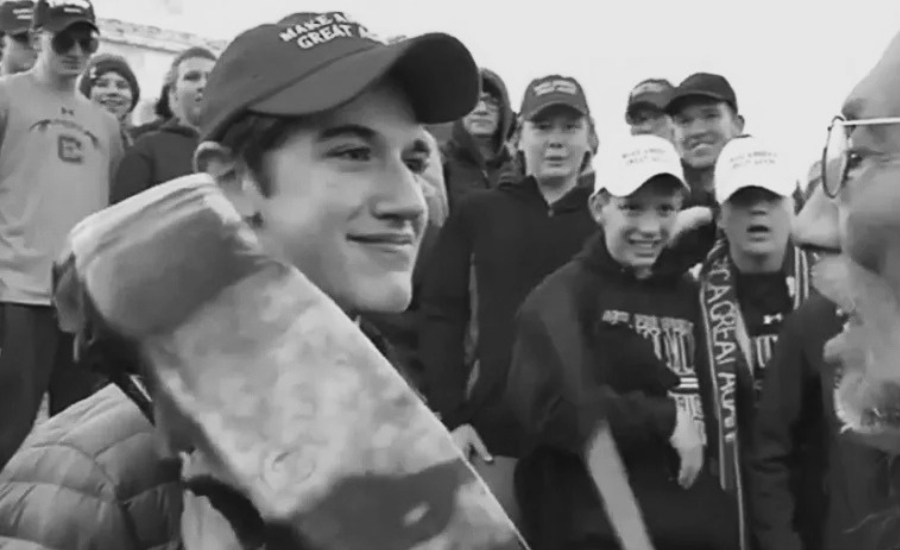
Nick Sandmann, then a 16-year-old Covington Catholic High School student, stands close to Nathan Phillips, a 64-year-old Native American elder, near the Lincoln Memorial in Washington on Jan. 18, 2019, in a video clip that spread within hours and drew national condemnation before fuller footage complicated the story. (Credit: Al Jazeera)
Sandmann was cast nationally as the face of a hateful generation. His school received threats serious enough to close for a day, and his family left their home for a time. The Diocese of Covington publicly condemned the students before the day was out.
Then longer video surfaced. It showed a third group that had been shouting at both Phillips and the students well before the moment everyone reacted to, and it showed the Native American elder walking into the crowd of students, not the other way around.
A third-party investigation commissioned by the diocese concluded that the students had not instigated the confrontation and found no evidence that they had made the racist statements they had been accused of making.
The bishop who condemned them later apologized and said the investigation had exonerated them. Sandmann sued several news organizations for defamation. CNN and The Washington Post both settled for undisclosed amounts without admitting wrongdoing.
And long before any of that, in March 2006, a Black exotic dancer named Crystal Mangum told police that three white members of Duke University's lacrosse team had raped her at a team party. The story spread through campus and national media within days.
It fit a shape many people already believed in: privileged white athletes at an elite university, a Black woman from a working-class Durham neighborhood, and a district attorney up for reelection who told reporters there was "no doubt in my mind" she had been assaulted, weeks before any charges were filed.
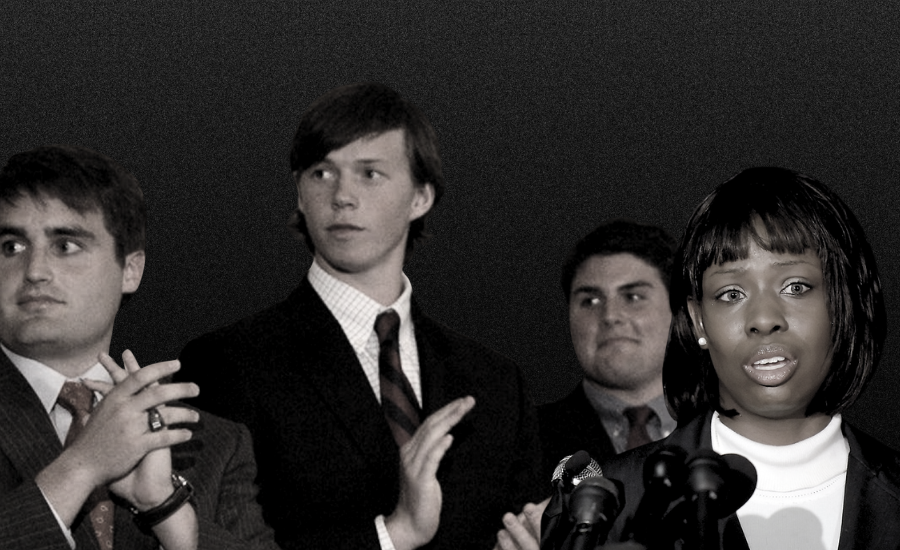
From left, former Duke lacrosse players David Evans, Collin Finnerty and Reade Seligmann, shown in a composite photo illustration with Crystal Mangum, the North Carolina Central University student who accused them of rape at a team party in 2006. (Credit: EEW Magazine)
Eighty-eight Duke faculty members signed a public statement implying something had happened to Mangum and thanking student protesters, some of whom carried signs calling for the players' castration, "for not waiting."
A year later, the case collapsed.
DNA evidence matched none of the accused, the district attorney had withheld results that cleared them, and North Carolina's attorney general dropped all charges, declared the three players innocent, and called them victims of a prosecutor's "tragic rush to accuse."
Former Durham County District Attorney Mike Nifong was disbarred in June 2007 by the North Carolina State Bar. It took until 2024, eighteen years after the party, for Mangum herself to admit, from prison, that she had made the accusation up.
Three cases, three different communities, three different assumed shapes for who the villain and the victim were supposed to be. In each one, the public reached a verdict within days, sometimes hours, and in each one, more information arrived later, sometimes years later, that complicated, reversed, or reopened what had seemed settled.
The common thread has less to do with which group gets it wrong than with how quickly any of us trade patience for certainty once a story arrives wearing a label we recognize.
Scripture has more to say about this than it gets credit for. "Spouting off before listening to the facts is both shameful and foolish." (Proverbs 18:13)
"The first to speak in court sounds right until the cross-examination begins." (Proverbs 18:17)
Exodus puts it even more plainly: "You must not follow the crowd in doing wrong. When you are called to testify in a dispute, do not be swayed by the crowd to twist justice" (Exodus 23:2).
None of these verses were written with social media in mind, but they describe exactly what social media rewards: speed over patience, certainty over searching, and the comfort of a crowd that already agrees with you.
James asks for the opposite. "Understand this, my dear brothers and sisters: You must all be quick to listen, slow to speak, and slow to get angry" (James 1:19).
That isn't merely advice but a description of what it looks like to wait for the truth before deciding what to think about it. For believers, the test isn't whether we ever get it wrong. It's what we do in the hours after a story breaks, when the facts are thinnest and the feelings are strongest.
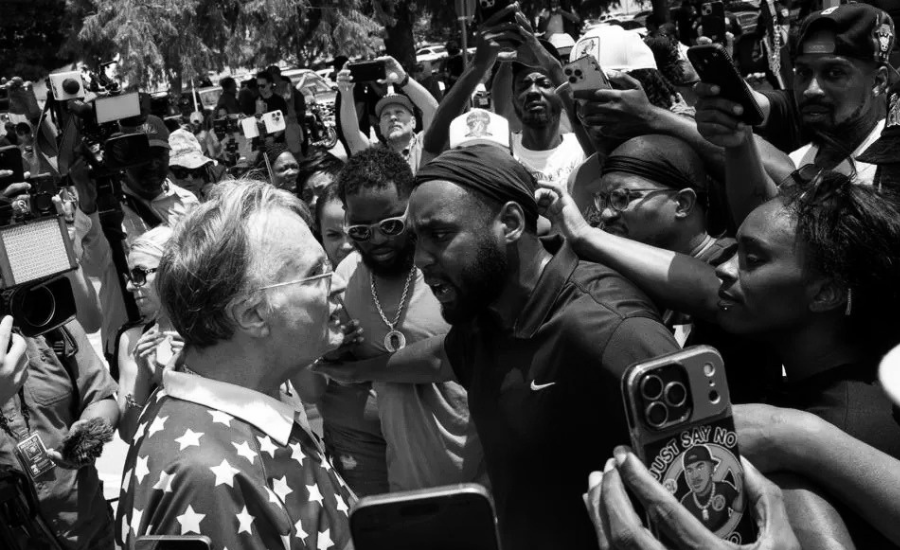
Supporters of Austin Metcalf and Karmelo Anthony confront each other outside the Collin County Courthouse in McKinney, Texas, on June 9, 2026, the day a jury convicted Anthony of murder in Metcalf's death. (Credit: The Dallas Morning News via Getty Images)
The next viral case won't announce itself in advance, and it won't always involve someone who looks like us, prays like us, or comes from where we come from. When it doesn't, the instinct to assume the worst about a stranger can move just as fast as the instinct to assume the best about someone we recognize as one of our own.
Both instincts skip the same step.
Pausing before weighing in means separating what we know from what we're supplying ourselves based on who the people involved remind us of, and that's a different discipline than staying silent forever.
It means asking what we know firsthand versus what we picked up from a caption, a screenshot, or a clip someone else decided was worth sharing. It means noticing when our certainty about a stranger's guilt or innocence is really certainty about people like them, people like us, or people we've decided are on our side.
A jury in Texas had four days of testimony and still needed two hours to reach a decision they were legally required to make. Most of us have neither the obligation nor the information to reach ours in two minutes.
Whatever anyone believes about the outcome in Frisco, two families are left with a loss that doesn't end when the headlines move on. A boy who was seventeen is gone. The seventeen-year-old who killed him, now nineteen after fourteen months awaiting trial, will spend most of his adult life in prison.
Scripture calls us to something harder than instant certainty: grief for the broken, prayer for the living, and the patience to let truth arrive before we claim to possess it.
More on EEW Magazine Online:






Scripture holds two truths without strain. God reigns completely. Man chooses freely. A study through Samson, Joseph, Pharaoh, the Cross, and the Potter and the Clay.