
Jesus Said the World Would Hate Us. In 165 Countries, It Does.
A new Pew Research Center report finds Christians were harassed in 165 countries in 2023, making them the world's most widely targeted religious group.
By EEW Magazine Global News Editors
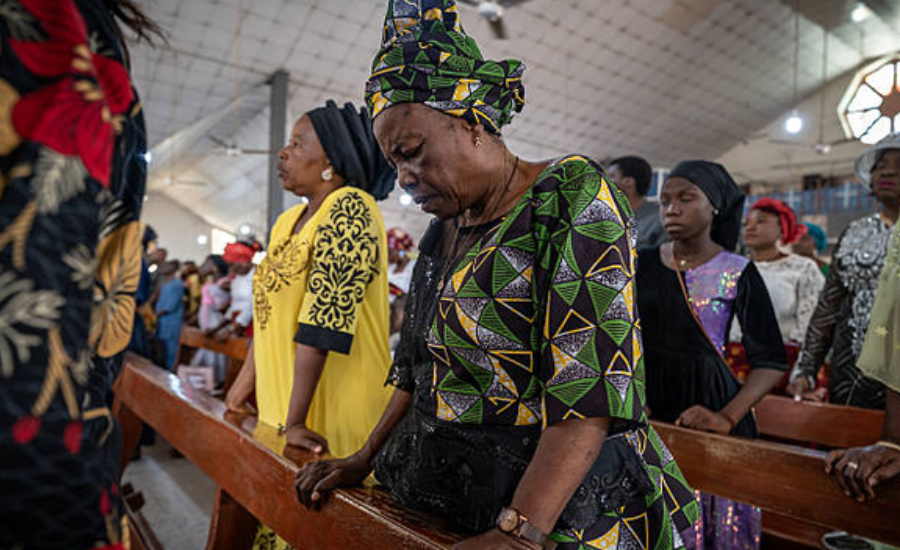
Catholics pray during Sunday service at Saint Michael's Cathedral in Minna, Nigeria, on Nov. 30, 2025, as the congregation prays for the safe return of students abducted earlier that month from Saint Mary's Catholic School. (Photo by Light Oriye Tamunotonye/AFP via Getty Images)
BUFFALO, N.Y. -- Two thousand years ago, Jesus warned His disciples plainly: the world would hate them. A new report from the Pew Research Center, released Monday, documents the global extent of that reality.
Christians were harassed by government officials or private actors in 165 countries in 2023, making them the most widely targeted religious group on earth. The findings come from the organization's 16th annual study of religious restrictions, which tracked social hostilities and government policies affecting faith communities across 198 countries and territories.
"If they have persecuted me, they shall also persecute you," Jesus told His followers in John 15:20 (KJV), adding that the world's hatred of believers was rooted in its rejection of the One who sent them.
He also told them plainly why: "all these things will they do unto you for my name's sake" (John 15:21, KJV).
For the 165 countries' worth of Christians documented in this report, those words carry the weight of present-tense reality, lived out in detention cells, destroyed sanctuaries, and displaced communities on every inhabited continent.
The report found that 55 countries had high or very high levels of social hostilities involving religion in 2023, a sharp increase from 45 the previous year. It was the third consecutive year of rising hostilities toward people of faith globally.
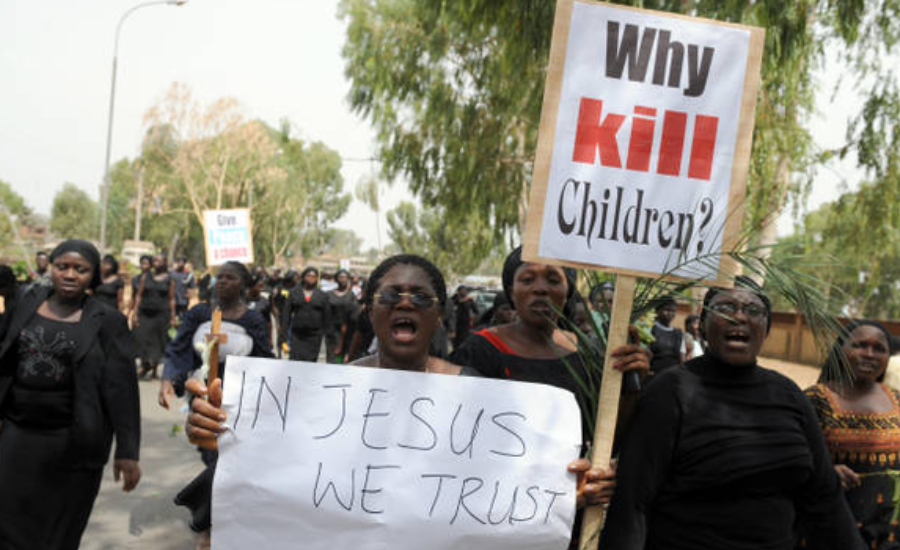
Christian women march in protest in Nigeria following attacks on predominantly Christian villages that left scores dead, including women and children. Protesters carried Bibles and placards calling for an end to the violence. (Photo by Pius Utomi Ekpei/AFP via Getty Images)
The sustained rise in hostility documented in the report echoes what the apostle Paul warned: "all that will live godly in Christ Jesus shall suffer persecution" (2 Timothy 3:12, KJV).
Nowhere in the 2023 data was the persecution of Christians more devastating than in Nigeria. The country recorded the world's highest score on the Pew Social Hostilities Index, a 9.0 out of 10.
On December 24, gunmen attacked more than a dozen villages in Plateau State, killing more than 150 people, mostly Christians, and displacing thousands of residents. Christian leaders said the assault was aimed at forcing Christian farming communities off their land, though analysts have noted that such conflicts in Nigeria often involve overlapping religious, ethnic, and economic tensions.
Throughout the year, the militant groups Boko Haram and ISIS-West Africa carried out repeated attacks on communities across the country, according to the U.S. State Department.
In India's northeastern state of Manipur, ethnic tensions erupted into large-scale religious violence. The conflict pitted the majority Meitei tribe, largely Hindu, against the minority Kuki tribe, largely Christian. More than 250 churches were torched, over 200 people were killed, and more than 60,000 were displaced during the fighting. Media reports indicated that more churches than Hindu temples were destroyed
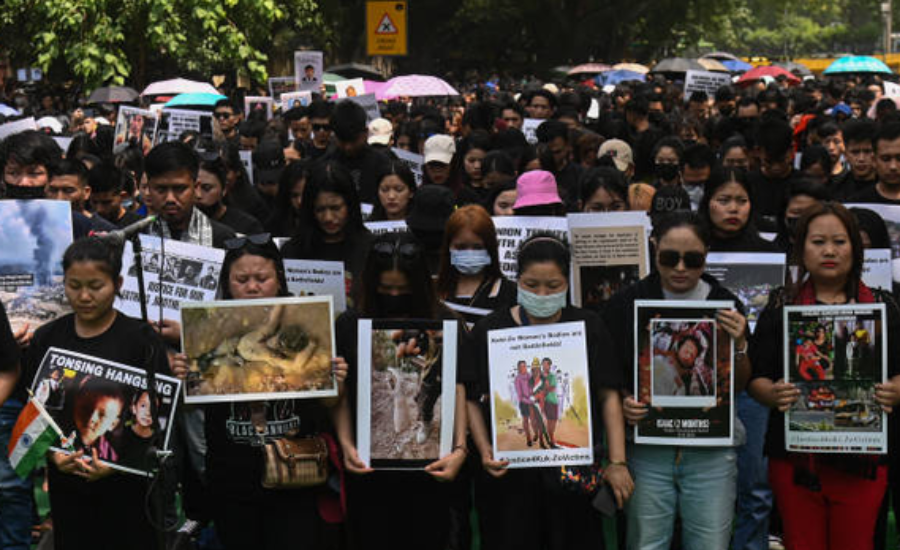
Members of the Kuki-Zo community hold placards during a protest in New Delhi, India, on May 3, 2024, marking one year since ethnic violence erupted in Manipur between the Meitei and Kuki-Zo communities. The conflict displaced tens of thousands and included widespread attacks on churches. (Photo by Kabir Jhangiani/NurPhoto via Getty Images)
In Laos, government authorities moved aggressively against new converts to the faith. Local officials in the Sa Mouay district allegedly forced at least eight families from their villages and destroyed their homes after those families converted to Christianity, according to the U.S. State Department.
In Nicaragua, the government's hostility toward the church intensified throughout the year. Twenty-seven Catholic priests and two seminarians were detained. A bishop named Rolando Alvarez, arrested in 2022, received a 26-year sentence without trial and had his citizenship revoked, though he was later released and exiled to the Vatican in 2024. The government also stripped citizenship from six additional Catholic priests. President Daniel Ortega publicly referred to Catholic leaders as "bishops of Satan."
In the Democratic Republic of the Congo, the Islamist militant group ISIS-DRC targeted Christians in the eastern village of Mukondi, killing at least 38 people, injuring 17 others, and burning their homes. The group claimed responsibility for additional attacks on Christians in nearby villages that same month, taking the lives of 45 people, including a Catholic priest.
The scope of the data extends beyond any single country. Government harassment of religious groups of all kinds occurred in 185 countries, 93 percent of all nations and territories studied. Religion-related killings took place in 48 countries. Christians were not the only group under pressure: Jews were harassed in 98 countries, up from 90 in 2022, driven in part by a surge in antisemitic incidents following the Oct. 7, 2023, Hamas attacks on Israel. Muslims were harassed in 143 countries.
The map below puts the data on the ground. Hover over any highlighted country to see the story behind it.
Source: Pew Research Center · "More Countries Had Elevated Levels of Social Hostilities Involving Religion in 2023" · June 2026
Jesus did not present persecution as a possibility His followers might encounter. He presented it as a certainty. "Ye shall be hated of all nations for my name's sake," He told them in Matthew 24:9 (KJV). He said these things, as He declared in John 15:25, so that the word would be fulfilled. The third consecutive year of rising global religious hostilities documented in the Pew report is not a geopolitical anomaly. It is the unfolding of a prophecy spoken by the Son of God to a small band of disciples in an upper room, a prophecy that has never ceased its forward motion and that Scripture indicates will intensify before His return.
The appropriate response is clear-eyed recognition, intercessory prayer, and active solidarity with suffering members of the global body of Christ. The book of Hebrews instructs the church to "remember them that are in bonds, as bound with them; and them which suffer adversity, as being yourselves also in the body" (Hebrews 13:3, KJV).
The families displaced in Laos, the congregations burned out of Manipur, the priests imprisoned in Nicaragua, and the Christmas Eve dead in Nigeria are not distant statistics. They are brothers and sisters in the same faith.
Jesus said the world would hate us. He said it so we would not be caught off guard when it did.
We should not be surprised. We should be praying.
The full Pew Research Center report is available at pewresearch.org.
More on EEW Magazine Online:





Scripture holds two truths without strain. God reigns completely. Man chooses freely. A study through Samson, Joseph, Pharaoh, the Cross, and the Potter and the Clay.